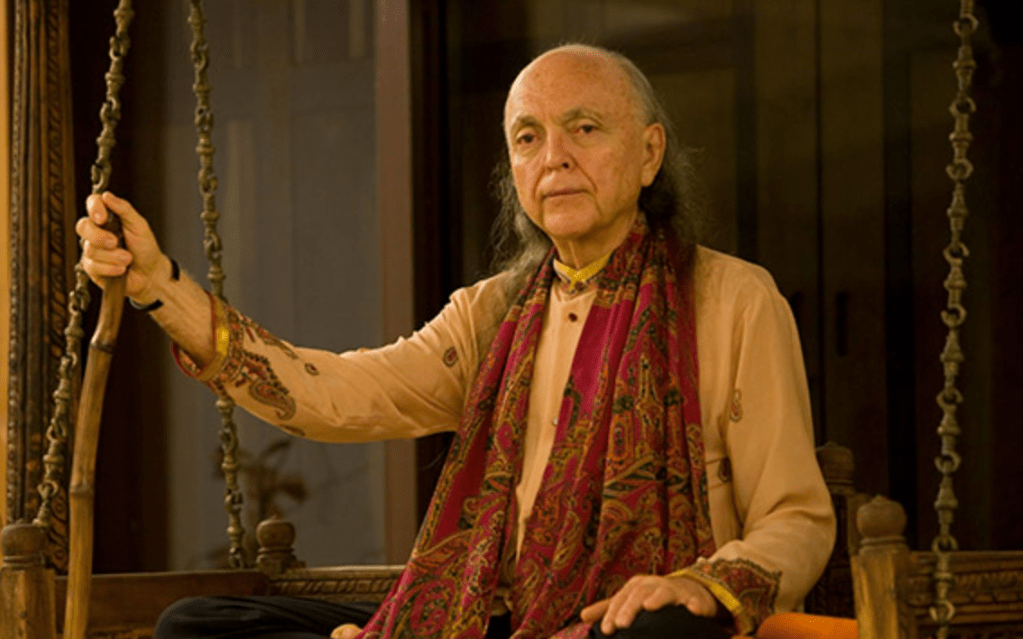
Franklin Albert Jones was born into a middle-class household in Queens, New York, in 1939. In his youth, he considered becoming a minister in the Lutheran church in which he was raised, and studied philosophy at Columbia University. After obtaining his bachelor’s degree, he did graduate work in English literature at Stanford, studying under novelist Wallace Stegner and completing a master’s thesis on modernism and the works of Gertrude Stein.
While at Stanford, Jones became interested in the use of hallucinogenic drugs as spiritual practice, and participated in Veterans Administration studies on the use of LSD, mescaline, and psilocybin. After completing his degree, he moved to New York and became a student of Albert Rudolph, an American-born Hindu teacher who taught under the name “Rudi.” Rudi urged Jones to get a job and pursue theological studies, and so Jones enrolled first at Lutheran Theological Seminary in Philadelphia and then at Saint Vladimir’s Russian Orthodox Seminary in New York.
In 1968, Jones traveled to India to meet Rudi’s guru Swami Muktananda, who gave Jones the names “Dhyanananda” and “Love-Ananda.” Jones moved to Los Angeles and was briefly involved with the Church of Scientology, then went back to India and on a pilgrimage to Christian holy sites after having visions of Mary.
Back in Los Angeles in 1970, Jones achieved what he called perfect enlightenment while meditating at the Vedanta Society Temple. He began teaching and in 1972 he published a spiritual autobiography, The Knee Of Listening. He broke with Muktananda after a final meeting in India in 1973 and adopted the name “Bubba Free John.” Jones established a commune and proclaimed himself to be “the divine lord in human form.”
Jones made sexual experimentation a part of his group’s spiritual practice after the break with Muktananda, teaching that this experimentation was necessary to get past emotional and sexual neuroses and to transcend the ego. He adopted the name “Da Free John” in 1979 and finally adopted the name “Adi Da Samraj,” or simply Adi Da.
Adi Da relocated to an island in Fiji in 1983, establishing a hermitage with a small group of followers. There, his movement took the name Adidam, which is focused on Adi Da as an avatar of the “Bright” — the “conscious light” of the universe. (It had initially been founded in 1972 as the Dawn Horse Communion and had gone by various names including the Free Communion Church, the Laughing Man Institute, and the Way of Divine Ignorance over the intervening decade.)
Adidam stresses the devotional relationship with Adi Da, and followers meditate, chant, and study Adi Da’s writings. They also engage in certain physical exercises and adhere to strict dietary guidelines. Adi Da said that Adidam drew on bhakti yoga, Advaita Vedanta Hinduism, and Buddhism, as well as containing original concepts. Philosopher Ken Wilber, who developed integral theory, lauded Adi Da’s work but cautioned against joining the Adidam community, Religious scholars Georg Feuerstein and Scott Lowe similarly praised Adi Da as a spiritual teacher but were disenchanted by the community.
The relocation to Fiji came shortly before controversies raised the profile of Adidam in the United States. The San Francisco Chronicle and several other Bay Area publications ran exposés alleging abusive practices and tax fraud, which Adi Da and the organization denied. One attorney for the group said that some of the sexual practices brought up by former members did take place as part of Adi Da’s practices during the 1970s but that they had been discontinued.
In the late 1990s, Adi Da told his disciples that his period of active teaching was nearing an end, and in 2000 he stopped teaching. He spent the last eight years of his life in near-total silence, writing and making digital art that was exhibited worldwide. He died in Fiji in November 2008. He said before his death that his message was complete and that he would have no successor nor would there be any further Adidam revelations. The movement today consists of students of his work, which consists of more than 75 books, and is estimated to have about 1,000 practitioners worldwide.
Key Sources:
Ellwood, R. (1997). DA: The strange case of Franklin Jones. Nova Religio the Journal of Alternative and Emergent Religions, 1(1), 153.
Feuerstein, G. (1992). Holy Madness: The Shock Tactics and Radical Teachings of Crazy-Wise Adepts, Holy Fools, and Rascal Gurus. Penguin.
Forsthoefel, T. A., & Humes, C. A. (2012). Gurus in America. State University of New York Press.
Jones, F., & Da Samraj, A. (1973). The knee of listening. Ashram.
Rawlinson, A. (1997). The Book of Enlightened Masters: Western Teachers in Eastern Traditions.
 Encyclopedia of Cults, Sects, and New Religious Movements