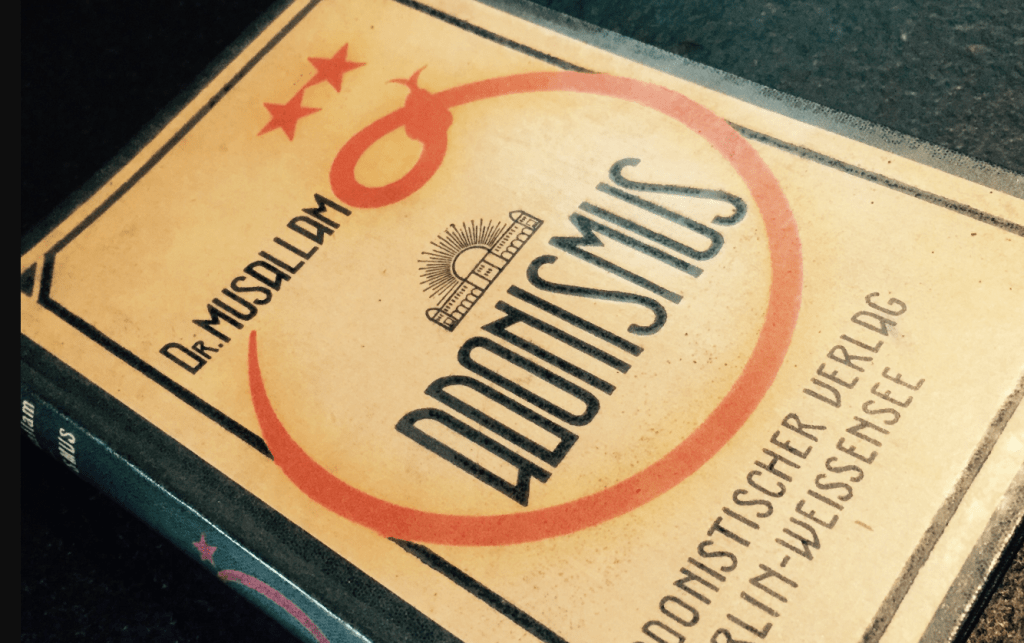
Adonism is a Neopagan religion that was founded by German esotericist Franz Sättler in 1926. Its name is drawn from both the Greek “Adonis” and the Hebrew “Adonai.” Sättler, who wrote under the pseudonym “Dr. Musalam,” claimed that Adonism was an ancient faith, but scholars concur that it was his own creation.
Sättler was born in Bohemia in 1884 and earned a doctorate in linguistics, going on to publish the first German-Persian dictionary. Though he was not a combatant in the First World War, he was traveling in France at the time, and, as an Austro-Hungarian national, was imprisoned. During his incarceration, he first encountered Theosophy and occultism. After the war, he briefly worked as an intelligence agent for the new nation of Czechoslovakia and was again jailed, this time by Germany.
Sättler established the Adonistic Society after his release. Sattler’s sale of supposed magical cures and his role in a dubious investment venture resulted in financial scandals and accusations of fraud, so he renamed the group the Alliance of Orion in hopes of a clean slate. Though the organization won a rare exemption from a Nazi ban on esoteric groups in 1937, it was later banned in June 1939. Sättler vanished in the early 1940s after the Nazi occupation of Czechoslovakia, and it has been claimed that he died either in an Austrian prison or at a concentration camp in that country.
Adonism is a polytheistic system centered on five principal deities: Adonis, Belus, Biltis, Dido, and Molchos. Adonis is the primary figure and is a benevolent deity, though his closest Judeo-Christian parallel is Satan. Molchos is Adonism’s most adversarial deity, who has enslaved humanity through monotheism and the sending of false prophets such as Moses, Jesus, and Muhammad. Belus and Biltis are the parents of both Adonis and Molchos, as well as the parents of Dido. When Molchos killed Adonis out of jealousy, Dido resurrected him. Followers of Adonism foresaw a final battle between Adonis and Molchos in the year 2000, with Adonis winning and the world entering a golden age.
Influenced by the teachings of Theosophy, Sättler claimed that Adonism was a root religion practiced by various cultures including the Egyptians, Greeks, and Persians. Sättler said that ancient texts on Adonism were stored at a temple in a place called Nuristan, and claimed that it was at this temple that he received both his wisdom and his pseudonym, but there is no evidence of Nuristan’s existence.
Adonistic rituals centered on sexual intercourse unbound by heterosexual norms. Sättler believed that eroticism was central to worship, and advocated tolerance in sexual practice.
A man named Walter Koblizek tried to revive the Adonist Society in West Germany in the 1950s, but his effort failed and he died in 1967. Professor Adolf Hemberger of the University of Gießen, a collector of Sättler’s, also attempted an Adonist revival in the 1970s but nothing came of it. The organization closest to Adonism that still exists is the Fraternitas Saturni, a German esoteric order, that was also founded in 1926.
Key Sources:
Hakl, H. T. (2010). Franz Sättler (Dr. Musallam) and the Twentieth-Century Cult of Adonism. Pomegranate: The International Journal of Pagan Studies.
Jackson, F. (2021, June 23). Adonism: a Pagan Religion. CoreSpirit.com.
Paulms. (2013, March 14). Adonism (Dieselpunk era spirituality). A Steampunk Opera (the Dolls of New Albion).
 Encyclopedia of Cults, Sects, and New Religious Movements