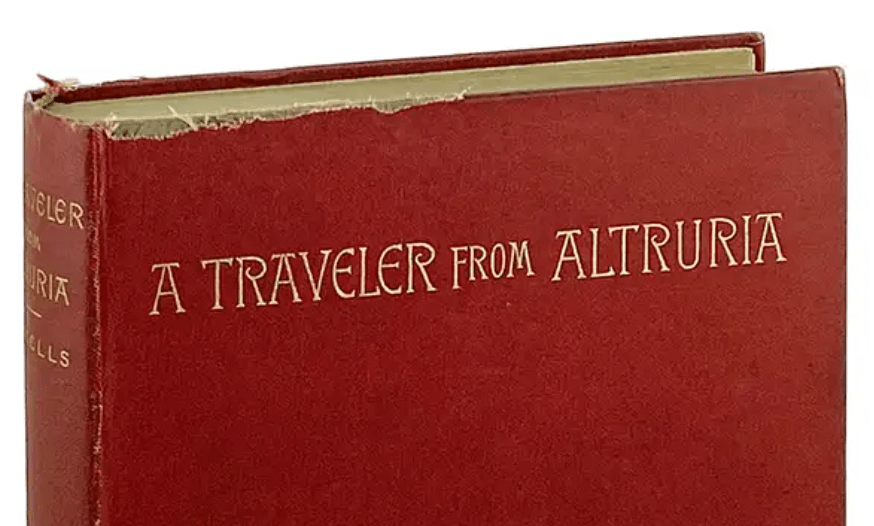
Altruria was a utopian community founded in Sonoma County, California, that was inspired by A Traveler from Altruria, a novel by William Dean Howells published earlier that year. The novel, which had been published in serial form in The Cosmopolitan magazine in 1892 and 1893, was a critique of capitalism involving a visitor to a fictional island where altruism reigned.
The popularity of the novel led to the establishment of Altrurian Clubs. Unitarian minister Edward B. Payne was a member of the Berkeley, California, club, and he and several other members decided to form a community based on Howells’s ideas. They started a newspaper and acquired 185 acres of property near Santa Rosa with houses and a mill.
A hotel and post office were established at Altruria and its population grew. The Altrurians maintained orchards and gardens and sold produce in San Francisco. But management issues with the hotel led to financial disagreements, and illness ran through the colony during its first winter. By June 1895, just 14 residents remained. They continued publishing the newspaper but sold the land in 1896 and abandoned the project, which Payne called a “glorious failure.”
Key Sources:
Dawson, A. (2022, December 29). Fountaingrove’s Altruria community was a utopian dream in 1890s. The Santa Rosa Press Democrat.
Howells, W. D. (1894). A Traveler from Altruria.
O’Connor, P. S. (2000). On the road to Utopia: The social history and spirituality of Altruria, an intentional religious community in Sonoma County, California, 1894–1896.
 Encyclopedia of Cults, Sects, and New Religious Movements