Rudolf Steiner was born in a part of the Austrian Empire that is now Croatia in 1861. His father was a telegraph operator and the family moved regularly during Steiner’s childhood. Steiner would report supernatural experiences from early in life, including encountering the spirit of an aunt who told him she had recently died. This episode took place before Steiner’s family received word of her death.
Steiner had other similar experiences in preadolescence, and at age 15 he experienced an epiphany which he said gave him a complete understanding of time and awakened clairvoyant abilities. The young Steiner befriended an herb grower named Felix Kogutzki, who had developed a personal concept of the spiritual realm of one of direct and accessible personal experience.
Steiner studied science and mathematics at the Vienna Institute of Technology, and one of his professors recommended him for a job editing a portion of the collected works of Johann Wolfgang von Goethe dealing with Goethe’s exploration of natural sciences, a task that experienced Goethe scholars were not interested in taking on. This led to Steiner’s employment as an editor at the Goethe archives and his publication of works on that author. Steiner completed his doctorate in philosophy in 1891. Three years later, Steiner published The Philosophy of Freedom, his first work on his own emerging philosophy. The book received little attention at the time. Steiner moved to Berlin and became an editor a literary journal.
In 1899, an article by Steiner caught the eye of local leaders of the nascent Theosophical Society, and Steiner was invited to address the group. The charismatic and erudite Steiner was embraced by the Theosophists, and in 1902 he was elected head of the Society’s German section, followed by his appointment as head of the Theosophical Esoteric Society for Germany and Austria, even though his ideas differed from those of H.P. Blavatsky and other Theosophical leaders in key ways. Both critics and supporters of Steiner have suggested that he may have seen the Theosophical Society as a vehicle to establish himself as an esoteric leader and to attract his own following.
Steiner came into conflict with Annie Besant, the president of the international Theosophical Society, and left the group in 1912, with most German Theosophists joining him in his new organization, the Anthroposophical Society. Steiner borrowed the word, meaning “human wisdom,” from an 1856 book by Austrian philosopher Robert von Zimmermann. In so doing, he declared Anthroposophy as rooted in the European philosophical tradition, in contrast with the Eastern leanings of Theosophy under Besant.
Steiner intended Anthroposophy to be a spiritual science that applied the methods of science to the exploration of spiritual and parapsychological matters. Anthroposophy posited that spiritual beings exist in all levels of experience and that they can be accessed and interacted with through research and practice.
The Anthroposophical Society experienced a period of significant and rapid growth in its formative years, attracting individuals from diverse backgrounds who were drawn to Steiner’s unique synthesis of spiritual inquiry and intellectual rigor. Steiner saw the arts as an essential element in spiritual development, and he wrote several plays. He and his wife created a theatrical movement they called “eurythmy” that had its own movement and dance style and a unique approach to the recitation of text.
After the First World War, Steiner turned his attention to practical applications of anthroposophy to improve the wider world. He worked with doctors to develop anthroposophic medicine, setting up medical clinics and founding a pharmaceutical company called Weleda. In 1919, Steiner founded the first Waldorf school, named for the Waldorf-Astoria cigarette factory in Stuttgart where the school was located. The school was based on Steiner’s notions of the holistic development of the child. He also developed his own system of sustainable farming that he called “biodynamic agriculture.”
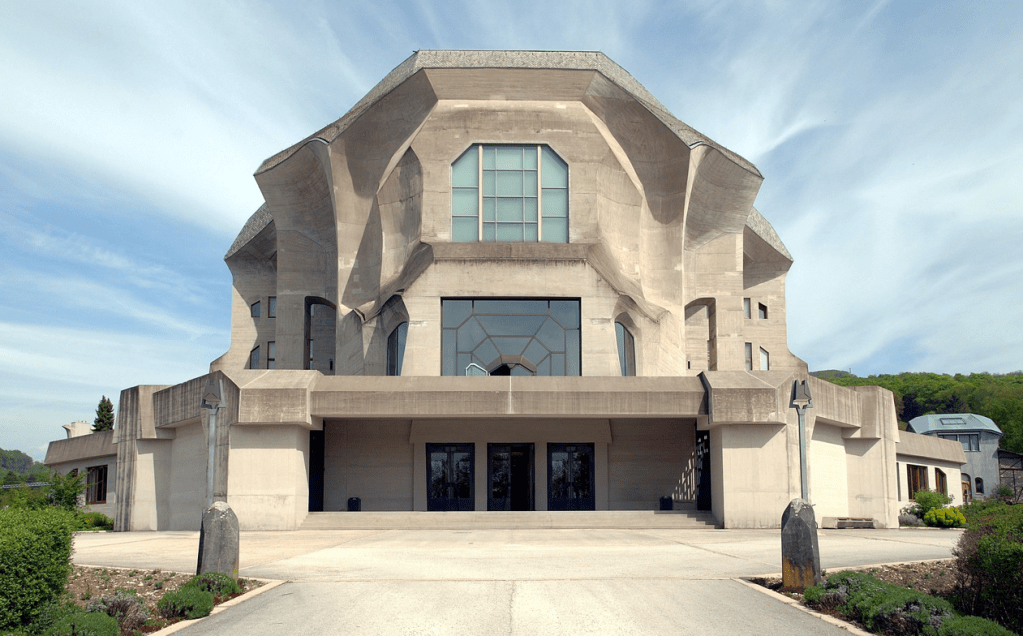
With a growing need to establish a dedicated artistic and organizational home for their increasingly popular yearly conferences, the leaders of the Society decided to construct a theater and central organizational facility. Steiner, who had developed his own theory of architecture, designed the Goetheanum, a center for anthroposophical arts and performances.
The first Goetheanum was destroyed in an arson attack on New Year’s Eve 1922 and Steiner replaced it with a new Goetheanum made of concrete which was completed in 1928. The next year, he founded the School of Spiritual Science within the Anthroposophical Society. The school was organized into sections dedicated to the arts, education, medicine, science, and general anthroposophical ideas.
Steiner died in 1925. The rise of the Nazis in Germany shortly thereafter significantly impacted the anthroposophical movement. Despite some support within the Nazi regime, anthroposophists faced scrutiny, although with relative moderation compared to other persecuted groups, in part because some leaders of the post-Steiner Society expressed outward sympathy for the new regime in Germany. The Society was still eventually banned by the Nazis, along with most other esoteric groups.
But the Society survived the war, and Steiner’s ideas, especially in education, thrived in the postwar period and in the countercultural tide of the 1960s. Today, there are national branches of the Anthroposophical Society in more than 50 countries, with approximately 10,000 institutions operating based on Steiner’s principles.
Key Sources:
Chertoff, E. (2012, November 30). Is This Grade School a ‘Cult? (And Do Parents Care?) The Atlantic.
Faivre, A., Needleman, J., & Voss, K. (1995). Modern esoteric spirituality. Crossroad Publishing.
Flakin, N. (2022, May 16). How Germany’s favourite cult took over everything from schools to supermarkets. The Berliner.
Lombard, S. (2003, November 2). Spotlight on Anthroposophy. Cultic Studies Review.
Lachman, G. (2007). Rudolf Steiner: An Introduction to His Life and Work. Penguin.
McKanan, D. (2018). Eco-Alchemy: Anthroposophy and the History and Future of Environmentalism. Univ of California Press.
Poplawski, T. (1998). Eurythmy: Rhythm, Dance and Soul. Central European University Press.
Steiner, R. (1984). The essential Steiner: Basic Writings of Rudolf Steiner. Harper San Francisco.
Steiner, R. (2002). What is Anthroposophy?: Three Perspectives on Self-knowledge. SteinerBooks.
Toncheva, S. (2015). Out of the new spirituality of the twentieth century: The Dawn of Anthroposophy, the White Brotherhood and the Unified Teaching. Frank & Timme GmbH.
Wachsmuth, G. (1995). The life and work of Rudolf Steiner: From the Turn of the Century to His Death. SteinerBooks.
 Encyclopedia of Cults, Sects, and New Religious Movements