Alice Bailey was born Alice La Trobe-Bateman in Manchester, England, in 1880. Though born wealthy, she said her childhood was isolated and unhappy. Her mother died when she was young and she described her father as indifferent. She attempted suicide three times by the age of 15. After the third attempt, she said she had an encounter with a mysterious figure in a turban who told her that she would have an important life mission. She later determined this figure to have been Koot Hoomi, a teacher of Theosophical Society founder H.P. Blavatsky.
In 1907, she married Walter Evans and moved with him to the United States so that he could become an Episcopal seminarian. They had three daughters but the marriage was strained, and they divorced in 1915. She was left to provide for her daughters on her own, and took a job in a sardine factory in California. It was during this period that she first discovered Theosophy. She met fellow Theosophist Foster Bailey and in 1919 they married, becoming significant figures in the Theosophical Society in California.
That same year, Bailey said that she had started receiving communications from an adept called “The Tibetan,” receiving messages in addition to those that Blavatsky and other earlier Theosophists had claimed to receive from the Masters. Her growing influence led to conflict between Alice Bailey and Annie Besant, the leader of the Theosophical Society worldwide, and the Baileys left the Society in 1920.
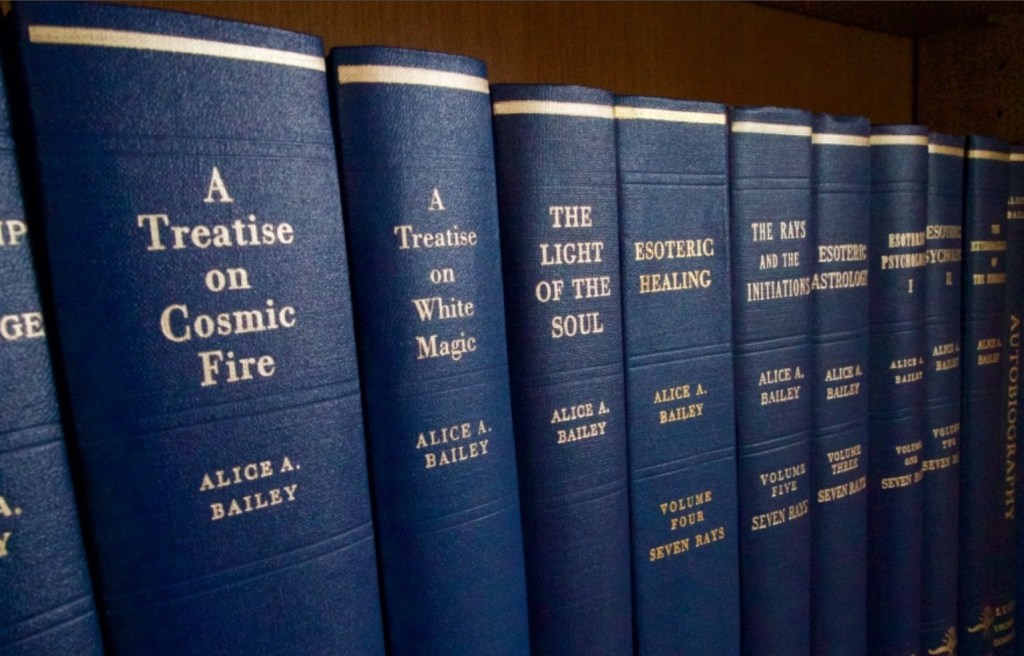
In 1922, the Baileys established the Lucis Trust, which served as an umbrella for their spiritual, educational, and publishing endeavors. They founded the Arcane School one year later, offering instruction in mediation and in Bailey’s ever-growing body of writings. Her books presented a comprehensive system of esoteric thought, with the “seven rays” as a central concept, described as fundamental energies influencing all aspects of manifestation. She promulgated a concept of esoteric astrology that she attributed to a spiritual Master named Djwhal Khul. These works focused on the evolution of the soul consciousness and on the interconnectedness of the soul and personality.
In 1937, Bailey wrote a five-stanza prayer called the “Great Invocation” that would ultimately be translated into more than 80 languages. Bailey envisioned it as a unifying prayer for a new era, potentially replacing traditional prayers in a future world religion. Eleanor Roosevelt would recite the prayer over the radio in a broadcast from the United Nations in 1952.
Bailey wrote 17 books during her esoteric career and entered into correspondences with luminaries including psychologist Carl Jung. Her 1944 book Discipleship in the New Age was one of the first uses of that term to refer to that nascent spiritual movement, and the Great Invocation has influenced many New Age works.
Today, the Arcane School focuses on training individuals in meditation and service to develop their spiritual potential and understand their role in the evolution of consciousness. Discipleship within the school involves service to humanity, cooperation with a perceived spiritual Plan, and the development of inherent soul capacities. The training emphasizes meditation, study of esoteric principles, and active engagement in service. The Arcane School has physical centers in Geneva, London, and New York, with most students participating through distance learning. Following Alice Bailey’s death in 1949, Foster Bailey succeeded her as the head of the school, and after his death in 1977, their daughter Mary Bailey continued to lead the organization.
Key Sources:
Bailey, A. (1951). The unfinished autobiography of Alice A. Bailey. Lucis Press.
Bailey, A. (2003). Ponder on this: From the Writings of Alice A. Bailey and the Tibetan Master, Djwhal Khul. Lucis Press.
Blackthorn, I. (2020). Alice A. Bailey: Life and Legacy.
Hammer, O. (2003). Claiming knowledge: Strategies of Epistemology from Theosophy to the New Age. Brill.
Mills, J. (1987). 100 Years of Theosophy, A History of the Theosophical Society in America.
Newburn, K. (2007). A Planetary Awakening: Reflections on the Teachings of the Tibetan in the Works of Alice A. Bailey. Blue Dolphin Publications.
Ransom, J. (1938). A Short History of the Theosophical Society.
Wessinger, C. (1993). Women’s leadership in marginal religions: Explorations Outside the Mainstream.
 Encyclopedia of Cults, Sects, and New Religious Movements