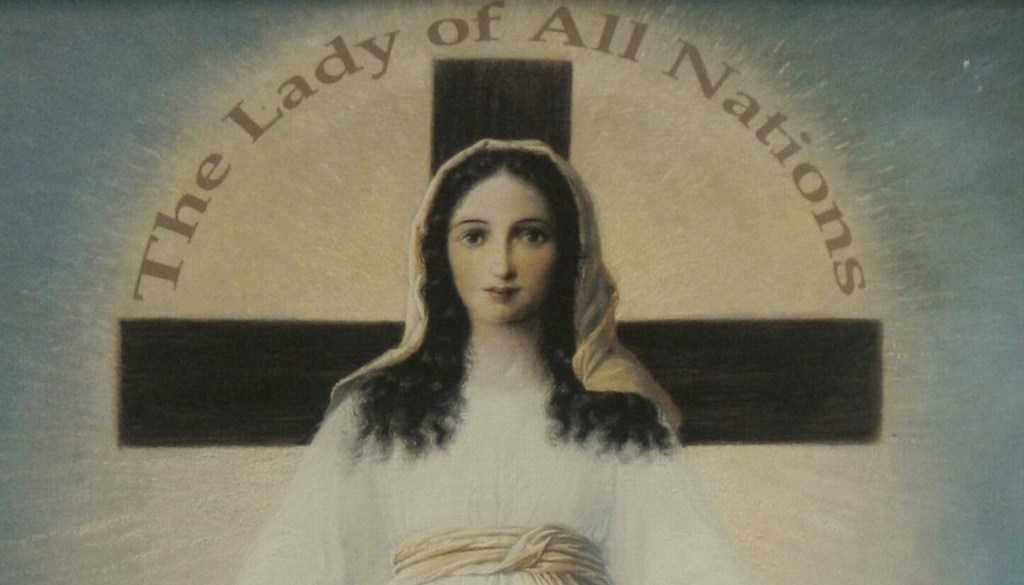
Marie-Paule Giguère, born Roman Catholic in Quebec in 1921, reported hearing celestial voices when she was 12 years old. She considered becoming a nun but was advised against it by her local church, and in 1944 she married Georges Cliché. They had five children, but the marriage was an unhappy one, and they divorced after a decade.
One year later, Giguère began journaling about her spiritual experiences under the pen name “Marie-Josée,” later naming herself “Mère Paul-Marie” when she began publishing these writings. She gained a small following and started a prayer group. In August 1971, while on a pilgrimage to a Marian shrine with this group, she said that she received a revelation that directed her to create an “Army of Mary” devoted to the “Triple White” of Mary, the Eucharist, and the Pope. The group gained about 75 members in its first year, with a priest named Philippe Roy joining and becoming its spiritual director.
Cardinal Maurice Roy of Quebec approved the Army of Mary as a formal Catholic pious association in 1975, and word continued to spread. By 1977, it had devotees in about 20 countries. That year, Giguère said that she had received a revelation instructing her to introduce the Militia of Jesus Christ, an association formed in France in 1973 without church approval, in Quebec. Many members of the Army of Mary also joined the Militia of Jesus Christ.
Giguère’s relatively cordial relationship with the church soured in 1978 when she started to claim to be the mystical reincarnation of Mary. Since Catholic doctrine asserts that Mary was bodily assumed into Heaven, any sort of Marian reincarnation is impossible. In 1981, she changed the name of her group to the Family and the Community of the Sons and Daughters of Mary, and a large complex including guesthouses, a radio station, and a retreat center was established shortly thereafter.
In 1987, Cardinal Joseph Ratzinger, head of the Vatican’s Congregation for the Doctrine of the Faith, declared the Army of Mary movement’s teachings to be in “major and severe error.” Two months later, the new archbishop of Quebec withdrew official support and declared the group to be schismatic.
The group continued its activities but turned insular, with devotees largely restricting themselves to the Quebec compound. In 1998, two bishops defied the Vatican and secretly ordained two priests to join and serve the Army of Mary. In 2001, the Catholic Bishops of Canada declared the group to not be a “Catholic association” because of its “spurious new doctrines that are without foundation in Scripture or Tradition.”
In March 2007, Archbishop Marc Ouellet of Quebec stated that the group had become “a schismatic community and, as such, a non-Catholic association” and said that Catholics should not support it. The group responded two months later by holding four days of ceremonial feasts during which it named its own pope, ordained six priests, ordained a saint, and declared Mary to be equal to Jesus as the world’s redeemer. The Congregation for the Doctrine of the Faith excommunicated the group and its members two months after that, with Ratzinger, by then Pope Benedict XVI, approving the action.
Though Giguère remained the central figure in the group until her death in 2015 at age 93, following the excommunication, theologians within the group began to take on a dominant role, crafting a unique liturgy promoting a “Marian Trinity” of Mary, Marie-Paule, and the Holy Spirit, and a mystical system based on the number 55,555, which they believe symbolizes the triumph over evil. The group now asserts that the church based at Vatican City has become “degenerated” and will ultimately be succeeded by a new Catholic faith.
Key Sources:
The Associated Press (2007, September 27). 6 Nuns in Ark. excommunicated for heresy.
Brean, J. (2007, September 12). Army of Mary cast out. The National Post.
Catholic News Agency (2007, September 14). Army of Mary excommunicated by the Vatican.
Fastiggi, R. (2012). The Rise and Fall of the Army of Mary (L’Armée de Marie). Marian Studies.
Harvey, B. (2000, May 16). Bishop defends sect condemned by Vatican, Quebec. The National Post.
Margry, P. (2012, January). Mary’s Reincarnation and the Banality of Salvation: The Millennialist Cultus of the Lady of All Nations/Peoples. Numen: International Review for the History of Religions.
The Montreal Gazette (2007, September 14). Excommunicated sect looks to God, not Rome.
Patriquin, M. (2001, October 4). Mary, Quite Contrary. Hour Magazine.
 Encyclopedia of Cults, Sects, and New Religious Movements