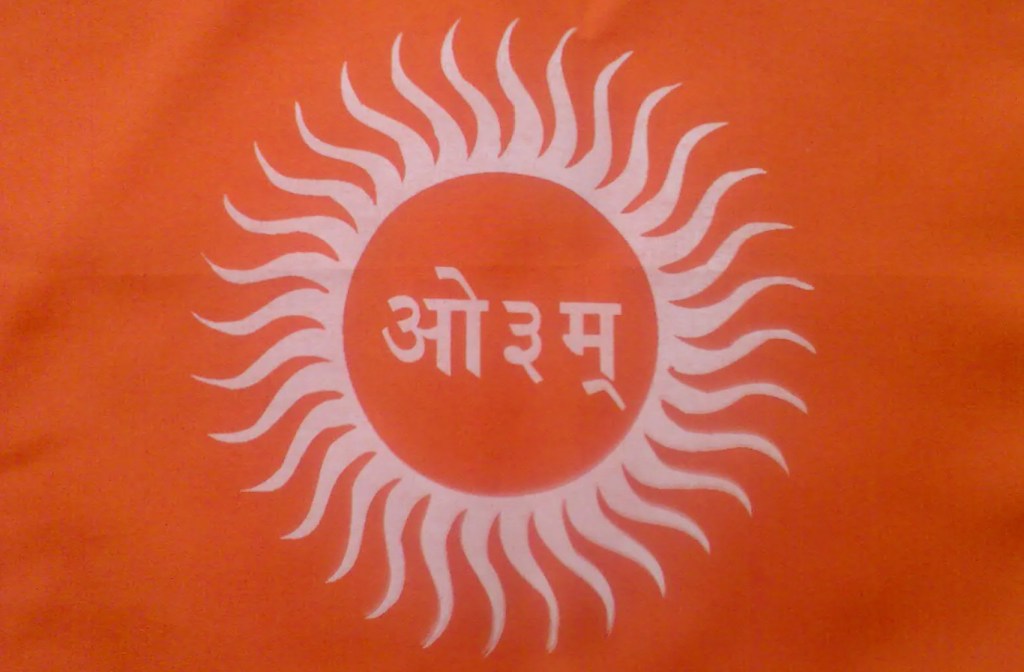
The Arya Samaj is a Hindu modernization and reform movement founded in 1875 by Dayananda Saraswati, and it was the first significant Hindu organization to actively seek converts to Hinduism.
Saraswati, born Mool Shankar Tiwari, was born in 1824 into a Brahmin family. At age eight, he was initiated into religious study in the Saivite tradition, but in he soon began to question traditional Hinduism. After his uncle and younger sister both died of cholera, he began a deeper exploration of his religious doubts, rejecting an arranged marriage and leaving home.
At age 21, he began a period as a wandering ascetic that would last more than 20 years. He visited pilgrimage sites across northern India, went on retreat in the Himalayas, and learned several forms of yogic practice. He ultimately became a disciple of Virajanand Dandeesha, who believed that Hinduism had deviated from its original form. Taking the name Saraswati, he pledged to use the rest of his life to restoring the Vedas at the center of Hindu belief.
Between 1869 and 1873, Saraswati began his active efforts to reform orthodox Hinduism. He established schools that emphasized the Vedas. These schools were open to both boys and girls and provided an alternative to the imperial British education system. Saraswati taught that there is a single, formless, and omnipresent deity encapsulated in the syllable “Aum,” and that this god could be worshipped only through yoga, not through devotion to idols. Saraswati said that the Vedas promoted scientific and philosophical inquiry, and that their true meaning had been corrupted by centuries of ritual-based religious practice.
He founded the Arya Samaj, meaning “Noble Society,” in Bombay (now Mumbai) in April 1875. Among its founding principles were the prioritizing of general public welfare over religious ritual and that all actions should be performed with the objective of benefiting the whole of humanity. His rejection of traditional ritual practice and openness to Hindu converts brought him into conflict with other Hindu sects and reform groups, as did his public challenging of scholars and priests of all creeds. He also promoted Indian self-governance, angering British authorities.
Saraswati survived several assassination attempts during his public career, but succumbed to one such attempt in 1883. While visiting the Maharaja of Jodhpur, Saraswati admonished that royal for his relationship with a dancer named Nanhi Jaan. Nanhi Jaan took offense and bribed Saraswati’s cook to mix small pieces of glass into his milk. Saraswati became ill and the cook confessed. Saraswati forgave the cook and gave him the money to escape before the Maharaja’s men could arrest and execute him. Saraswati’s condition slowly worsened and he died one month later.
The Arya Samaj continued to grow following Saraswati’s death, but with the growth came factionalism. One schism erupted in 1893 between vegetarians and omnivores within the group. The rising Indian Home Rule movement also impacted the Arya Samaj, with the British Raj declaring it a political entity and firing members from government jobs. Members would also split between moderate self-governance groups and more radical ones like the Hindu nationalist Rashtriya Swayamsevak Sangh.
The Arya Samaj continues to be a strong presence in India and in other countries with sizable Hindu populations like Australia, Kenya, Mauritius, South Africa, and Trinidad and Tobago. Its global membership is estimated at about eight million. There are more than 10,000 Arya Samaj-affiliated schools in India, as well as thousands of Arya Samaj libraries that are open to the public.
Key Sources:
Jones, K. W. (1989). Socio-Religious reform movements in British India. Cambridge University Press.
Naidoo, T. (1992). The Arya Samaj movement in South Africa. Motilal Banarsidas.
Rai, L. (1992). History of the Arya Samaj: An Account of Its Origin, Doctrines and Activities with a Biographical Sketch of the Founder.
Rai, L. L., & Rai, L. (1991). The Arya Samaj: An Account of Its Origin, Doctrines, and Activities. Reliance Publishing House.
Saxena, G. S. (1990). Arya Samaj Movement in India, 1875-1947.
Sharma, J. M. (1998). Svami Dayanand: A Biography.
Vable, D. (1983). The Arya Samaj: Hindu Without Hinduism. Vikas Publishing House.
Yadav, K. C., & Arya, K. S. (1988). Arya Samaj and the Freedom Movement. Manohar Publications.
 Encyclopedia of Cults, Sects, and New Religious Movements