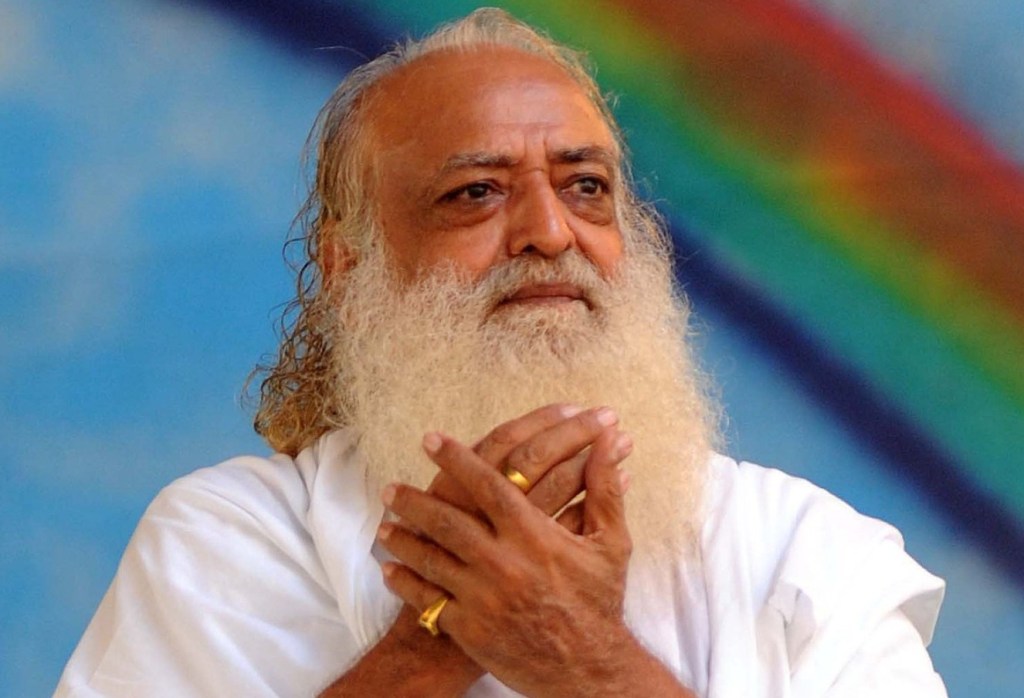
Asumal Thaumal Harpalani was born in British India in 1941 in a town that was located in Pakistan after the partition of 1947. After partition, his family migrated to Ahmedabad, India, where his father opened a coal and wood business. Harpalani dropped out of school in third grade and briefly managed the family business after his father’s death. His early occupations were varied and included selling liquor, repairing bicycles, and trading sugar.
He began his religious journey in his early 20s and began to study under guru Leelashahji Maharaj in the early 1960s. He was ordained and given the name “Asaram” in 1964. By this time he had married and would eventually become the father of two children who would later become involved in both his religious empire and legal controversies.
In the early 1970s, Asaram began establishing his spiritual base. He returned to Ahmedabad in 1971 and built a hut that he converted into a small ashram in 1973. He gained a devoted following through engaging religious discourses that blended humor, music, and dance.
His network of ashrams grew rapidly, aided by political patronage across party lines but with significant support from leaders of the Hindu nationalist Bharatiya Janata Party (BJP) including Prime Ministers Atal Bihari Vajpayee and Narendra Modi. Asaram began working Hindu nationalist messaging into his sermons, strongly opposing European cultural influences and conversions to Christianity.
By 2013, Asaram claimed to oversee 400 ashrams across India and 18 countries, boasting an estimated 40 million followers. He launched two magazines that reached a combined monthly circulation of 1.4 million copies. His organization also acquired large amounts of real estate and faced accusations of illegally occupying public and private land, often through forged records and intimidation tactics.
However, Asaram’s political support began to decline around this time. In 2008, two boys went missing from one of his religious schools, and their mutilated bodies were later found on the banks of a river. An autopsy indicated drowning, but rumors spread that black magic had played a role in their deaths. Two more deaths under similar circumstances only heightened the hysteria. Though Asaram was ultimately cleared of any responsibility (though ashram authorities were faulted for negligence), Modi, then a provincial chief minister, urged the BJP to distance itself from the newly controversial Asaram.
In January 2013, Asaram drew nationwide condemnation for comments he made regarding a notorious gang rape in Delhi in 2012, calling the survivor “as guilty as her rapists.” Later that same year, a 16-year-old girl accused Asaram of sexually assaulting her at his ashram in Jodhpur, under the guise of exorcising evil spirits. Her parents, who were long-time devotees, filed a complaint with the Delhi police, and a medical exam confirmed assault. After ignoring a summons for questioning, Asaram was arrested on September 1, 2013.
Despite recently distancing themselves from him, BJP leaders expressed support for Asaram following his arrest, and violent protests against his arrest broke out across India. Asaram publicly cited letters of support from political dignitaries and also stated that he was sexually impotent and could not have committed the alleged assault. He was denied bail 12 times and remained in jail following his arrest.
Four months after Asaram’s arrest, his son was arrested as well after two sisters accused both Asaram and the son of sexual abuse spanning nearly a decade. They also accused Asaram’s wife and daughter of complicity.
In April 2018, Asaram was convicted of raping a minor and was sentenced to life in prison. One year later, his son was convicted on multiple counts and was also sentenced to life imprisonment. The criminal cases had been marked by systematic violence and intimidation against witnesses. Multiple attacks were carried out, including shootings, stabbings, acid assaults, and one confirmed assassination of a former aide. One key witness and former assistant to Asaram was stabbed, then later went missing entirely. Another narrowly survived a murder attempt and remains under state protection.
In January 2025, the Supreme Court of India granted Asaram interim bail on medical grounds until March 31, noting his age and chronic health conditions. The Rajasthan High Court later approved similar bail terms for treatment related to the Jodhpur conviction.
Despite the court rulings, Asaram still has a large following across India.
Key Sources:
Dave, H. (2018, April 26). Asaram’s daughter running empire of 400 ashrams spread over India. Hindustan Times.
Gupta, S. (2023, February 1). Indian guru Asaram given life sentence in second rape case. CNN.
Langa, M. (2013, August 29). Controversial godman: Can Asaram come clean on the sexual assault allegations? Hindustan Times.
Majumdar, U. (2018). God of Sin: The Cult, Clout and Downfall of Asaram Bapu. Penguin Random House India Private Limited.
 Encyclopedia of Cults, Sects, and New Religious Movements