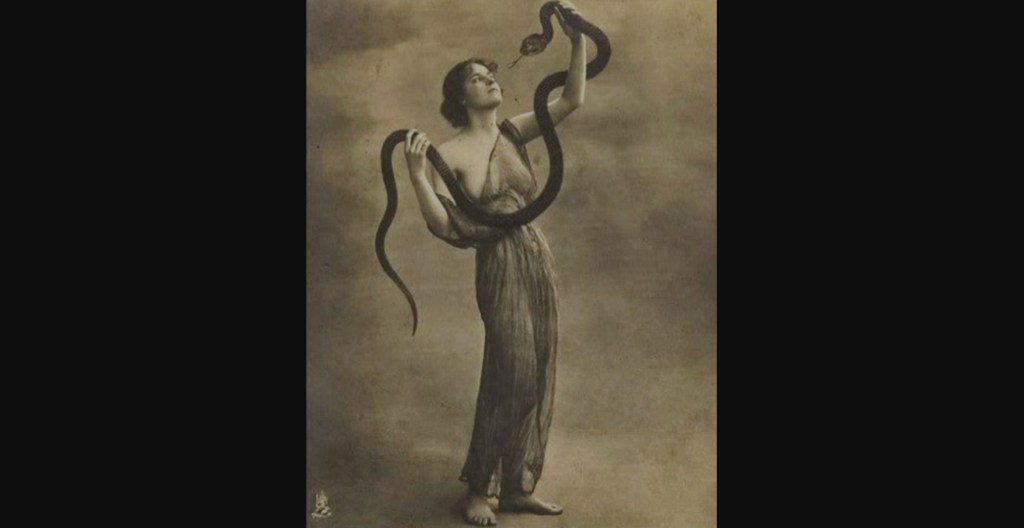
Maria de Naglowska was a Russian occultist, mystic, author, and journalist who gained notoriety in Paris during the 1930s. She was the founder of the Brotherhood of the Golden Arrow, a short-lived esoteric society known for its focus on sexual magic and its unique theological perspectives.
Born on August 15, 1883, in St. Petersburg, Naglowska was the daughter of a provincial governor. Orphaned at age 12, she received her education at the Institute Smolna. She later married Moise Hopenko, a Jewish commoner, a union that led to her estrangement from her aristocratic family.
The couple moved to Berlin and then Geneva, where they had three children. Around 1910, Hopenko left Naglowska to move to Palestine. To support her family, Naglowska worked as a school teacher and journalist. Her radical writings led to her imprisonment and subsequent expulsion from Switzerland.
Around 1920, she relocated to Rome, where she continued her journalism career and met the Italian esotericist and philosopher Julius Evola. This period was influential in the development of her occult interests.
In 1929, Naglowska moved to Paris. Unable to secure a work permit, she began to hold occult seminars to support herself. These seminars, which focused on her ideas about sexual magic, attracted notable avant-garde figures, including Evola, Man Ray, and André Breton.
These gatherings laid the groundwork for the establishment of the Brotherhood of the Golden Arrow in 1932. The society was based in Paris and existed until 1935. Naglowska’s central doctrine was the “Third Term of the Trinity,” a concept that identified the Holy Spirit as the divine feminine. She aimed to reconcile light and dark forces in nature through the spiritual power of sex.
Naglowska’s published works were central to her teachings. In 1931, she translated the writings of American occultist Paschal Beverly Randolph on sexual magic, a work that brought his ideas to Europe. In 1932, she published the semi-autobiographical novella Le Rite Sacré de l’amour magique, followed by The Light of Sex, a required text for initiates into the Brotherhood.
The Brotherhood’s rituals were often controversial. One account describes a ceremony where a naked Naglowska reclined on an altar while a male initiate placed a chalice on her body. This ritual was intended to arouse Lucifer, a figure Naglowska depicted as a force within humanity rather than an external evil. She referred to herself as a “Satanic woman,” an action that Julius Evola claimed was a deliberate attempt to shock and scandalize.
In 1935, Naglowska gave a speech at the Club de Faubourg on “magic and sexuality.” The club was subsequently charged with “outrage to public decency” but was later acquitted on appeal. Her ideas also influenced the surrealist movement, and she was acknowledged in the catalog of the 1959 International Surrealist Exhibition.
In 1935, Naglowska had a dream that she interpreted as a premonition of her death. She moved to Zurich to live with her daughter and died there on April 17, 1936, at the age of 52. Following her death, the Brotherhood of the Golden Arrow dissolved.
Key Sources:
Naglowska, M. (1934). The Rituals of the Brotherhood of the Golden Arrow.
Southgate, T. (2018, December 6). Maria de Naglowska and the Doctrine of the Third Term of the Trinity. Nowhere News.
Traxler, D. C. (2012, November). Maria de Naglowska, A Herald of the New Era. New Dawn.
Varady, S. (2019, November 25). The First Lady of Satan and the Brotherhood of the Golden Arrow. Medium.
 Encyclopedia of Cults, Sects, and New Religious Movements