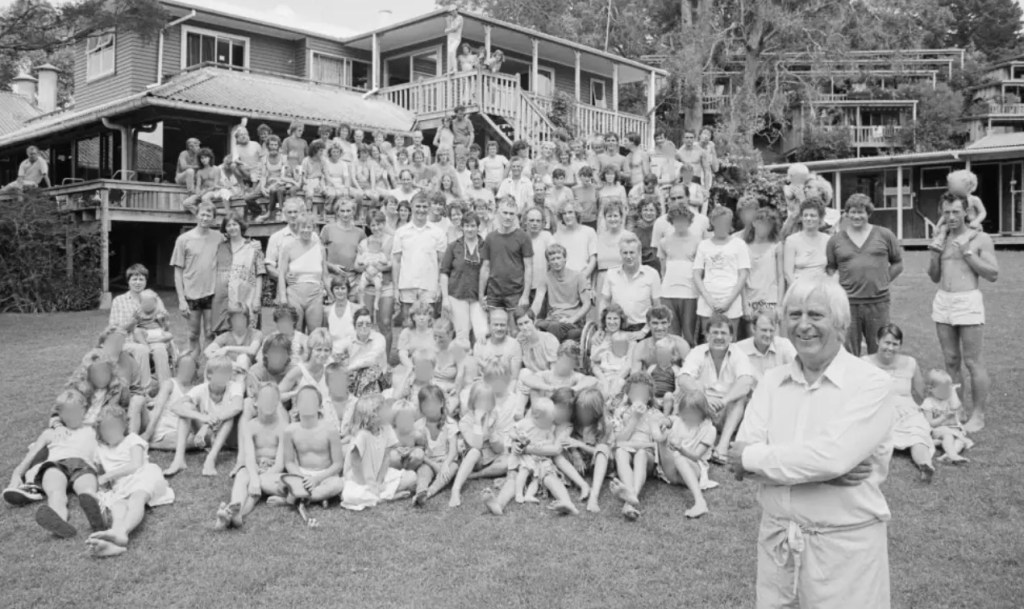
Centrepoint was a commune established in Albany, New Zealand, in 1977 by Herbert “Bert” Potter. At its height, around 275 people lived on the property, making it one of the largest alternative communities in the country. It drew middle-class families searching for support, intimacy, and alternative approaches to living. While initially seen as a social experiment, Centrepoint became widely regarded as a cult, notorious for sexual abuse, manipulation, and criminal activity.
Potter was born in 1925 and worked in advertising before turning to therapy in the 1970s. He was influenced by the Human Potential Movement in California, which promoted personal growth through encounter groups and emotional openness. He applied these ideas in New Zealand, combining therapeutic exercises with communal living. Centrepoint was envisioned as a place where social restraints could be cast off in pursuit of psychological healing and personal freedom.
Residents were expected to participate in group therapy sessions led by Potter and other counselors. These sessions encouraged vulnerability, confrontation, and the breaking down of boundaries. Sexual openness became central to the community’s philosophy. Couples were often pressured to separate, and members were encouraged to pursue relationships outside traditional family structures. This ethos, presented as liberation, placed Potter at the center of a system where authority and intimacy overlapped.
Drug use reinforced the commune’s practices. Large amounts of MDMA were manufactured on site, using sassafras oil as a precursor. LSD was also circulated, though accounts differ as to whether it was made at Centrepoint or sourced elsewhere. Ketamine entered the community through veterinary supplies. Drugs were presented as tools to deepen therapy and unlock insight. In practice, they became mechanisms for control, with teenagers pressured into use. Several girls later testified that drugs were given to them during sessions with Potter to facilitate sexual abuse.
During the 1980s, Centrepoint’s reputation was contested. The commune published a book to counter negative perceptions, portraying an idyllic environment of shared labor, child-rearing, and creative energy. Yet troubling accounts emerged from those inside, describing sexual coercion, physical punishments, and neglect. While some residents experienced the community as liberating, others endured manipulation and exploitation that went largely unchecked due to Potter’s authority.
In 1992, Potter was convicted on 13 counts of indecent assault against five girls between 1979 and 1984. He received a seven-year prison sentence. Several other members faced related convictions, including for sexual offending and drug manufacturing. Three were convicted specifically of offences tied to MDMA production.
Potter’s imprisonment marked the unraveling of Centrepoint’s leadership, but the commune continued into the late 1990s. After his release in 1999, Potter briefly returned to the community before being paid to leave. In March 2000, the High Court of New Zealand ordered Centrepoint’s dissolution, placing its assets under the management of the New Zealand Communities Growth Trust. By then, approximately 300 children had lived in the commune over its 22 years of existence.
In 2010, Massey University’s School of Psychology released a study on the long-term impacts of Centrepoint. Based on interviews with 29 adults who spent part of their childhood in the commune, it documented wide-ranging harms. Interviewees described early sexual encounters, often between ages 11 and 13, which were normalized by the community but later recognized as abuse. Girls were often idealized as “in touch with their loving,” while boys reported being propositioned but able to resist more easily.
Children were exposed to drugs, neglect, bullying, corporal punishment, and frequent conflict among adults. Parents’ imprisonment and the stigma attached to Centrepoint compounded these difficulties. Many former residents reported lifelong consequences, including psychological disorders, substance abuse, difficulty with intimacy, and uncertainty about their own memories.
Following the dissolution of Centrepoint, the Albany property was repurposed. Former members attempted to form new communities, including the Anahata Eco-village, and later artists used the land as a creative collective. In 2008, the Public Trust sold the property to the Prema Charitable Trust, which established the Kawai Purapura Retreat Centre. The retreat distanced itself from the commune’s history while continuing to operate on the same site. It was closed in 2024 after an eviction order. In early 2025, a fire damaged the derelict buildings, which were by then occupied by squatters.
Potter lived quietly after leaving Centrepoint. He suffered from Alzheimer’s disease in his final years and died in 2012 at the age of 86 after a fall. His funeral was attended by family and former members, some of whom remained loyal to him.
Key Sources:
Daniell, S. (2021, May 20). Bert’s Labyrinth. North & South Magazine.
King, R. C. (2021). Surviving Centrepoint: My Years in New Zealand’s Most Infamous Cult. Penguin Books.
Matthews, P. (2024, June 11). New Zealand cults hit the world stage. The Christchurch Press.
McConnell, A. (2021, May 18). Centrepoint: Albany’s Lost Cult. Debate Mag.
Oakes, L. (1986). Inside Centrepoint: The Story of a New Zealand Community.
Richter, A. (2021, May 22). Centrepoint survivors on speaking out and reconciliation. NZ Herald.
Richter, A. (2021, May 31). Centrepoint: Neither free nor loving. RNZ News.
Richter, A. (2022). Cult trip: Inside the World of Coercion and Control.
RNZ News. (2012, May 7). Potter had quiet life after leaving prison.
 Encyclopedia of Cults, Sects, and New Religious Movements