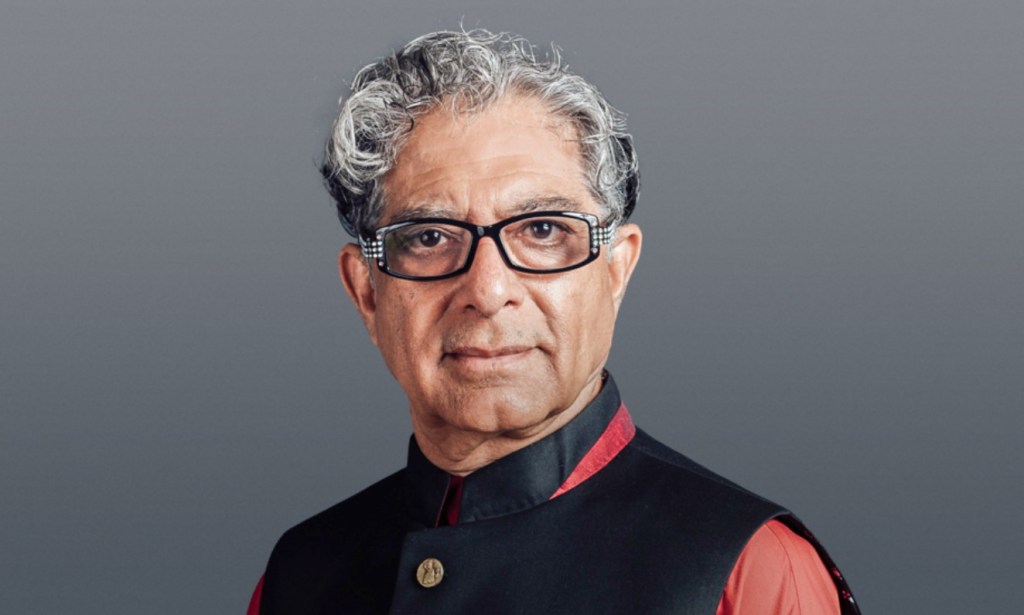
Deepak Chopra is an author, public speaker, and alternative medicine advocate. Over the course of several decades, he has moved from a career in conventional medicine to a prominent role in the global wellness industry. His books, public appearances, and centers for health and well-being have made him one of the most widely recognized figures associated with alternative medicine and spirituality.
Chopra was born in New Delhi to Krishan Lal Chopra, a cardiologist and lieutenant in the British Indian Army, and Pushpa Chopra, a homemaker. His upbringing in a medical family introduced him early to the field of healthcare. He attended St. Columba’s School in New Delhi, a Roman Catholic institution with a reputation for academic rigor.
Following his secondary education, he entered the All India Institute of Medical Sciences (AIIMS), one of the country’s leading medical schools. He graduated in 1969 with a medical degree. After a brief period practicing medicine in rural India, Chopra chose to pursue further opportunities abroad. In 1970, he emigrated to the United States to complete his postgraduate training.
In the United States, Chopra undertook a clinical internship at Muhlenberg Hospital in Plainfield, New Jersey. He then completed residencies in internal medicine at several hospitals in Massachusetts, including the Lahey Clinic and Beth Israel Deaconess Medical Center. By 1977, he was board-certified in internal medicine and endocrinology, establishing himself in the field.
Chopra’s conventional medical career progressed steadily. He accepted teaching positions at medical schools, including Tufts University, Boston University, and Harvard Medical School. In 1980, he was appointed chief of staff at New England Memorial Hospital (NEMH) in Stoneham, Massachusetts. In this role, he oversaw clinical operations while continuing to practice endocrinology.
During this period, Chopra balanced hospital duties with academic teaching and clinical work. His reputation as a physician was well established, and he held a respected position within the medical community.
In the early 1980s, Chopra’s career path shifted. In 1981, during a visit to New Delhi, he consulted with an Ayurvedic physician, whose influence encouraged him to revisit traditional Indian medical practices. This meeting initiated his interest in Ayurveda, an ancient system of medicine rooted in Indian philosophy and practice.
In 1985, Chopra was introduced to Maharishi Mahesh Yogi, the founder of the Transcendental Meditation (TM) movement. Impressed by the Maharishi’s teachings, Chopra became closely involved with TM. He resigned from his hospital position in Massachusetts and devoted himself to studying and promoting Ayurveda in conjunction with TM.
That same year, Chopra established the Maharishi Ayurveda Health Center in Lancaster, Massachusetts. The center provided Ayurvedic treatments such as herbal remedies, diet counseling, and massage therapy, alongside instruction in meditation. Patients included both members of the general public and well-known personalities, including actress Elizabeth Taylor.
Through this association, Chopra began promoting a more holistic view of health, integrating spiritual and physical approaches. His alignment with the TM movement marked the beginning of his transition from conventional medicine into the broader field of alternative wellness.
Chopra’s early publications helped expand his profile beyond clinical practice. His book Quantum Healing: Exploring the Frontiers of Mind/Body Medicine (1989) gained international attention. In this work, he presented the idea that the mind could directly influence physical health through processes he described using the language of quantum physics.
The book introduced concepts that Chopra would continue to emphasize in later works, including the idea of the body as a dynamic system of energy and information. Quantum Healing reached a wide readership and established him as a leading voice in the field of alternative medicine. Other publications followed, broadening his audience and solidifying his reputation as both a physician and an author presenting nontraditional approaches to health.
In the early 1990s, Chopra relocated to California, which became the base for his expanding career. His public profile rose sharply after a 1993 appearance on “The Oprah Winfrey Show,” which introduced him to a much larger national audience. Following this exposure, sales of his books increased dramatically, and he became a familiar presence in American media.
Around this period, Chopra distanced himself from the TM movement. He expressed concerns about what he described as a cult-like atmosphere and chose to pursue an independent direction. After leaving the movement, he accepted a position as executive director of Sharp HealthCare’s Institute for Human Potential and Mind/Body Medicine in San Diego, California.
In 1996, he co-founded the Chopra Center for Wellbeing in La Jolla, California, along with neurologist David Simon. The center offered wellness retreats, workshops, and training programs, combining meditation, yoga, and Ayurveda with broader lifestyle counseling. It served as the organizational base for Chopra’s expanding wellness brand.
Chopra has been a prolific author, publishing more than 90 books across health, spirituality, and personal development. Many have been translated into multiple languages and sold millions of copies worldwide. Titles include Ageless Body, Timeless Mind (1993), The Seven Spiritual Laws of Success (1994), and How to Know God (2000).
His works often draw on a mix of Eastern philosophical traditions, Western psychology, and scientific terminology. The books range from guides on meditation and wellness to explorations of spirituality and consciousness. Several have been bestsellers, further expanding his global reach.
At the core of Chopra’s teachings is the idea that mind and body are closely interconnected. He has argued that mental states directly influence physical health and that practices such as meditation, yoga, and diet can produce profound improvements in well-being.
Chopra has described “perfect health” as a state free from disease, pain, and aging, and he often emphasizes the importance of self-awareness in achieving such outcomes. His teachings also highlight the inseparability of mind, body, and spirit, presenting them as parts of a unified whole.
In addition to health, Chopra has written extensively about spirituality. He often references Hindu philosophical traditions and integrates ideas from quantum physics to explain consciousness and existence. His writings seek to blend spiritual traditions with modern science, though the interpretation of scientific concepts has been a subject of debate.
By the mid-1990s, Chopra had become a well-known public figure. His lectures attracted large audiences, and he became a frequent guest on television programs. His celebrity clients and endorsements further raised his profile.
The Chopra Center became a destination for individuals seeking alternative wellness experiences, while his books consistently performed well in international markets. As a result, Chopra established himself as one of the most recognized figures associated with the global wellness movement.
Although widely read, Chopra’s work has also been met with criticism. Members of the scientific and medical communities have expressed concern about the use of scientific terminology in his explanations of health and healing. Critics argue that his use of concepts such as “quantum healing” misrepresents the principles of physics.
In 1991, Chopra co-authored an article on Ayurveda in the Journal of the American Medical Association. The article was criticized for lacking empirical support, and requests to test his claims under controlled scientific protocols were declined. In 1998, he was awarded an Ig Nobel Prize in physics, a satirical award given for unusual scientific claims, for his interpretations of quantum mechanics.
Some of his statements, particularly regarding serious diseases, have drawn scrutiny. For example, his remarks on AIDS and the potential role of sound in treatment were criticized by medical professionals for lacking evidence.
Chopra’s work expanded beyond books and lectures into a broader business enterprise. The Chopra Center offered retreats, training courses, and wellness products. He has also maintained an active schedule as a public speaker, often commanding high fees for lectures and appearances.
Key Sources:
Chopra, D. (2009). Quantum healing: Exploring the Frontiers of Mind Body Medicine. Bantam.
Plait, P. (2009, December 1). Deepak Chopra: redefining “wrong.” Slate.
Strauss, V. (2015, May 15). Scientist: Why Deepak Chopra is driving me crazy. The Washington Post.
Time. (2008, November 14). New Age Supersage.
Wheen, F. (2005). How Mumbo-Jumbo conquered the world: A Short History of Modern Delusions. PublicAffairs.
 Encyclopedia of Cults, Sects, and New Religious Movements