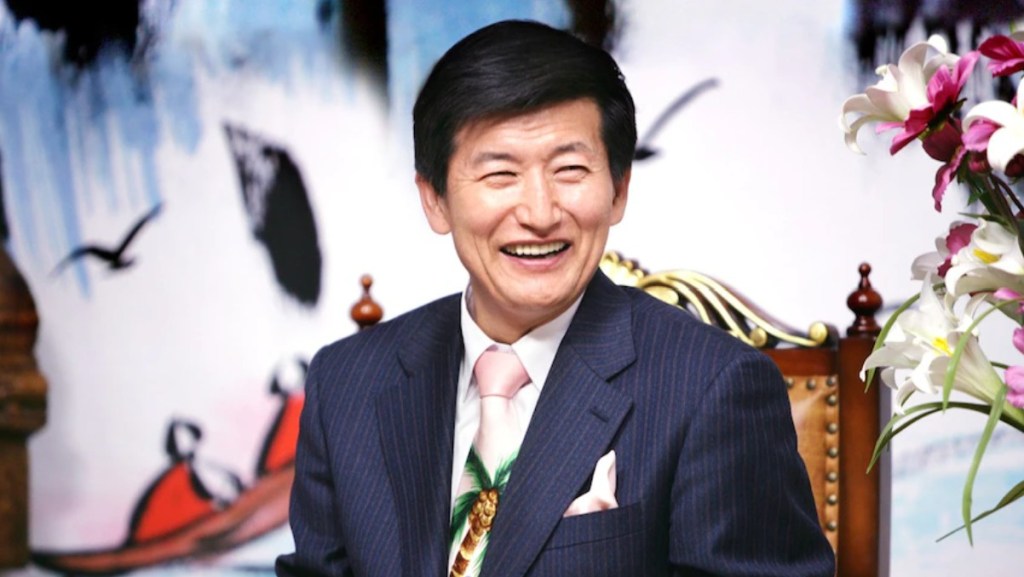
Christian Gospel Mission, officially known as Providence and commonly referred to by the acronym JMS (Jesus Morning Star), is an offshoot of the Unification Church (“Moonies”) founded by Jung Myung-seok in South Korea in 1980. The organization has been widely designated as a cult by international media. Before establishing his own group, Jung was a member of the Unification Church in the 1970s.
The movement began its formal history in 1980 when Jung founded the Ae-chun Church, which was initially affiliated with the Methodist Church. In 1983, Jung forged a diploma from the Korea Bible Correspondence School. That same year, he joined the Jesus Korea Methodist Church, renaming it the Jesus Korea Methodist Aechun Church, and launched the World Youth University MS Union, adopting the name “Jesus Morning Star” (JMS) for himself.
The organization changed its name to the International Christian Association in the mid-1980s. One of Jung’s top lieutenants was forced out of the group in 1986 after attempting to address the growing sex scandals within the sect, and after that point, Jung faced no internal opposition or criticism. By the mid-1980s, the movement expanded internationally, starting operations in Japan around 1985 and in Taiwan in 1988. The group is also active in Australia and New Zealand.
The core doctrines of Providence are contained in unpublished precepts called the “30 Lessons.” These teachings bear considerable resemblance to the Unification Church’s “Divine Principle.” The lessons use numerological interpretations, particularly of the Book of Daniel, to advance the controversial claim that Jung is the Messiah and the Second Coming of Christ. Furthermore, the theology, which allegorizes the relationship between God and humanity as that of two lovers, taught that the original sin involved a sexual act and could be redeemed by having sexual intercourse with Jung.
The recruitment process for new members, who were often young people, became a subject of controversy. The group initially approached inductees through non-religious “activity circles” or clubs, delaying the revelation of the group’s religious nature until later Bible study sessions. This deceptive practice, used to target young and attractive women, was eventually ruled “fraudulent” under law by the Japanese Supreme Court.
In October 1999, the organization officially changed its name to Christian Gospel Mission. The same year, the movement was thrust into the public eye when the South Korean broadcaster SBS aired a sensational exposé on the rampant sexual abuse allegedly committed by Jung, reporting on interviews with over 100 alleged victims. Following the broadcast, Jung fled the country, starting an eight-year period as an international fugitive.
While on the run, Jung continued to lead his followers. Overseas events were held, and his sermons were published online. During his time as a fugitive, the organization began operating in Australia in 1997. In Taiwan in November 2001, an article alleged that Jung had raped over one hundred Taiwanese female college students, prompting Taiwanese authorities to investigate Jung before he fled the country.
In July 2003, Jung was arrested in Hong Kong for overstaying his visa but was released on a large bail. When Hong Kong authorities approved his extradition to Korea, he absconded. The following year, in 2004, Interpol issued a red notice for Jung. In 2006, South Korean authorities put him on an international wanted list on rape charges, and the government officially requested China’s assistance in his extradition.
Throughout this period, Providence’s activities in Japan drew scrutiny. In 2006, the Asahi Shimbun newspaper labeled the organization a “cult” causing “serious social problems,” reporting on pressures for members to live together, donate regularly, and marry within the organization. By this time, it was estimated that over 100 women in Japan alone had been victims of Jung’s sexual transgressions, where he allegedly summoned women almost daily for improper sexual encounters under the guise of “health checks.”
Jung was finally arrested in Beijing by Chinese police on May 1, 2007, after about eight years on the run. He was extradited back to South Korea to face charges on February 20, 2008. In January 2008, even before his criminal trial, the Supreme Court of Korea awarded damages to a South Korean and a Japanese woman who had filed a civil suit against Jung for rape in 2003. The court found that Jung had forced the followers to have sex with him, arguing it was a “religious behavior meant to save their souls.” Following the verdict, Providence followers rioted outside of newspapers that reported on the decision.
The criminal trial heard testimony from former members that Jung was provided with female members as “gifts,” selected from photographs before being conveyed to his location. In August 2008, the Seoul Central District Court convicted Jung for raping female followers and sentenced him to six years in prison. The Seoul High Court then added four years to the sentence in February 2009, increasing the total to ten years after overturning a lower court acquittal and finding him guilty on four counts of rape. The Supreme Court of Korea upheld this 10-year sentence in April 2009.
In November 2009, a separate civil lawsuit by one of the sexually assaulted women resulted in a verdict ruling that Jung had violated the plaintiff’s “right to bodily integrity” and was required to pay compensation for her pain.
Jung was released from prison on February 18, 2018. However, allegations of misconduct persisted. Former members claimed that even during his incarceration, Jung was supplied with photograph profiles of female members for the alleged purpose of selecting women to be groomed for future sexual exploitation, known internally as the “Evergreens.”
In October 2022, Jung was again indicted and arrested on charges of sexually assaulting two women, an Australian and a Hong Kong national, between 2018 and 2021 at the movement’s sanctuary in Geumsan. The group’s second-in-command, Kim Ji-sun, was also convicted in this period, with the Supreme Court finalizing her seven-year prison sentence for aiding and abetting quasi-rape and forcible molestation in October 2024. Finally, on January 9, 2025, the Supreme Court finalized a 17-year prison sentence for Jung on the new charges.
Key Sources:
Agence France Presse (2018, November 22). On a mission from God: South Korea’s many cults.
AllKpop. (2023, December 21). Jung Myung Seok founder of the South Korean religious cult JMS sentenced to 23 years in prison by the district court for raping followers of his church.
Australian Broadcasting Corporation. (2017, December 13). Sex, cults and the bizarre world of Providence leader Jeong Myeong-seok.
Lee, K. (2020, February 14). Visit Wolmyeongdong, the Center of Providence, God’s New History. The Korea Post.
The Straits Times. (2023, March 23). South Korean cult JMS raided over religious leader’s alleged sex crimes.
Turner-Cohen, A. (2022, May 31). Sydney ex-member of religious sect Providence claims last 10 years of her life was a waste. News.com Australia.
 Encyclopedia of Cults, Sects, and New Religious Movements