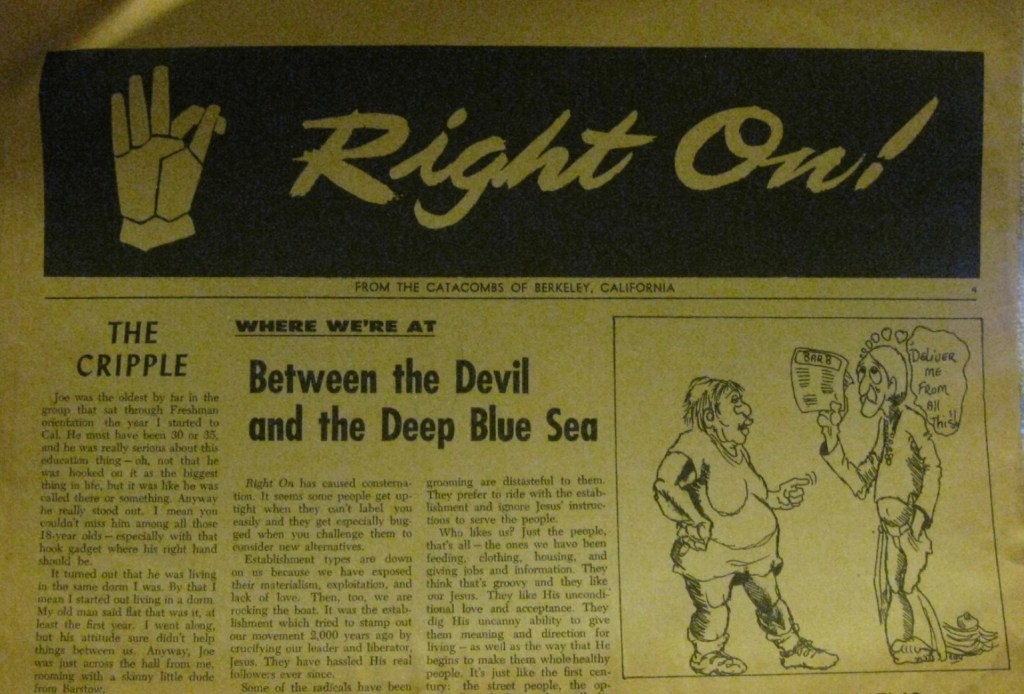
The Christian World Liberation Front (CWLF) was an evangelical Christian campus ministry at the University of California, Berkeley, active from its founding in April 1969 until its dissolution in June 1975. It emerged during the peak of the 1960s counterculture and became one of the most visible ministries associated with the wider Jesus People movement, largely due to the impact of its underground newspaper, Right On.
The CWLF’s roots trace back to the efforts of Campus Crusade for Christ (CCC). In 1967, CCC President Bill Bright devised a plan to evangelize at UC Berkeley, a university known for its radical student activism. A weeklong outreach by 600 CCC staff and students failed to make a significant impact. This disappointment led Jack Sparks, a former associate professor of statistics at Penn State, and two other CCC staff members, Pat Matrisciana and Fred Dyson, to visit Berkeley in February 1969. They concluded that in order to reach the students, they would need to adopt the counterculture’s methods, including distributing leaflets, using signs, and employing bullhorns.
Sparks and his colleagues moved to Berkeley with their families in April 1969 to launch a more direct outreach. Initially funded as a covert pilot program by the conservative CCC — who wanted to avoid alarming their donors — the ministry was designed to blend evangelical Christianity with the aesthetic and strategies of the counterculture. Matrisciana and Dyson soon left, leaving Sparks as the group’s undisputed leader. The group adopted the name Christian World Liberation Front partly in response to the Third World Liberation Front, a radical student organization established at UC Berkeley earlier that year.
The CWLF’s approach combined evangelical Christianity with the outward symbols of the New Left, such as growing long hair, wearing casual clothing, and incorporating contemporary music into their gatherings. Sparks’s teachings, which he called “Bible raps,” became a hallmark of their outreach. The group fostered a communal ethos, often passing around a hat with the invitation: “If you have something to spare, give; if you need, take.” They established several initiatives, including the “radical” free university The Crucible, a street theater troupe, and the Spiritual Counterfeits Project, a Christian anti-cult organization. They also offered free food and “crash pads” to young people recovering from drug addiction.
One of their key outreach efforts was the publication Letters to Street Christians, a street language version of the New Testament epistles. Written by Sparks and associate Paul Raudenbusch, this version featured slang and illustrations in the style of underground comic books, aiming to connect with a younger, disillusioned audience.
However, the group’s most significant tool for spreading their message was Right On (later renamed Radix Magazine), an underground newspaper distributed nationwide through a network of churches and schools. The publication covered social and political issues from a Christian perspective, often critiquing mainstream society. As the CWLF’s language became increasingly aligned with the New Left, adopting a more anti-establishment tone, it led to tensions with its parent organization, CCC. The growing radicalism of the CWLF eventually prompted the CCC to withdraw its covert funding. In response, the CWLF sought and received financial backing from Evangelical Concerns, a group of San Francisco Bay Area Baptist pastors and laymen.
The CWLF’s mix of radical activism and conservative Christian faith frequently led to confrontations with leftist groups. In 1970, CWLF members infiltrated and disrupted a regional conference of the Students for a Democratic Society (SDS), demanding to be heard. They also antagonized student protesters by reserving prime locations for rallies, such as the steps of Sproul Hall. A notable incident occurred when the CWLF refused to vacate these steps for anti-war protesters, resulting in the protesters setting fire to the university’s ROTC building. This escalated into what was described as “the worst riots the school had seen up until that time.”
Around 1973, Sparks began reaching out to former CCC colleagues who had left during the initial Berkeley outreach. These individuals would form the core of the New Covenant Apostolic Order (NCAO), a group that sought to restore the church to its historical roots, emphasizing apostolic authority.
By 1975, Sparks attempted to transform the CWLF into a church based on the principles of the NCAO, which placed a heavy emphasis on authority and discipleship. However, this shift sparked significant internal conflict, particularly over questions of authority. This division led to the dissolution of the CWLF in June 1975.
In the aftermath, the Berkeley Christian Coalition was established to continue the ministry’s work, though most of the CWLF staff did not follow Sparks. Around half of the CWLF’s members joined Sparks in forming the NCAO, which eventually became part of the Evangelical Orthodox Church.
Key Sources:
DeFazio, J. C. (2022). The Christian World Liberation Front: The Jesus Movement’s Model of Revival and Social Reform for the Postmodern Church. Wipf and Stock Publishers.
Enroth, R. M., Ericson, E. E., & Peters, C. B. (1972). The Jesus people: Old-time Religion in the Age of Aquarius.
Sparks, J., & Raudenbush, P. (1971). Letters to street Christians. Bellywater Press.
Time (1971, June 21). The alternative Jesus: Psychedelic Christ.
York, R. (1969). Jesus in Berkeley. Christian World Liberation Front.
 Encyclopedia of Cults, Sects, and New Religious Movements