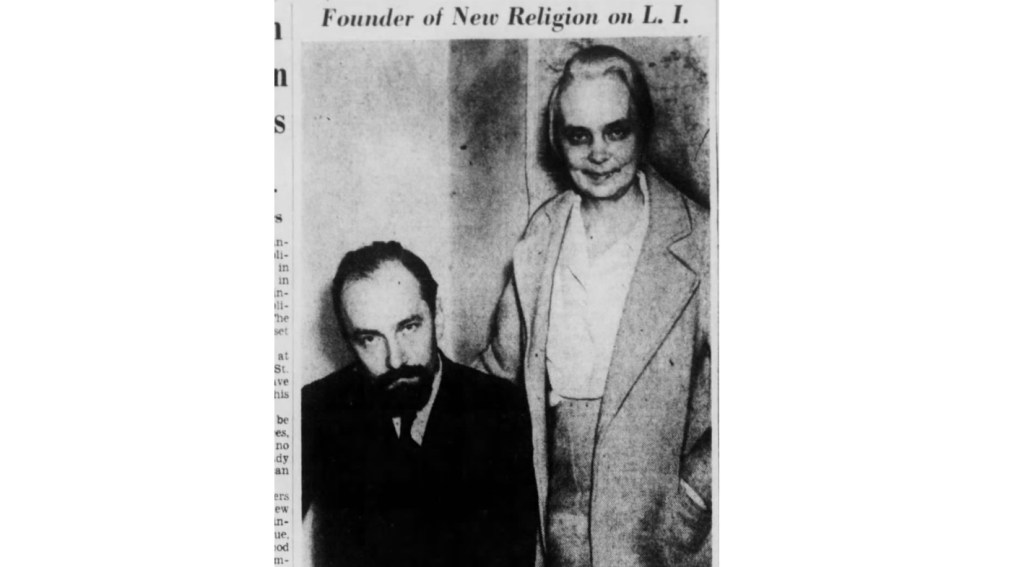
The Church of Aphrodite was a religious group founded in 1938 by Gleb Botkin, a Russian émigré who had settled in the United States. It is recognized as one of the early precursors to the later Goddess movement in North America. The church was monotheistic, centered on a single female divinity named after the ancient Greek goddess of love. Its creation reflected the culmination of Botkin’s personal philosophical and religious development, shaped by his experiences in imperial Russia and the upheavals of the Russian Revolution.
Gleb Yevgenyevich Botkin was born on July 29, 1900, in Ollila, in what was then the Grand Duchy of Finland, part of the Russian Empire. His father served as physician to the Romanov royal family. Raised in an upper-class environment and close to the imperial household, Gleb occasionally played with the children of Tsar Nicholas II. His parents divorced in 1910, and his father retained custody. His older brother Dmitry was later killed in World War I.
Accounts of Gleb’s youth describe him as articulate and artistic. While the Botkin family was exiled with the Romanovs in Tobolsk, he entertained the grand duchesses with stories and humorous caricatures. These early creative tendencies foreshadowed his later career as a writer and illustrator.
The Russian Revolution brought an end to the monarchy and upheaval to the Botkin family. In July 1918, the Bolsheviks executed the royal family in Ekaterinburg, along with their aides, including Evgeny Botkin. After his father’s death, Gleb and his sister Tatiana retreated eastward with the White forces. When the Whites were defeated, they fled Russia via Japan and arrived in San Francisco in October 1922.
The stories and illustrations Botkin had created in exile for the Romanov children were later preserved and published in 1996 as Lost Tales: Stories for the Tsar’s Children.
Before leaving Russia, Botkin had briefly considered a religious vocation. Following his father’s death, he spent a summer at a Russian Orthodox monastery in Siberia, contemplating the priesthood, but ultimately chose a secular life. He later married Nadezhda Mandrazhi-Konshina, a noblewoman and war widow. The couple emigrated to the U.S., where they had a daughter and three sons.
Settling on Long Island, New York, Botkin first worked as a photo engraver while attending art classes at the Pratt Institute. He went on to become a commercial illustrator and novelist, drawing on his aristocratic background for much of his writing.
In 1931, Botkin published The Real Romanovs, as Revealed by the Late Czar’s Physician and His Son, a biographical account of his father’s service to the royal family. His fiction also reflected his evolving religious ideas. Her Wanton Majesty was a fictionalized biography of Catherine I of Russia, while his 1933 novel Immortal Woman featured a Russian composer who fled to Long Island and worshiped a benevolent female deity. In one passage, a priest in the novel declares that “the Supreme Deity must be a woman,” anticipating the theology Botkin would later formalize.
In 1938, Botkin founded the Church of Aphrodite in West Hempstead, New York, later relocating it to Charlottesville, Virginia. He argued that patriarchal society had caused many of humanity’s problems, once remarking, “Men! Just look at the mess we’ve made!” That same year, he successfully petitioned the New York State Supreme Court for an official religious charter. The court approved, with the presiding judge reportedly commenting, “I guess it’s better than worshipping Mary Baker Eddy.”
Botkin outlined the church’s teachings in his later treatise In Search of Reality, which he self-published in the 1960s. The work began by critiquing prevailing religious beliefs and moral systems as rooted in “fantasies” of ancient peoples. He proposed a philosophy intended to help individuals “develop morally and intellectually, as well as enable us to lead happier lives.”
At the center of his theology was the concept of Love, not only as emotion but as a fundamental energy that gives rise to all existence. The source of this energy was the Deity, described as the “inexhaustible Generator of Love — its Prime Source and Ultimate Object.” Creation, according to Botkin, was “organic,” meaning that the universe was the “fruit of the Divine Organism.” He therefore reasoned that the Supreme Deity should be envisioned as a Mother Goddess, as only the feminine organism is capable of bearing fruit.
This relationship between the Goddess and creation was likened to that between a mother and her child—one of both physical and intellectual care. The Goddess, therefore, represented both the Universal Cause and Universal Mind. Humanity’s capacity for conscious love toward each other and toward the Deity formed the basis for Botkin’s belief in immortality. “The Beyond,” or Paradise, was described as a state free of evil, the opposite of Love, Beauty, and Harmony.
As the head of the Church, Botkin held services before a statue of Aphrodite, dressed in archbishop’s robes embroidered with the church’s emblem, a cross topped by a circle symbolizing the Goddess. He described his faith as predating Christianity and offering an alternative to its moral dichotomies. His views on personal relationships were unconventional; he suggested that a husband should not respond with anger to infidelity, arguing that allowing a wife “her fling” could strengthen a marriage.
In his later years, Botkin became a public supporter of Anna Anderson, who claimed to be Grand Duchess Anastasia. He devoted significant time and resources to her cause and remained loyal to her even after others withdrew. Anderson never joined his church, but she accepted his closing prayer to her: “May the Goddess bestow Her tender caress on Your Imperial Highness’s head.”
Scholars later noted that Botkin’s writings anticipated aspects of the Goddess-centered faiths that emerged in the 1960s and 1970s, particularly Dianic Wicca. The Church of Aphrodite’s theology is considered closer to Dianic Wicca than to modern Hellenic reconstructionism.
Botkin died of a heart attack on December 27, 1969, at his home in Virginia, at the age of 69. He was buried beside his wife, Nadezhda, in Monticello Memorial Park in Albemarle County. The Church of Aphrodite did not continue long after his death, though some followers later joined emerging Neopagan movements with related ideas.
Key Sources:
Botkin, G. (1967). In Search of Reality.
Clifton, C. S. (2006). Her Hidden Children: The Rise of Wicca and Paganism in America. AltaMira Press.
Galtsin, D. (2012). Gleb Botkin and the Church of Aphrodite (1938–1969). The Pomegranate: The International Journal of Pagan Studies.
 Encyclopedia of Cults, Sects, and New Religious Movements