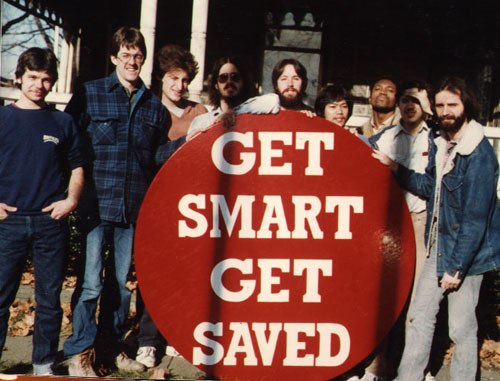
The Church of Bible Understanding, originally known as the “Forever Family,” is a Christian new religious movement founded in Allentown, Pennsylvania, in 1971 by Stewart Traill. The organization developed into a large communal network during the 1970s, reaching an estimated 10,000 members and operating about 110 communes, mainly in New York. Over time, its communal lifestyle, financial practices, and the centralized leadership of Traill became subjects of public scrutiny and controversy, and membership declined to a few hundred in later years.
Stewart Tanner Traill was born in Quebec in 1936, the second of three children of a Presbyterian minister and college professor. Raised in Allentown, Traill was remembered as independent-minded. His high school yearbook described him as a nonconformist, and a former teacher noted his “inability or unwillingness to approach his studies methodically.” As a senior, he attempted to build a cyclotron, securing donations and university advice, but the project was eventually abandoned. He left school and began repairing and selling vacuum cleaners for a living.
In 1959, Traill married Shirley Rudy, who identified as an atheist at the time. Becoming a father, he later said, led him to explore religion. After examining several faiths, he adopted Christianity but concluded that most believers misunderstood the Bible. He developed his own interpretive system, claiming that Scripture was written in a color-based code that only he could decipher. His message emphasized repentance and retribution more than grace and forgiveness. Quoting verses such as “Deny yourself, pick up your cross and follow me,” Traill began preaching on street corners in New York’s Greenwich Village.
Returning to Allentown, he attracted a small circle of teenage followers, forming the core of a group called the Forever Family. It was later incorporated as a nonprofit religious organization. In 1976, Traill renamed it the Church of Bible Understanding. That same year, he divorced his wife, Shirley, and was granted custody of their five children. Shirley Traill later said he forbade her from seeing their two youngest children and told the older ones she was destined for hell. Traill soon married his 20-year-old secretary, Gayle Gillespie, who remained with him until his death.
From the beginning, CBU revolved around Traill’s authority. Members viewed him as the only person able to interpret Scripture correctly, sometimes comparing him to figures such as Moses or Elijah. The movement promoted strict communal living and discouraged outside relationships. Members were expected to cut contact with their families and suppress physical attraction, as worldly interests were seen as incompatible with faith.
Communal life, especially in New York, involved crowded apartments and tenements shared by dozens of members. Former members described the housing as unsanitary and overcrowded. Members worked for minimal pay and were required to contribute their earnings to the church. Traill reportedly became wealthy through these operations. Ex-members recalled long days of manual labor followed by late-night Bible study and proselytizing, all framed as spiritual service. Marriage and family life were discouraged, allegedly on financial rather than spiritual grounds, as “marriages cost money.”
Traill maintained distance from most followers, communicating through intermediaries. Members would often wait hours for him to appear at “Big Meetings” held in rented theaters or roller rinks. When he arrived, he sometimes quoted 1 Corinthians 4:21 — “Shall I come to you with a rod or with gentleness?” — before publicly reprimanding members. Former participants said he demanded personal confessions and used them to shame individuals deemed unfaithful. Those who questioned him risked group criticism and social isolation. Members were taught that salvation existed only within the CBU.
In the 1970s, the group faced legal and social challenges. Reverend Bruce Ritter of Covenant House accused CBU of persuading 17 minors to leave his shelter, leading to a state injunction forbidding the group from housing or transporting anyone under 18 without parental consent. In the early 1980s, four members were convicted in Philadelphia for beating Traill’s 12-year-old son, Donald, reportedly on Traill’s orders after an accusation of shoplifting.
The Church of Bible Understanding supported itself through several business ventures. Its most visible was Christian Brothers Carpet Cleaning, a company whose practices inspired the Sunshine Carpet Cleaning cult episode of the television show “Seinfeld.” The group also operated a used-van business. Its most successful venture, however, became Olde Good Things, a chain of New York City stores specializing in architectural salvage and antiques. Tax filings for 2017 showed that Olde Good Things contributed $6.8 million to the church that year, indicating the organization’s continued financial activity despite a reduced membership.
A major internal event occurred on March 4, 1989, at a Philadelphia gathering known as the “Grace Meeting.” Traill admitted he had been wrong in harshly disciplining followers and in neglecting to teach the principle of grace. He also confessed to “straying” with at least one young female member. For many who had regarded him as spiritually infallible, this admission was decisive.
The church later extended its activities to Haiti, where it operated two orphanages. In 2013, an Associated Press investigation reported that both facilities had received failing grades from the Haitian agency responsible for child welfare oversight. The report stated that, despite CBU’s claim of spending about $2.5 million annually, the orphanages were overcrowded and unsanitary, and authorities recommended closure. On February 14, 2020, a fire at one of the homes killed 15 children — two from burns and the rest from smoke inhalation — after candles were used during a power outage caused by a failed generator.
Traill died in 2018 at a church-owned residence in Florida. Although the Church of Bible Understanding now has far fewer members than during its 1970s peak, it continues to operate in the U.S. and abroad. The organization remains noted for its distinctive communal structure, business enterprises, and the controversies surrounding its leadership and humanitarian activities.
Key Sources:
Kelly, C. J. (2003, February 9). Ex-Members tell of poverty, powerlessness. The Scranton Times-Tribune.
Kelly, C. J. (2003, February 9). On the Traill: Difficult To Peg Reclusive Lead. The Scranton Times-Tribune.
Klein, M. (2020, February 22). Haiti orphanage ravaged by deadly fire linked to “cult” known for NYC antique stores. The New York Post.
 Encyclopedia of Cults, Sects, and New Religious Movements