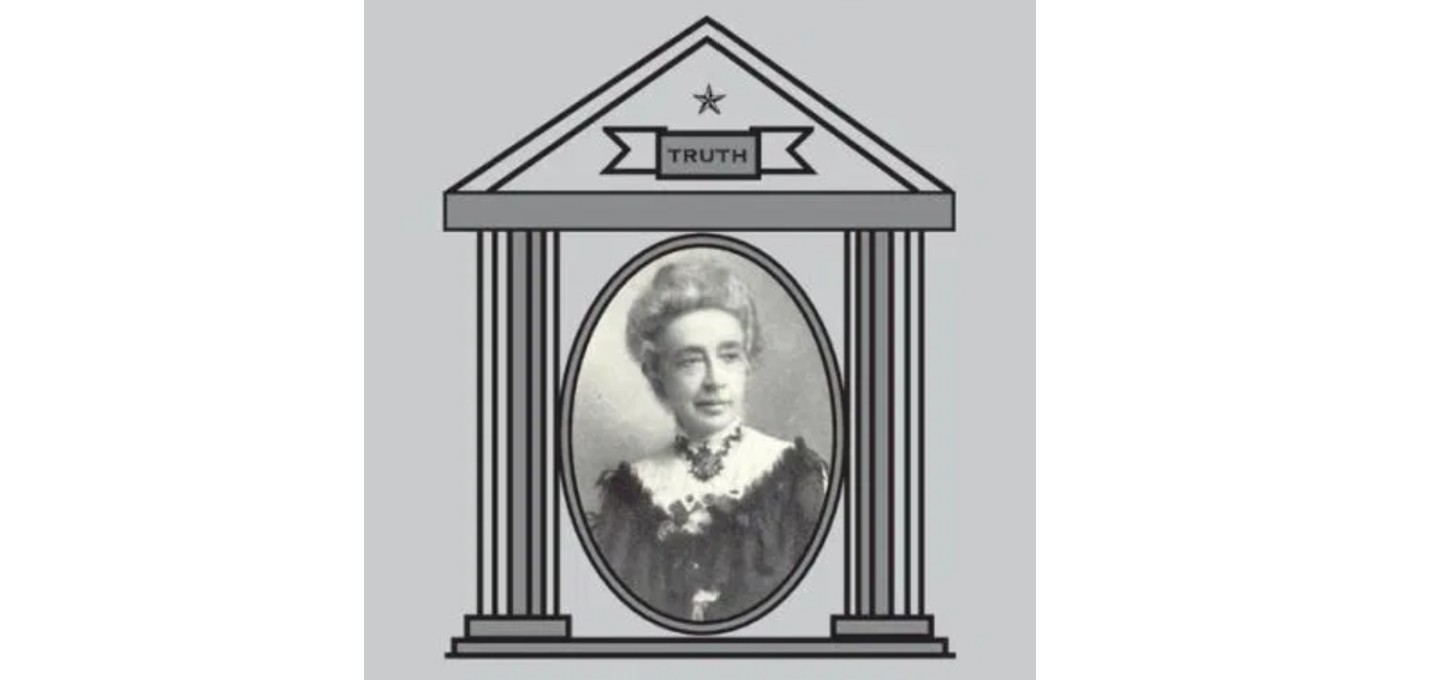
The Church of Divine Science was established in San Francisco in 1888 by Malinda Elliott Cramer as part of the New Thought movement that was emerging at the time. It describes itself as “an organized teaching pertaining to God and the manifestation of God in Creation,” based on the principle that “limitless Being, God, is Good, equally present everywhere, and the All of everything.”
Cramer was born in Greensboro, Indiana, on June 12, 1844, to Obediah and Mary Hinshaw Elliott. Seeking improvement in her health, she moved to San Francisco in 1872 and married photographer Charles Lake Cramer later that year. Her health difficulties persisted until 1885, when, following what she called an “hour of earnest meditation and prayerful seeking,” she experienced a spiritual revelation, “a realization of the oneness of Life.” She reported being healed of her ailments within two years. This experience led her to begin a faith healing practice in 1887.
In March 1888, Malinda and Charles Cramer formally organized their work by chartering the “Home College of Spiritual Science,” which was renamed two months later as the “Home College of Divine Science.” The phrase “Divine Science” was already in circulation, used by others such as Mary Baker Eddy, founder of Christian Science, and Wilberforce Juvenal Colville, who published a book of the same title that year. In August 1888, Cramer launched “Harmony,” a monthly journal featuring articles on “Truth, Science of Spirit, Theosophy, Metaphysics and the Christ Method of Healing.”
Cramer’s work attracted collaborators who helped formalize the movement. The church recognizes both Malinda Cramer and Nona L. Brooks as its founders, with early contributions from Fannie Brooks James, Alethea Brooks Small, and Kate Bingham. The teachings drew from the ideas of Phineas Quimby and Emma Curtis Hopkins, a major New Thought leader.
The Brooks sisters — Nona, Fannie, and Alethea — encountered the teachings of Divine Science in Pueblo, Colorado, likely through Bingham, who had learned about Christian Science in Chicago during the 1870s and shared those ideas with the Brooks sisters in regular meetings. Together they began adapting the philosophy into what became Divine Science, emphasizing a practical application of spiritual principles and allowing for the consultation of medical professionals alongside prayer and positive thought, distinguishing it from Christian Science.
Cramer continued to expand the organization throughout the 1890s. In 1892, she founded the International Divine Science Association, which later became a forerunner of the International New Thought Alliance. A year later, she helped establish a second Divine Science College in Oakland and began national missionary trips to promote the movement. Between 1893 and 1898, she trained Nona L. Brooks, ordaining her as a minister in December 1898. Brooks returned to Denver with her sisters to form a congregation that would become the home church of the denomination.
The 1906 San Francisco earthquake disrupted the movement’s early development. Cramer’s health declined following the disaster, and she died on August 2, 1906, from a recurrence of tuberculosis. After her death, the church’s headquarters moved from San Francisco to Denver and later to Pueblo, Colorado. By 1918, Divine Science congregations had been established in several U.S. cities, including Boston, Denver, Los Angeles, New York, and Portland. By 1925, additional churches had opened in Cleveland, San Diego, and Washington.
Membership records indicate 7,000 members in 1935 and 7,107 in 1953, with later figures unavailable. One of the church’s most recognized ministers was Emmet Fox, who led the First Church of Divine Science in New York City. During the Great Depression, his weekly services drew the largest church audiences in the country, with 5,500 attendees at the New York Hippodrome until 1938, and later at Carnegie Hall.
In the modern era, Divine Science has adapted its outreach through online ministries and email-based programs. Examples include “Symphony of Love” in Santa Fe, which operates internationally, and a web-based ministry in New York State that focuses on Emmet Fox’s legacy. Today, the Divine Science Federation serves as the denomination’s headquarters and is a member organization of the International New Thought Alliance.
Key Sources:
Hanegraaff, W. J. (1996). New age religión and Western culture: Esotericism in the Mirror of Secular Thought. Brill.
Miller, T. (1995). America’s Alternative Religions. SUNY Press.
Sword, L. (2011, October 29). Church of Divine Science has roots in Pueblo. Pueblo Chieftain.