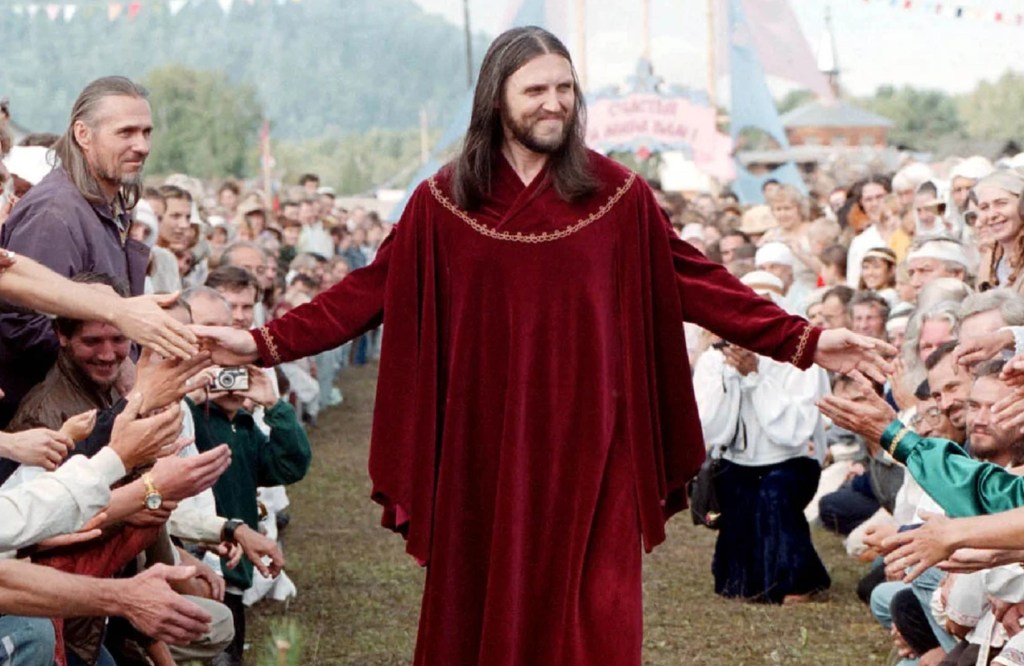
Sergei Anatolyevitch Torop was born on January 14, 1961, in Krasnodar, Russia. His family moved to Minusinsk in 1968. After completing his schooling, he served his compulsory military service in the Red Army, becoming a sergeant on construction sites in Mongolia. When he returned to Siberia, he worked as a factory metal worker and later as a patrol officer in Minusinsk, a job he lost in 1989. During this period, he developed an interest in religion and esotericism, including Agni Yoga, an offshoot of Theosophy founded by Russians Nicholas and Helena Roerich.
In May 1990, at age 29, Torop stated that he had undergone a “spiritual awakening.” He announced that his memory had been “opened” and that he now remembered being the Son of God. He adopted the name “Vissarion,” meaning “He who gives new life” or “life-giving.” He taught that he was the word of God rather than God himself and said that he had been baptized by God the Father on January 14, 1991.
Vissarion gave his first public sermon on August 18, 1991, near Minusinsk. The event coincided with the failed coup against Mikhail Gorbachev’s government and is commemorated within the movement as “Announcement Day.” This date marks the founding of what became the Church of the Last Testament, also known as the Community of Unified Faith. The movement established its center in the Siberian Taiga in the Minusinsk Basin east of Abakan, in a group of settlements including the community formally called Abode of Dawn and informally known as the Sun City.
Vissarion’s teachings combine elements of Christianity, the Russian Orthodox tradition, Buddhism, apocalypticism, collectivism, and ecological ideas. He teaches reincarnation, emphasizes harmonious interpersonal relations, and describes an imminent end of the world in which only his followers will be saved. The stated aim of the movement is to unite all religions on Earth.
The movement’s doctrines and revelations were compiled into a multi-volume work titled The Last Testament, presented as a supplement to the Bible with a focus on self-improvement, community life, and self-governance. Since 1992, Vissarion’s activities have been recorded in annual volumes by his biographer Vadim Redkin, contributing to international interest, including from members of Germany’s esoteric subculture.
Followers of the Church of the Last Testament, often called Vissarionites, follow a set of regulations centered on natural and communal living. A vegetarian or vegan diet is required, and the community prohibits animal protein, vegetable oil, sugar, and leavened bread. Members also abstain from smoking, alcohol, swearing, and the use of money, relying instead on a barter system. Followers are encouraged to sell their property and contribute proceeds to a common fund.
Vissarion replaced traditional Christian holidays with observances focused on his own life and teachings. His birthday on January 14 is celebrated as a feast day, and August 18 marks the anniversary of his first sermon. The community uses a calendar counted from Vissarion’s birth in 1961. He has claimed the ability to heal diseases such as cancer and AIDS by touch. The movement discourages followers from seeking conventional medical treatment, a stance linked to several deaths, including infants. Reports also state that Vissarion traveled abroad for his own medical care.
The settlement of Tiberkul was founded in 1994 and expanded to include neighboring villages such as Petropavlovka and Cheremshanka. The community emphasizes ecological sustainability, constructing hand-built wooden houses and using renewable energy sources such as windmills and solar panels. The central settlement is arranged in three levels: the Town (Abode of Dawn), the Heavenly Abode, and the Temple Peak, where Vissarion resides. Approximately 4,000 people live in the Siberian settlements, and the group claims more than 10,000 followers worldwide, with some estimates suggesting up to 50,000.
Observers and former members have raised concerns about the movement’s internal structure and practices. Reported issues include psychological pressure, restrictions on personal autonomy, and a hierarchical system described as placing men above women, who are expected to “serve men, just as men serve God.” Critics have also pointed to Vissarion’s personal life, including allegations that he promoted polygamy and married a 19-year-old who had lived with him since childhood. He has six children from two marriages. The community has faced scrutiny following incidents including the deaths of two infants from negligence in 2018 and the death of a child who froze after going into the taiga alone.
For nearly three decades, the Church of the Last Testament functioned largely outside public attention. Over time, however, the movement came under increasing scrutiny from the Russian government, the Russian Orthodox Church, and anti-cult organizations. In September 2020, Vissarion and two aides were arrested during a federal operation involving helicopters from Russia’s security services. They were accused of creating a religious organization whose activities could cause harm to citizens, including potential physical injury, and of extortion.
Some commentators viewed the arrests as part of a broader effort by the Russian government to regulate or suppress non-traditional religious movements, similar to measures taken against Jehovah’s Witnesses. Vissarion and his associates were held for years in a Novosibirsk prison without a formal indictment or trial date, prompting speculation about government motives, including possible interest in the commune’s land and natural resources.
On June 30, 2025, a court in Novosibirsk sentenced Vissarion to 12 years in a strict penal colony. His associates received similar sentences. The charges were consistent with those commonly applied to groups labeled as “cults” under Russian law. Despite Vissarion’s imprisonment, the Church of the Last Testament continues to function in Siberia and abroad. Followers participate in a nightly ritual during which they direct their thoughts toward Vissarion in prison, believing that he communicates with them in return.
Key Sources:
Aris, B. (2002, August 18). “I am Jesus Christ. . . It was prophesied that I would return to finish what I started.” News Telegraph.
Croft, A. (2025, July 6). Jesus of Siberia: The traffic cop who became a cult leader — and will now spend 12 years in jail. The Independent.
Hopkins, V. (2021, October 24). Long Arm of Russian Law Reaches Obscure Siberian Church. The New York Times.
Introvigne, M. (2025, July 3). Russia, Church of the Last Testament: Vissarion sentenced to twelve years. Bitter Winter.
News18. (2020, September 24). Who is “Jesus of Siberia”, the Cult Leader Arrested for Extortion and Emotional Abuse in Russia?
 Encyclopedia of Cults, Sects, and New Religious Movements