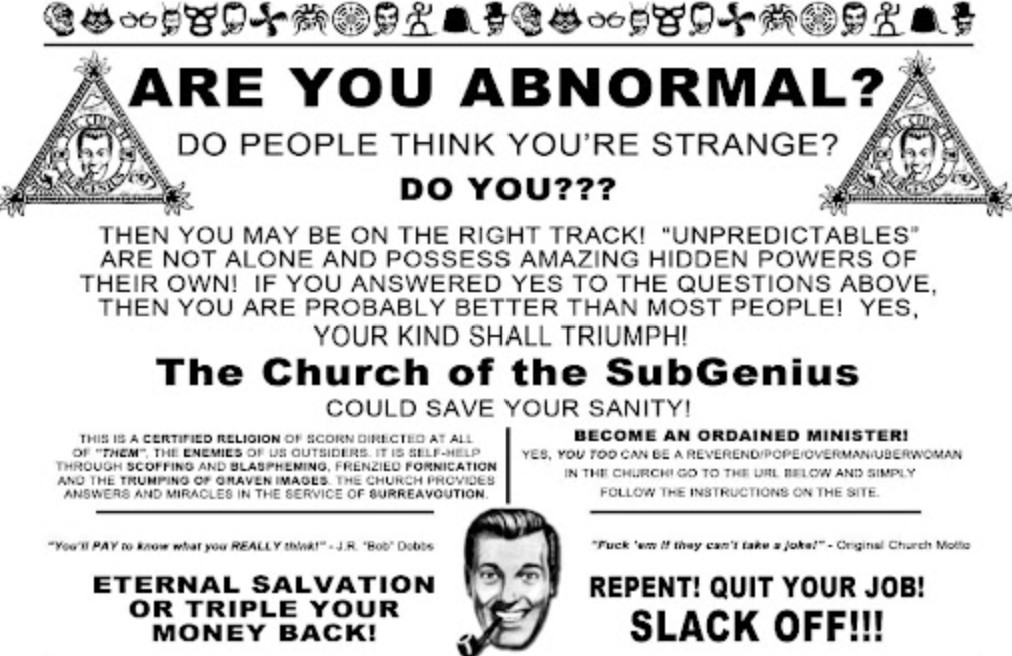
The Church of the SubGenius originated in the late 1970s as a parody religion critiquing belief systems including Christianity, New Age spirituality, and commercialism. The organization officially formed as the SubGenius Foundation and was co-founded by Ivan Stang (Douglas St. Clair Smith) and Philo Drummond (Steve Wilcox). Stang serves as a leader and publicist and has described himself as the “sacred scribe” of the Church’s central figure. The movement developed a complex philosophy that incorporates pop culture and ancient myth in an elaborate and often contradictory narrative.
The first documented activity of the group occurred in Dallas, Texas, in 1979 with the distribution of Sub Genius Pamphlet #1. This photocopied text warned of an imminent world-ending event and criticized established spiritual systems.
Central to the group’s mythology is J. R. “Bob” Dobbs, described as a prophetic figure and mid-century salesman. Commentators generally view accounts of Dobbs’s life as fictional, but Church leaders claim he founded the movement in 1953 and contacted Drummond telepathically in 1972. They state that Stang joined after meeting Drummond in 1973.
The Church teaches that Dobbs was contacted by an extraterrestrial entity named Jehovah 1 in the 1950s. This contact, said to occur while Dobbs was building or watching television, granted him supernatural knowledge and abilities. Jehovah 1 is characterized as a “rebel god” aligned with Eris, and both are included in a group of Elder Gods led by Yog-Sothoth — adopted from H. P. Lovecraft’s Cthulhu Mythos — who are depicted as committed to human pain. The use of Lovecraft’s lore reflects how some groups treat fictional worlds as religiously significant.
Dobbs is the main symbol of the Church, most commonly represented by an iconic pipe-smoking portrait based on Yellow Pages clip art. His name is stylized with quotation marks, and he is referred to as a “World Avatar” who is repeatedly reborn. Church lore often references 1950s American culture, with scholars arguing that these elements parody the era’s idealized social norms.
Multiple narrative versions describe Dobbs’s role. In one, he refuses Jehovah 1’s proposal to lead a conspiracy aimed at controlling humanity, instead infiltrating the group to resist it. In another, initially known as Bobby, he is not highly intelligent but extremely fortunate, later marrying Constance “Connie” Marsh Dobbs. The pair function as gender archetypes comparable to Shiva and Parvati in Hinduism. His work is variously described as involving drilling equipment or fluoride sales. Leaders state he can manipulate time, resulting in changing doctrines under what is called the “Sacred Doctrine of Erasability,” which discourages permanent plans.
A central SubGenius concept is “Slack,” a term always capitalized and embodied by Dobbs. It is undefined but associated with freedom from work and responsibility, which members believe is their right. Sexual activity and avoiding traditional employment are encouraged as ways to achieve Slack. The concept has been compared to Taoist notions of an ineffable natural state and described as a system for achieving goals with minimal effort.
The Church also teaches that a grand conspiracy controls humanity through UFO surveillance and conditioning, labeling most people as “pinks” who are unaware of their manipulation. SubGenius members are taught they descend from Yetis, giving them insight unavailable to others.
These ideas are summarized in five core commands: avoid regular employment (“SLACK OFF”); purchase Church merchandise (the Church openly identifies as for-profit, satirizing prosperity theology); oppose “law and order” through acts such as computer hacking; support the elimination of those not descended from Yetis (with drug abuse and abortion cited as methods of culling); and use conspiracy rhetoric to influence others.
SubGenius followers, called “clenches,” gather for events known as “devivals,” a play on the term revival. These include sermons, music, and performance art, often held in bars, and have been compared to Temporary Autonomous Zones that temporarily suspend conventional social norms. The Church’s style has attracted college students, artists, and notable supporters including Mark Mothersbaugh, Paul Reubens, David Byrne, and R. Crumb.
The SubGenius Foundation moved from Dallas to Cleveland, Ohio, in 1999, then to Glen Rose, Texas, in 2017. Stang once claimed that the Church had 40,000 members and an estimated 10,000 ministers, though actual membership figures are unknown. Becoming a minister requires only a small fee.
One major prophecy in early SubGenius literature was tied to July 5, 1998, referred to as “X-Day.” Church texts stated that aliens known as Xists would arrive on Planet X, and faithful members would board spaceships and reunite with goddesses. When the event did not take place, leaders stated that the date must have been misread — possibly backward as 1966 — parodying how religious groups handle failed predictions. Members continue to celebrate X-Day each July 5.
Key Sources:
Chidester, D. (2005). Authentic fakes: Religion and American Popular Culture. University of California Press.
Cusack, C. M. (2010). Invented religions: Imagination, Fiction and Faith. Ashgate Publishing.
Solomon, D. (2 November 2017). The Church of the SubGenius Finally Plays It Straight. Texas Monthly.
Stang, I. (1987). Book of the Subgenius. Gallery Books.
Stang, I. (1994). Revelation X: The “Bob” Apocryphon. Touchstone.
 Encyclopedia of Cults, Sects, and New Religious Movements