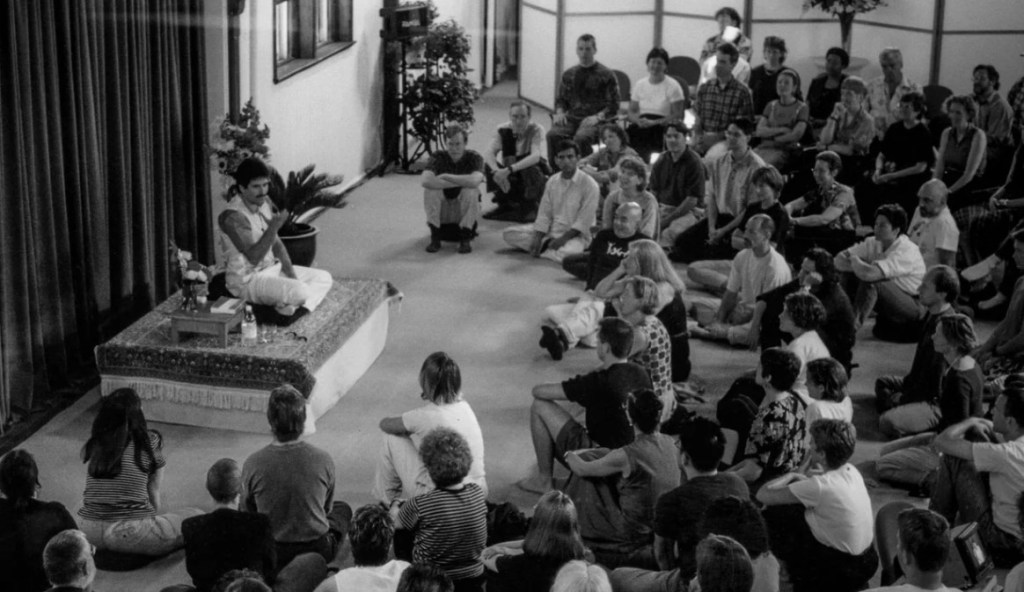
Over nearly four decades, Andrew Cohen developed a system of teaching that he called “Evolutionary Enlightenment.” His career traced a progression from teachings influenced by Eastern mysticism toward a Western-oriented philosophy centered on cosmic evolution. In later years, his work became closely associated with allegations of psychological, physical, and financial abuse within his teaching community.
Cohen was born in New York City into an upper-middle-class, secular Jewish family. At age 16, he reported a spontaneous experience he described as “cosmic consciousness,” which marked the beginning of his spiritual interests. After spending several years pursuing a career as a jazz musician, he used a substantial inheritance to support a full-time spiritual search.
In 1986, Cohen traveled to India, where he met H. W. L. Poonja, a disciple of Advaita Vedanta teacher Ramana Maharshi. After a brief period of interaction, Cohen claimed to have attained a permanent state of enlightenment. He initially stated that Poonja had recognized him as a spiritual successor, a claim that became a key source of authority for his early teaching career.
Upon returning to the U.S., Cohen established the Moksha Foundation and the Impersonal Enlightenment Fellowship. His early teachings emphasized that liberation is not achieved through effort but recognized as an already-existing condition. During this period, he attracted a committed group of students interested in accelerated spiritual realization.
Cohen’s relationship with Poonja deteriorated as Cohen began imposing stricter ethical expectations and disciplinary practices on his students than he perceived in his teacher. Poonja later publicly distanced himself from Cohen, stating that Cohen had misunderstood their interactions and lacked the maturity required to guide others.
In the early 1990s, Cohen’s philosophy shifted away from what he described as a static understanding of enlightenment toward a model he termed “Evolutionary Enlightenment.” He argued that spiritual practice should serve not only personal liberation but the conscious advancement of evolution itself. Within this framework, the “Authentic Self” was identified with an evolutionary impulse underlying the emergence of the universe and life. Cohen maintained that alignment with this impulse required the complete transcendence of the ego, defined as the need for separation and superiority.
This shift coincided with the founding of “What Is Enlightenment?” magazine in 1991. The magazine was later renamed “EnlightenNext,” which also became the name of Cohen’s most prominent organization. EnlightenNext established centers in Massachusetts, London, Amsterdam, Frankfurt, and Tel Aviv.
As the organization grew, the internal culture of the EnlightenNext community became increasingly structured. Many students lived in communal centers where daily life was closely regulated. Cohen employed a teaching style he described as “crazy wisdom,” which he argued was intended to disrupt ego-based patterns. Practices included public confrontations, verbal criticism, and, according to later accounts, occasional physical force. Men and women were often segregated, and some members were encouraged to adopt celibacy or make substantial financial contributions as part of their spiritual commitment.
The first major public critique of Cohen emerged from within his family. In 1998, his mother Luna Tarlo published Mother of God, a memoir describing her experiences as a student and her perception of her son’s increasing authoritarianism. She reported being discouraged from expressing independent views and described significant changes in his behavior and leadership style.
Further criticism followed in 2003 with the publication of Enlightenment Blues by André van der Braak, a former long-term student. The book documented the psychological effects of the organization’s practices and described financial pressures placed on members to support Cohen’s projects and lifestyle.
In 2004, EnlightenNext sought to formalize its educational offerings through a partnership with the Graduate Institute in Connecticut, which offered a master’s program in Conscious Evolution. Around the same time, Cohen pursued his musical interests through the jazz-funk-fusion band Unfulfilled Desires. He served as the group’s drummer, and the band released four albums between 2002 and 2010. Former students later alleged that the band relied heavily on the labor and financial support of community members.
By the late 2000s, the organization faced increasing challenges. The rise of digital spiritual content, combined with significant organizational debt, led to the closure of EnlightenNext magazine in 2011. At the same time, former students increasingly shared critical accounts online. In 2009, William Yenner and other contributors published American Guru, which documented patterns of financial control and psychological pressure within the movement. The book included a foreword by Buddhist scholar Stephen Batchelor, who criticized the absence of accountability in Cohen’s leadership.
The movement’s collapse occurred in 2013, when senior students and board members confronted Cohen about his conduct and the disparity between his teachings and personal behavior. In response, Cohen announced on his blog that he would take an extended sabbatical. He acknowledged that, despite his spiritual experiences, his ego remained active and that his actions had caused harm. Shortly afterward, EnlightenNext formally dissolved, and its primary assets, including its Massachusetts headquarters, were sold.
In May 2015, Cohen issued a public apology to former students after two years of silence. He wrote about the need to balance the spiritual drive of “eros” with the compassionate principle of “agape,” acknowledging that his previous approach had caused pain. The response among former members was mixed. In 2016, when Cohen announced plans to resume teaching, more than 240 former students signed a petition titled “Stop Andrew Cohen teaching again,” arguing that his past conduct disqualified him from a leadership role.
Despite these objections, Cohen launched a new online platform in 2020 called Manifest Nirvana. The initiative was presented as a digital community focused on preserving the core elements of Evolutionary Enlightenment while avoiding the centralized structures of earlier organizations. He continued to offer retreats and online meditations, though on a smaller scale than before.
Cohen spent much of his final years in India. He died in Tiruvannamalai on March 25, 2025, at the age of 69.
Key Sources:
Cohen, A. (2011). Evolutionary enlightenment: A New Path to Spiritual Awakening. SelectBooks.
Sand, M. (2015). Paradise and Promises: Chronicles of My Life with a Self-Declared, Modern-Day Buddha. O-Books.
Sobel, E. (2024, September 26). What happens when your guru disappears? The Daily Beast.
Tarlo, L. (2009). The Mother of God.
Van Der Braak, A. (2003). Enlightenment Blues: My Years with an American Guru. Monkfish Book Publishing.
Wheal, J. (2022, May 17). From Spiritual Guru to the Death of a Cult: Andrew Cohen’s Untold Story. Qualia.
Williamson, C. (2001, December 21). The Buddha of Belsize Park. The Evening Standard.
 Encyclopedia of Cults, Sects, and New Religious Movements