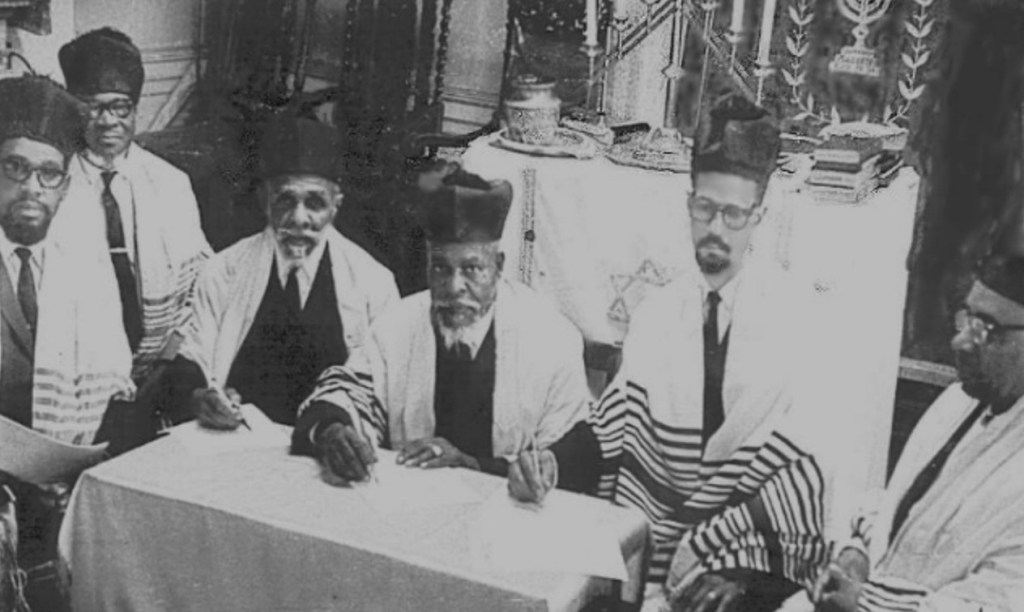
The Commandment Keepers Ethiopian Hebrew Congregation of the Living God Pillar & Ground of Truth, Inc. is a Black Hebrew religious organization founded in Harlem in 1919. The congregation teaches that people of Ethiopian descent are among the lost tribes of Israel and identifies King Solomon and the Queen of Sheba as ancestral figures. It also maintains that the biblical patriarchs were black.
The congregation was founded by Rabbi Wentworth Arthur Matthew, an Afro-Caribbean immigrant who began preaching on the streets of Harlem at the age of 27. The group initially functioned as a Christian church, but over time Matthew deemphasized the role of Jesus Christ and introduced Orthodox Jewish practices. This doctrinal transition led to the formal renaming of the congregation to reflect its Hebrew identity. Although some Black Hebrew groups adopted anti-Semitic rhetoric, the Anti-Defamation League noted that Matthew promoted respectful relations with white Jews and rejected racist teachings.
During its peak years, the Commandment Keepers served as a center for both religious worship and education. Matthew established a school in which children were taught Hebrew and Jewish history. The congregation used traditional Jewish religious materials, including parchment Torah scrolls, the Hertz Chumash, and the De Sola Pool Spanish and Portuguese prayerbook. Religious services followed an Orthodox Sephardi liturgical style for the Sabbath and holy days.
In 1962, the congregation purchased a neo-Renaissance mansion at 1 West 123rd Street that was formerly the residence of industrialist John Dwight. The building became a permanent home for the synagogue and a visible symbol of the congregation’s institutional growth.
Over time, the Commandment Keepers emerged as a central institution within the Israelite community in New York. The synagogue functioned as a coordinating hub for auxiliary organizations and influenced the development of other Black synagogues in the Bronx, Brooklyn, Queens, and Chicago.
Leadership instability followed the death of Rabbi Matthew in 1973. Shortly before his passing, he ordained his grandson, David Matthew Doré, and designated him as his spiritual successor. In 1975, however, the congregation’s board elected Willie White as leader, triggering a dispute that divided the community into rival factions led by Doré and White. Throughout the 1980s, tensions escalated, and Doré was eventually barred from access to the 123rd Street synagogue.
By the 1990s and early 2000s, the congregation experienced a significant decline in active membership. Although several hundred individuals remained affiliated with the community, regular attendance at the main synagogue reportedly fell to fewer than 10 people. The prolonged leadership conflict resulted in legal disputes, physical confrontations, and repeated police involvement. In 2004, Zechariah ben Lewi was appointed as rabbi in an effort to restore stability, but the underlying divisions remained unresolved.
In April 2007, the faction aligned with the board sold the John Dwight mansion for a reported $1.6 million. The sale took place without a memorial service and without the awareness of many congregants. David Matthew Doré, acting as attorney for the original corporate entity, filed a lawsuit challenging the transaction, arguing that the board lacked authority to sell the property. In October 2007, a court vacated the sale and ordered a trial, a ruling later upheld by an appellate court in 2013. Despite the ongoing litigation, the building was ultimately acquired in 2010 by poet James Fenton and his partner.
By 2014, the original congregation at 1 West 123rd Street had largely ceased active operations. Nevertheless, the Commandment Keepers’ religious legacy persisted through affiliated synagogues in New York and Chicago.
Key Sources:
Ben Levy, S. (2007). Destruction of the Commandment Keepers. BlackJews.org.
Harlem World. (2012, July 8). Commandment Keepers in Harlem.
Herschthal, E. (2007, July 6). Decline of a Black Synagogue. The Jewish Week.
Wiener, R. (2015, October 14). Tragedy at African-American synagogue. New Jersey Jewish News.
 Encyclopedia of Cults, Sects, and New Religious Movements