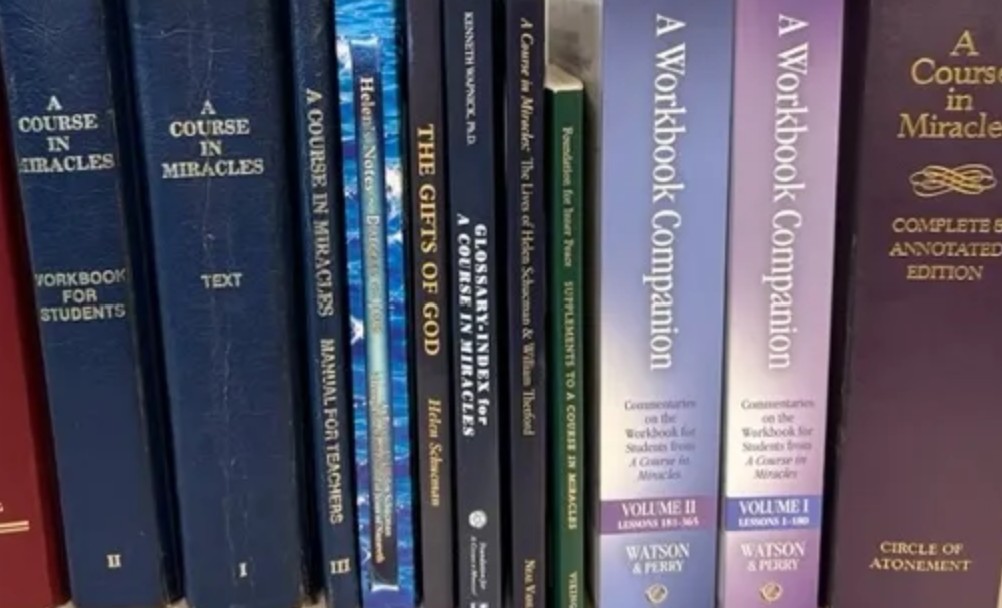
A Course in Miracles (ACIM) is a spiritual self-study program rooted in a book by the same name. It combines Christian terminology with psychological and Vedantic concepts, presenting a system focused on forgiveness as a means of releasing guilt. The text teaches that the physical world is an illusion produced by the ego and that ultimate reality consists only of love.
Since its publication, A Course in Miracles has become widely associated with the New Age movement. It has sold millions of copies and led to the formation of study groups, teaching organizations, and foundations across multiple countries.
The origins of ACIM are closely tied to the life of Helen Schucman. She was born Helen Dora Cohn in 1909 in Manhattan to non-observant Jewish parents. Her early exposure to religion was varied, shaped by her mother’s interest in Theosophy and Christian Science and by the family’s Baptist housekeeper, who influenced her spiritual outlook.
At age 12, Schucman visited Lourdes and was later baptized as a Baptist. Despite these experiences, she identified as an atheist for much of her adult life. She pursued a career in psychology and earned a Ph.D. from New York University in 1957.
In 1958, Schucman joined Columbia University’s College of Physicians and Surgeons as a research associate. There, she worked under William Thetford. Their professional relationship was marked by frequent tension and interpersonal conflict during the early years.
In 1965, during a particularly difficult meeting, Thetford remarked that “there must be another way” for them to work together. Schucman later described this moment as the beginning of a series of internal experiences, including vivid dreams and visions.
On October 21, 1965, Schucman reported hearing an inner voice that identified itself as Jesus Christ. According to her account, the voice instructed her, “This is a course in miracles. Please take notes.” For the next seven years, Schucman engaged in what she described as a process of inner dictation. She stated that she remained fully conscious while recording the material in shorthand notebooks. Each day, she read her notes aloud to Thetford, who typed them.
The process was collaborative in practice. While Schucman served as the scribe, Thetford provided organizational support and encouragement. Although Schucman believed the voice was Jesus, she experienced anxiety about the material and found it difficult to apply its teachings in her personal life.
The completed manuscript was organized into three parts: a Text outlining the theoretical framework, a Workbook for Students consisting of 365 daily lessons, and a Manual for Teachers. Initially, the material circulated privately among colleagues and friends through photocopies. In 1972, Schucman and Thetford met psychologist Kenneth Wapnick, who later assisted with editing the text. Concerned about their professional standing as academic psychologists, both Schucman and Thetford chose to remain anonymous. The Foundation for Inner Peace published the first hardcover edition of A Course in Miracles in 1976.
During the late 1970s and 1980s, the book gradually gained a larger audience. Gerald Jampolsky became a prominent advocate, publishing Love Is Letting Go of Fear, which was based on ACIM principles. After Jampolsky appeared on Johnny Carson’s “Tonight Show,” the book sold millions of copies.
The text reached an even broader audience in 1992 when spiritual writer and lecturer Marianne Williamson discussed it on “The Oprah Winfrey Show.” Williamson’s book A Return to Love drew heavily from ACIM and helped drive a substantial increase in sales, establishing the course as a widely recognized spiritual work.
As interest grew, the organization of ACIM teaching became more formal. In 1983, Kenneth Wapnick and his wife, Gloria, founded the Foundation for A Course in Miracles (FACIM). While the Foundation for Inner Peace remained the publisher, FACIM focused on teaching, interpretation, and scholarly analysis.
Additional organizations emerged, including the Miracle Distribution Center and the Circle of Atonement. These groups supported study networks, educational materials, and counseling services for students around the world.
Despite its popularity, ACIM has been the subject of theological criticism. From a traditional Christian perspective, critics argue that the text diverges from biblical teachings, despite its use of Christian language. Terms such as “atonement” and “salvation” are redefined within the course.
The text states that the world was not created by God but is an illusion of the ego. It also presents Jesus not as the sole savior but as an “elder brother” who completed the process of atonement first. These positions have led some religious scholars and leaders to describe the work as neo-Gnostic or incompatible with Christian doctrine.
Legal disputes over copyright emerged in the late 1990s. The Foundation for Inner Peace and FACIM sought to protect the text, but in 2004, a U.S. court revoked the copyright and trademarks. The ruling was based on evidence that early versions had circulated without proper copyright notices before 1976.
During the case, the court determined that Schucman was the legal author of the work, regardless of her claim of divine dictation. For some students, this ruling raised concerns about the text’s spiritual authority.
The broader political and psychological context of the course’s creation has also been examined. Critics have pointed to William Thetford’s prior involvement as a consultant in the CIA’s MKUltra program, which focused on behavioral research during the Cold War. Some commentators have speculated that inward-focused spirituality diverted attention from political engagement. Supporters of ACIM counter that its emphasis on inner peace and mental correction reflects legitimate psychological principles rather than political intent.
Schucman retired from Columbia University in 1976. She lived privately until her death from pancreatic cancer on February 9, 1981. Her role as the scribe of A Course in Miracles was publicly disclosed only after her death.
Key Sources:
Coburn, L. (2011). Breaking Free: How Forgiveness and a Course in Miracles Can Set You Free.
Foundation for Inner Peace. (1976). A Course in Miracles.
Miller, D. P. (2011). Understanding a course in miracles: The History, Message, and Legacy of a Spiritual Path for Today. Celestial Arts.
Phillips, B. (2024, November 21. Is “A Course in Miracles” a Cult Or a Spiritual Path? Medium.
Remski, M. (2021, April 17). Why A Course in Miracles Is Not Good For You, or Those You Love: An Open Letter from a Former Student. Medium.
 Encyclopedia of Cults, Sects, and New Religious Movements