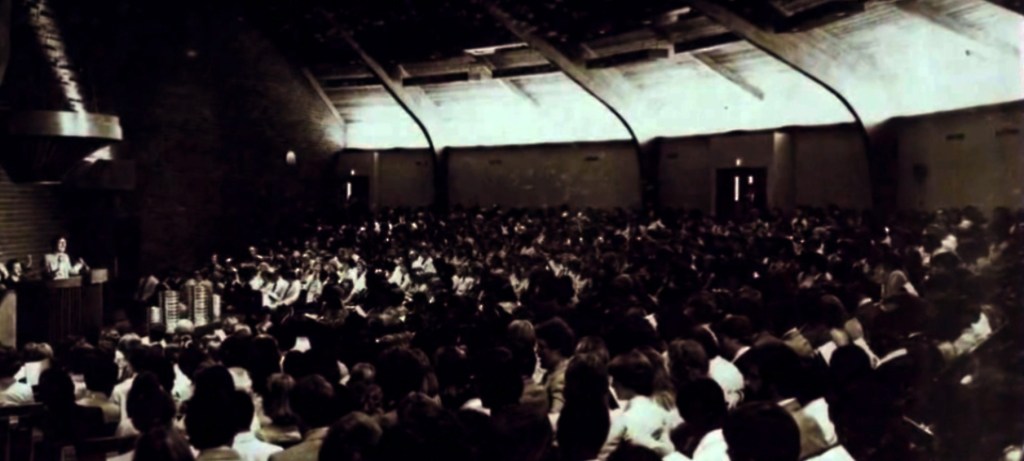
The Crossroads Movement, later known as the International Churches of Christ (ICOC), emerged in 1967. Its origins lie in the 14th Street Church of Christ in Gainesville, Florida, which later adopted the name Crossroads Church of Christ. Under the leadership of minister Chuck Lucas, the congregation launched an evangelical outreach initiative known as “Campus Advance,” focused on students at the University of Florida.
Campus Advance introduced practices that became central to the movement. These included “soul talks,” small group Bible studies held in student residences, and the assignment of new converts to experienced “prayer partners.” This system, referred to as “discipling” or “shepherding,” required junior members to closely follow the guidance of their mentors.
By 1971, the Crossroads Church was adding roughly one hundred new members per year and had established a training program for campus ministers. One of the early converts was Kip McKean, who was baptized by Lucas and trained within the Crossroads system. McKean later served as a campus minister in several locations, where his ministries experienced rapid growth.
In 1977, leaders at the Memorial Drive Church of Christ in Houston withdrew their support for McKean. They accused him of promoting controlling practices and what they described as “deceitful” teachings. This break marked an early point of internal conflict within the broader Churches of Christ community.
In 1979, McKean took leadership of a small congregation in Lexington, Massachusetts, which became the Boston Church of Christ. He required what he termed “total commitment” from members. Over the next decade, the congregation grew from approximately 30 members to about 3,000. This phase became known as the “Boston Movement.”
By 1982, Boston had replaced Gainesville as the center of the movement. The group pursued an ambitious goal of evangelizing the world within a single generation. During this period, it began “reconstructing” other congregations by installing leaders trained in Boston to align them with centralized standards and practices.
As the movement expanded, it attracted increasing criticism from mainstream Churches of Christ and from anti-cult organizations. That same year, Chuck Lucas was dismissed from the Crossroads Church of Christ following allegations of sexual impropriety. By 1988, the Crossroads congregation formally disassociated itself from the Boston Movement.
In 1989, McKean moved the movement’s headquarters to Los Angeles. By 1993, the group formally separated from the mainstream Churches of Christ and adopted the name International Churches of Christ. Throughout the 1990s, the ICOC expanded rapidly, establishing congregations in more than 100 countries. This growth was accompanied by reports of “love bombing,” a recruitment practice involving intense initial attention and affirmation that is common in cults.
In 2002, the movement began shifting toward a more decentralized governance model. McKean formally stepped down from leadership in 2003. In 2022, federal lawsuits alleged that ICOC leadership had covered up child sexual abuse and financially exploited members between 1987 and 2012. These federal cases were dismissed in 2023, though similar claims were later filed in California state courts.
As of 2024, the ICOC reported a global membership of approximately 112,000.
Key Sources:
Ross, B. (2023, January 27). Revisiting the Boston Movement. The Christian Chronicle.
Stanczak, G. C. (2000). The Traditional as Alternative: The GenX Appeal of the International Church of Christ.
Willis, L. (1990, October 18). Where is the movement today? Truth Magazine.
 Encyclopedia of Cults, Sects, and New Religious Movements