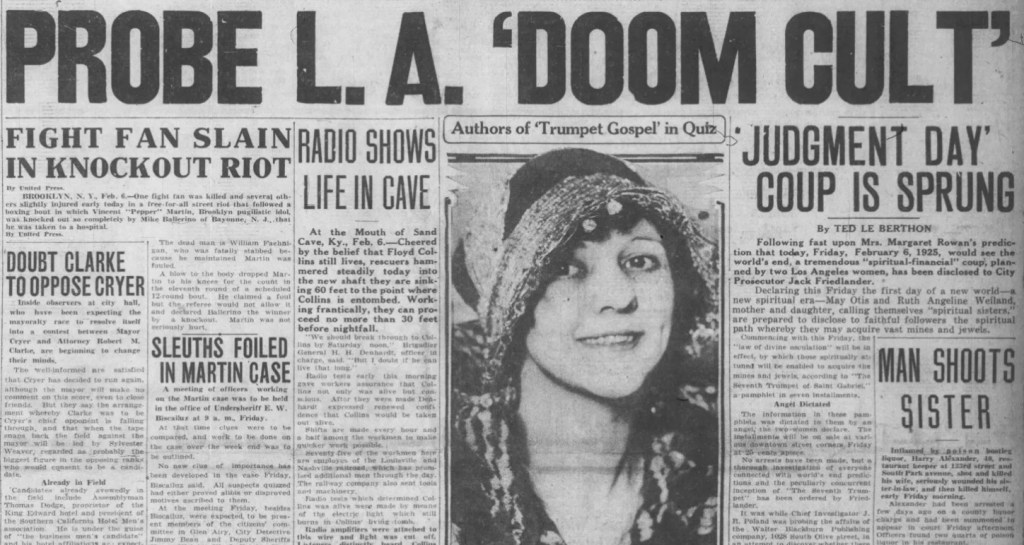
May Otis Blackburn was the founder and “Queen and High Priestess” of a Los Angeles-based group formally known as the Divine Order of the Royal Arms of the Great Eleven, also referred to as the Cult of the Great Eleven or colloquially as the “Blackburn Cult.” She was born May Otis in 1881 in Storm Lake, Iowa, and spent her early life in the Midwest and Pacific Northwest.
At the age of 15, she married Alfred Weiland and later gave birth to a daughter, Ruth. By 1910, Blackburn and Ruth were living in Portland, Oregon. During this period, Blackburn worked in real estate and later attempted to establish a career in the motion picture industry as a producer and director, casting Ruth in leading roles.
After unsuccessful efforts in Seattle and Portland, Blackburn and her daughter relocated to Los Angeles in 1918. Their continued lack of success in Hollywood led to financial difficulties. During this time, Ruth worked as a taxi dancer to support them.
In 1922, while living in the Bunker Hill neighborhood of downtown Los Angeles, Blackburn claimed to have experienced a series of divine visitations. She asserted that the archangels Gabriel and Michael appeared to both her and her daughter and declared them the “two witnesses” described in the biblical Book of Revelation.
These claims became the foundation of a movement known as the Great Eleven, or the Great Eleven Club. Blackburn stated that angels were dictating a book to her, initially titled “The Seventh Trumpet of Gabriel” and later renamed “The Great Sixth Seal.” She claimed the text would reveal the mysteries of life and death, the structure of the universe, and the locations of hidden oil and gold deposits. Blackburn also prophesied that the book’s publication would trigger an apocalyptic event associated with the breaking of the Seventh Seal.
According to the group’s theology, 11 “queens” would rule the world from marble palaces to be built on Olive Hill in Hollywood. They would be joined by 11 “kings” selected by Gabriel, forming the 22 “royal arms” of the order. Followers were required to surrender money, property, and personal possessions to support this mission. Blackburn also issued “concords,” or spiritual titles, to wealthy supporters in exchange for financial contributions.
One of the most significant benefactors was Clifford Dabney, a nephew of a wealthy oil magnate. Dabney provided Blackburn with approximately $50,000 in cash and assets, including 164 acres of land in Simi Valley. The property became a communal retreat known as Harmony Hamlet.
Conditions at Harmony Hamlet were rudimentary. The site lacked electricity and running water, and members transported supplies on foot and built cabins and a temple by hand. A solid gold throne was installed at the site. Members worked in nearby packing sheds and turned over their wages to Blackburn and her new husband, Ward Sitton Blackburn, who was also her stepbrother. Within the movement, Ward was referred to as the “North Star of the World.”
The group practiced rituals that included animal sacrifices and dances described as Egyptian-inspired, performed at night in long purple robes. Followers were reportedly instructed to abandon their automobiles in remote areas as a symbolic rejection of material possessions.
Internal practices became increasingly severe. In January 1925, 16-year-old Willa Rhoads, identified within the group as a “princess,” died from a tooth infection. Blackburn reportedly persuaded the girl’s parents that Willa would be resurrected once the sacred book was completed. As a result, the body was preserved in a bathtub using ice, salt, and spices rather than being buried.
For 14 months, the Rhoads family kept the body, at times placing it in the backseat of their car during outings to create the appearance that Willa was still alive. Eventually, the remains were placed in a steel casket and buried beneath the floorboards of the family’s home in Venice, California. Seven dead puppies were placed around the casket, which Blackburn claimed symbolized the seven tones of Gabriel’s trumpet.
Other incidents later drew scrutiny, including the death of Frances Turner, a paralyzed woman who was subjected to a ritual intended to cure a blood condition. She was placed in a makeshift brick oven for two days and died during the process. Her burial circumstances were later questioned.
In 1929, the movement began to unravel after Dabney became disillusioned and left the group. At his uncle’s urging, Dabney filed civil and criminal complaints against Blackburn, alleging she had defrauded him of $50,000. This led to a broader investigation by the Los Angeles District Attorney, who accused Blackburn of defrauding followers of more than $200,000.
During the investigation, authorities uncovered the preserved remains of Willa Rhoads and examined the disappearances of several members, including Blackburn’s son-in-law, Samuel Rizzio, who was rumored to have been poisoned.
In 1930, Blackburn was tried on multiple counts of grand theft. The case attracted extensive media coverage. Although evidence related to deaths and unusual rituals was introduced to illustrate the nature of the organization, Blackburn was formally charged only with financial crimes. On March 2, 1930, she was convicted on eight counts of grand theft and sentenced to prison.
Blackburn appealed her conviction, and in 1931, the California Supreme Court overturned the verdict, ruling that evidence related to deaths and animal sacrifices was prejudicial and irrelevant to the fraud charges. The justices further held that the state could not assess the truth or falsity of religious beliefs and that individuals deemed mentally competent were responsible for their own decisions to support such movements.
After her release, Blackburn’s influence declined sharply. Public attention and prolonged legal proceedings had reduced both her following and financial resources. In 1936, she published The Origin of God, which incorporated elements of her earlier claims but failed to revive the movement.
The Divine Order of the Royal Arms of the Great Eleven effectively disbanded. May Otis Blackburn lived quietly in Los Angeles until her death on June 17, 1951. Ruth Blackburn died in 1978.
Key Sources:
Blackburn, M. O. (1936). The Origin of God.
Fort, S. (2014). Cult of the Great Eleven. Createspace.
The Los Angeles Times. (1929, December 4). Divine Arm Cult Chief Arraigned: Mrs. Blackburn’s Plea Set for Monday on Charges of $28,000 Grand Theft.
Perry, A. (2025, September 6). The Blackburn Cult. Medium.
Spitzzeri, P. R. (2020, December 30). Take it on faith: The Divine Order of the Royal Arms of the Great Eleven. Homestead Museum.
Young, P. (2002). L.A. Exposed: Strange Myths and Curious Legends in the City of Angels. Macmillan.
 Encyclopedia of Cults, Sects, and New Religious Movements