The Cult of the Unknown Tongues was a local religious movement in eastern Kentucky that drew national attention in 1933 after the ritual killing of its founder’s mother.
John Mills, born in 1899, was one of 14 children and left school after eighth grade. He worked as a farmer and later as a gas line repairman. Following the sudden death of his daughter in 1929, he experienced a psychological decline that led to unemployment and a prolonged period of instability. During this time, he began searching for spiritual meaning and direction.
Mills initially partnered with Pentecostal preacher William Duty to establish a church in the village of Tomahawk. Disagreements within the congregation eventually resulted in Mills being expelled. Afterward, he began preaching independently in Martin County, where he attracted a small but devoted group of followers.
The practices of the group included speaking in tongues, ecstatic dancing, and extended fasting. Contemporary observers referred to adherents as “Tongue People” and identified two theological viewpoints within the movement: one holding that speaking in tongues followed a separate baptism of the Holy Ghost, and another believing both occurred simultaneously.
In early 1933, following a two-week period of fasting and ritual prayer, Mills claimed to have received a direct command from God requiring a human sacrifice. His initial target was Duty, who escaped. Mills then turned his attention toward members of his own family.
The group gathered at the hillside home of Mills’s brother-in-law, Tomie Boyd, where they entered what they described as a continuous revival. Participants engaged in a ritual known as “swording,” which involved passing a Bible across one another’s throats, and reported visions of miraculous events.
On February 7, 1933, the group barricaded themselves inside the Boyd residence, which they had designated as a temporary temple. Neighbors became concerned after hearing screams and seeing four young girls flee the house. The girls informed authorities that Mills had selected several “virgins” for sacrifice.
When police officers arrived, they found the adults chanting and dancing around an improvised altar. At the center of the room lay the body of Lucinda Mills, Mills’s mother. Mills was discovered kneeling on her chest, repeatedly shouting religious phrases. Investigators determined that he had strangled her using his hands and a heavy trace chain.
Authorities reported that the group intended to burn the body on a cruciform altar to complete the ritual. Several members were armed with knives, and officers used force to restrain Mills. Lucinda Mills was described as having willingly participated in the sacrifice, possibly believing her death would lead to the release of another son, Leonard, from a psychiatric hospital.
Nine family members were arrested and taken to the county jail in Inez, Kentucky. Those detained included Mills, his brother Fred, his nephew Ballard, and several sisters and in-laws. While in custody, the family initially continued praying and chanting, later claiming they had been unable to intervene due to Mills’s influence.
The legal proceedings attracted large crowds and extensive media attention. Outside the courthouse, vendors and entertainers created a carnival-like atmosphere. In court, defense attorneys argued that family members had been under Mills’s hypnotic control. Physicians and mental health specialists from Lexington evaluated Mills’s mental state. Although his attorneys initially sought a temporary insanity verdict, they ultimately did not pursue a formal insanity defense.
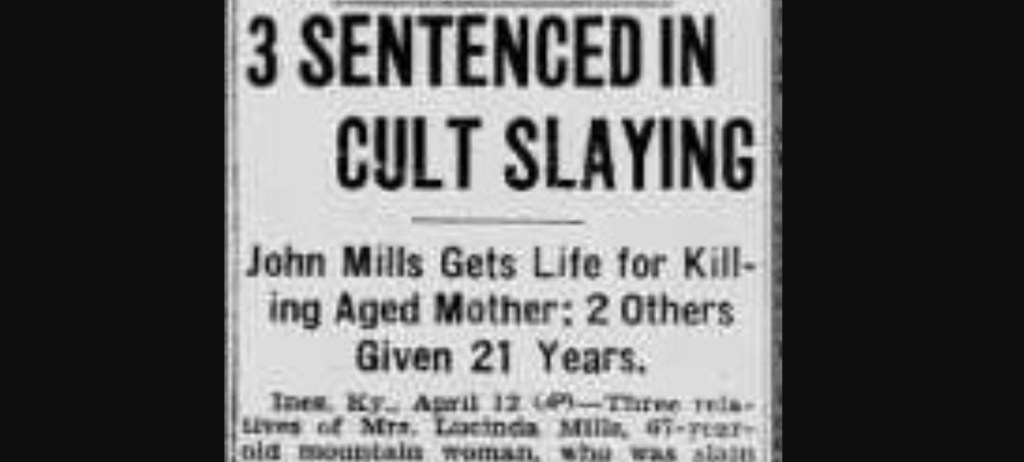
Only three defendants received substantial sentences. John Mills was convicted of first-degree murder and sentenced to life imprisonment. His nephew Ballard Mills and brother-in-law Blaine McGinnis were each sentenced to twenty-one years. The remaining defendants, including women who were present during the killing, were acquitted. After the trial, Mills’s wife, Alma, divorced him and left the area.
Despite his life sentence, Mills was paroled in 1941 after serving eight years. He lived for a time in Akron, Ohio, where he entered into multiple marriages and divorces with Icie Bell Boggs, before returning to Martin County. He died in 1968 and is buried in the Mills Cemetery, near the grave of his mother.
The case remains the only documented instance of ritual human sacrifice in Appalachian history.
Key Sources:
Bowen, J. L. (1933, February 9). Son Strangled Mother During Rites of Cult. The Associated Press.
The Charleston Gazette. (1933, April 7). Insanity Plea Now Plan for Cult Slaying.
Clark, E. T. (1937). The Small Sects in America: An Authentic Study of Almost 300 Little-Known Religious Groups. Abingdon Press.
Sparks, J. (2016, June 21). The Sacrifice of Lucinda Mills. Commontater.
 Encyclopedia of Cults, Sects, and New Religious Movements