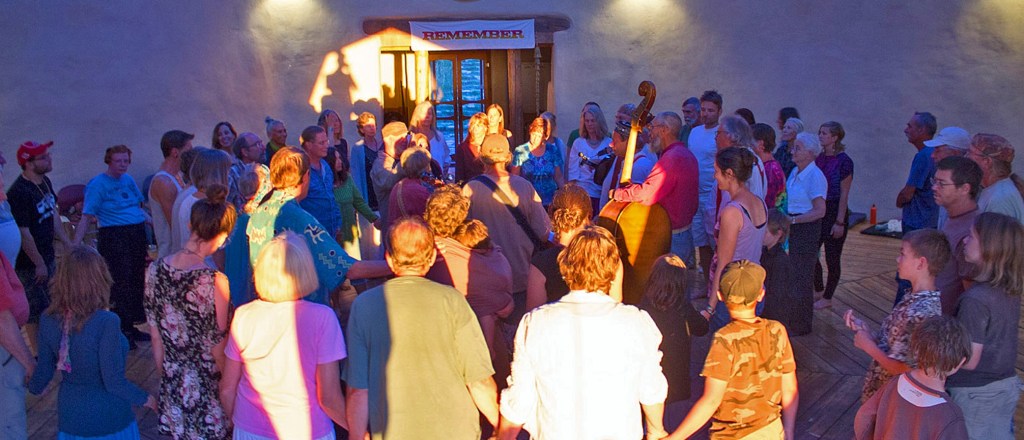
The Dances of Universal Peace (DUP) are a spiritual practice that integrate singing, chanting, and collective movement with the aim of fostering interfaith understanding and personal awareness. The practice combines sacred phrases from multiple religious traditions with simple, repetitive movements.
The practice originated in North America during the late 1960s. Its development is attributed to Samuel Lewis, a Sufi teacher and Rinzai Zen master also known as Sufi Ahmed Murad Chisti. Lewis led the first Dances of Universal Peace on March 16, 1968, in San Francisco.
Lewis’s approach was shaped by his spiritual associations with Hazrat Inayat Khan, who introduced universal Sufism to Western audiences, and by his studies with modern dance pioneer Ruth St. Denis. The dances draw visible influence from Sufi devotional practices such as the Sema and the whirling of dervishes, while also incorporating elements drawn from Hindu, Buddhist, Christian, Jewish, Zoroastrian, and Indigenous traditions.
A typical DUP gathering consists of five to 500 participants standing in a circle. A trained leader facilitates the dances from the center, often accompanied by live musicians using acoustic instruments such as drums, flutes, guitars, or strings. The structure emphasizes participation rather than performance and observing without joining is generally discouraged. Each dance is taught at the beginning of a session so that participants of varying experience levels can take part.
The verbal components of the dances include short poems, sacred phrases, and mantras. The practice makes deliberate use of many sacred languages, including Arabic, Aramaic, Hebrew, Persian, and Sanskrit. Participants may chant phrases such as “Om Sri Ram,” “Allah,” or “Shema Yisrael” while moving together, with the intention of engaging the meaning of the words through embodied repetition rather than verbal explanation.
The Dances of Universal Peace expanded internationally after the formation of the International Network for the Dances of Universal Peace in 1982. The network was founded by Neil Douglas-Klotz and Tasnim Fernandez to coordinate leader training and support the transmission of the dances. Douglas-Klotz contributed to the expansion of the repertoire by developing dances based on the Aramaic language attributed to the teachings of Jesus.
Through the network, the practice spread to more than 28 countries and continues to be transmitted primarily through an oral mentor-student tradition. While initially associated with New Age and alternative spiritual communities, the dances have since been adopted in a range of secular and religious environments.
Today, DUP sessions are held in settings such as schools, universities, prisons, hospices, and holistic health centers. Oversight of the practice is currently provided by the Mentors Guild within Sufi Ruhaniat International.
Key Sources:
Lewis, S. L., & Douglas-Klotz, N. (1990). Spiritual dance and walk: An Introduction to the Dances of Universal Peace and Walking Meditations of Samuel L. Lewis. Peaceworks International Center.
Miller, K. A. (1997). Wisdom Comes Dancing: Selected Writings of Ruth St. Denis on Dance, Spirituality and the Body. PeaceWorks.
Reed, E. A. (2007). Abwoon Circles: Starting a Local Group. Open Heart Publishing.
 Encyclopedia of Cults, Sects, and New Religious Movements