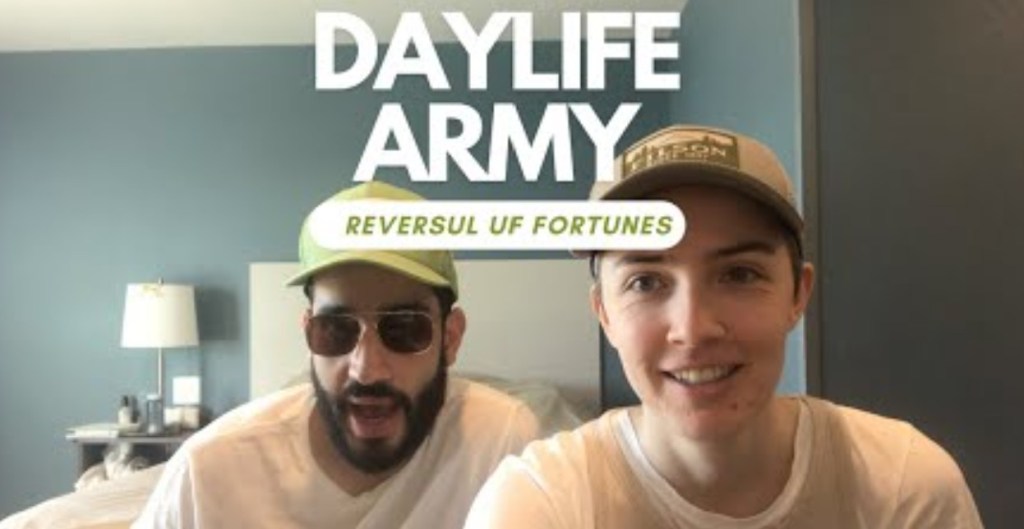
The DayLife Army was a high-control group that emerged in the early 2010s and used social media platforms to recruit young artists and musicians. Its development offers an example of how online subcultures, including the “Weird Facebook” scene, were used to build tightly controlled social organizations. The group was founded by Eben “Wiz-EL” Carlson and Kimberly “KoA” Malone, who combined language centered on racial and economic justice with spiritual beliefs and strict behavioral rules.
The origins of the group date to 2013, when Carlson and Malone began recruiting on Twitter. They focused on young people interested in music, creativity, and branding. Carlson and Malone presented themselves as mentors who could help followers create “multidimensional content brands.”
By 2015, these informal mentorship efforts became a more structured organization called “Tumple.” The group developed a distinct visual identity and introduced a proprietary language known as “Unglish.” This marked the transition from loose online interaction to a more formalized group structure.
Unglish involved altering English spelling, particularly replacing vowels with the letters “U” and “Y.” Leaders described this practice as a rejection of Western linguistic norms. Members were required to wear all-white clothing and adhere to a set of rules called “Standurds,” which included avoiding drugs and alcohol. The group’s belief system combined elements of Gnostic Christianity and African diasporic spirituality. Participation required monthly payments ranging from $1,000 to $2,000, described as contributions toward a “Black pleasure foundation.”
In 2016, following growing media scrutiny, the group rebranded as the DayLife Military. Malone, a Black woman and former bar owner, took the title of “General” and claimed to be a “Pleiadian Light Form” representing an extraterrestrial entity called the “Galactuc Federation.” Carlson served as her deputy. The group described its mission as a fight against the “Pain Matrix,” which it defined as capitalism, racism, and outside social influence.
By 2017, the organization shifted from being primarily online to operating as a mobile live-in group. At that point, it consisted of roughly a dozen core in-person members and more than 50 online supporters, referred to as “orbiters.” The group moved frequently, staying in a cabin in Washington state and later in short-term rentals and hotels across Arizona, California, and Nevada.
New recruits were required to complete a process known as “washing.” This involved giving up personal belongings and money to Carlson and Malone. Members were not allowed to hold traditional jobs and instead spent their time producing social media content designed to attract donations. They posted praise for the leaders on personal accounts and directed PayPal contributions back to the founders, which funded upscale housing and travel related to viewing expensive properties.
In 2018, the recruitment of Edaan, the son of a well-known political commentator, highlighted the group’s appeal to people dissatisfied with global economic systems. Edaan sold his music equipment and joined the group in Phoenix, where he was renamed “DayLife Jesus.” Despite this status, he and other members experienced ongoing financial strain. The leadership imposed daily fundraising targets of $90 per person to cover their own food and lodging, while members often slept in cars or shared public spaces.
To meet these targets, members were directed to pursue multiple fundraising strategies. These included “digital panhandling,” which involved sending mass messages to strangers online asking for money. Leaders also encouraged the use of dating and escorting apps. One was instructed to create an escort profile with a $2,000 rate, with the expectation that all earnings would go to Malone. Other members used apps such as Tinder and Grindr to seek small payments or temporary places to stay.
Differences between the leaders’ conditions and those of the members became more visible later in 2018, when Malone demanded a luxury vehicle. Members obtained a lease for a Honda Pilot through a dating-app contact. Afterward, Malone and Carlson used the vehicle to travel to California, while the members who secured it followed in an older car. Around this time, the leaders reduced direct contact and instructed members to cover phone cameras with sticky notes for security reasons.
Daily life within the DayLife Army was tightly regulated. Leaders held sessions described as “psychoanalysis,” during which they evaluated members’ expressions and behavior. Any perceived resistance was attributed to influence from the “Pain Matrix.” Discipline varied by situation. One former member reported being instructed to eat yogurt in a closet as part of a ritual described as “ego death.”
Former members also described inconsistencies between the group’s rhetoric and internal practices. Although Malone spoke publicly about “Black Subpremacy,” leadership positions were largely held by white members, who were often responsible for disciplining Black female recruits.
By 2019, internal pressures led to increasing departures, and as the new decade began, the group’s activity on platforms such as Facebook declined. Malone claimed her accounts were removed because she was “the most dangerous person in the world,” and the organization shifted toward more private communication channels. Through voice recordings and newsletters, she continued to promote a system she called “social fascism,” in which she would redistribute resources taken from the “Pain Matrix.”
Malone also introduced a proposed social currency called “Tume,” which she described as a “proof of pleasure” intended to replace traditional money. Although many early members had left, the group remained active on Instagram and Twitter, especially during periods of social unrest. Most notably, during the Black Lives Matter protests of 200, the organization attempted to recruit demonstrators, urging them to serve Malone rather than participate in conventional activism.
Key Sources:
Colburn, R. (2020, June 24). An exploitative digital cult born from Facebook meme groups is imploding. AV Club.
Friedlander, E. & Crane, J. (2020, June 24). Beyond the Pain Matrix. OneZero.
Friedlander, E. (2020, August 25). The Real-Life cult that started on Facebook. The Culture Journalist.
 Encyclopedia of Cults, Sects, and New Religious Movements