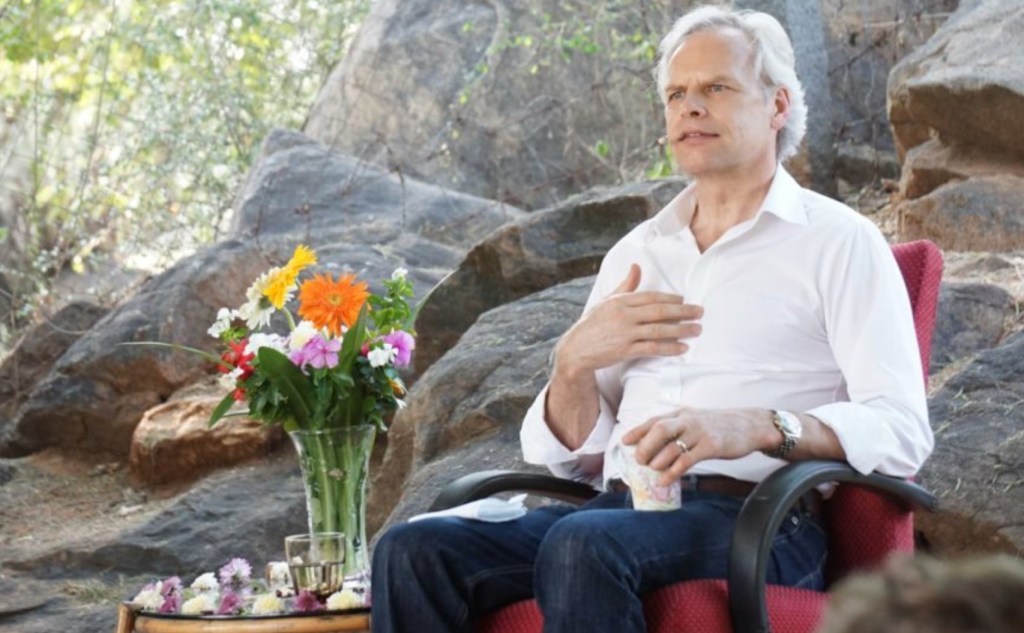
John de Ruiter is a Canadian spiritual leader and author who developed an international following through a blend of New Age spirituality and a personalized teaching style. He was born on November 11, 1959, in Stettler, Alberta, to Dutch immigrant parents and was raised in traditional Christian settings. His father worked as a shoemaker, and de Ruiter initially followed the same trade, training and working as an orthopedic shoemaker in Edmonton.
At age 17, de Ruiter experienced what he later described as an immersion into “innermost contentment,” a state that he said lasted for approximately one year. When the experience ended, he began a prolonged search to understand and regain that sense of consciousness. Over the following decade, he explored a range of religious and philosophical traditions in pursuit of what he viewed as a foundational spiritual truth.
His formal theological education began in 1983 with a year at a Baptist seminary in Toronto, followed by a year at the Prairie Bible Institute in Three Hills, Alberta. After concluding that traditional church structures were too restrictive, he began interning with a pastor at Bethlehem Lutheran Church in Edmonton. During this period, his teaching style diverged from conventional Christian practice.
A pivotal moment occurred during a nine-hour session in which de Ruiter described his spiritual “awakening” to church elders. The presentation alienated many members of the congregation but attracted a small group of committed followers. By the late 1980s, de Ruiter left the Lutheran church and established an independent ministry. Early gatherings were held in private homes and later moved to a bookstore on Whyte Avenue as attendance increased.
By the late 1990s, his organization had expanded enough to require larger venues. This growth led to the formation of the College of Integrated Philosophy. In 2007, the group opened the Oasis Centre in West Edmonton, a facility costing approximately $7 million and featuring marble columns and a 350-seat auditorium. The center became the primary location for de Ruiter’s meetings, which moved away from traditional Christian doctrine and emphasized concepts such as devotion to truth, surrender of ego, and a distinction between the self and the soul.
De Ruiter’s public presence was shaped by a distinctive seminar format. Meetings often involved extended periods of silence and sustained eye contact. He typically sat in an elevated armchair, with large video screens projecting close-up images of his face. At times, he remained silent for up to thirty minutes before responding to a question, stating that he was in a state of samadhi, or spiritual absorption.
Followers traveled from countries including Israel, Germany, and the United Kingdom, with some relocating to Edmonton to volunteer for the organization. As the community grew into the thousands, scrutiny increased. Critics and former members raised concerns about what they described as cult-like dynamics, including the role of prolonged staring as a form of psychological influence. Public discussion also included claims that de Ruiter viewed himself as a messianic figure. Additional concerns focused on the insularity of the group and the degree of influence he appeared to exert over followers’ personal decisions and finances.
Internal disputes became public in 1999, when de Ruiter’s wife confronted him during a meeting regarding his relationships with two sisters, Benita and Katrina von Sass, who were members of the community. The sisters later filed a civil lawsuit alleging the existence of a three-way common-law marriage. In court filings, Benita von Sass stated that de Ruiter used spiritual authority to pressure her into sexual relationships, framing compliance as God’s will and resistance as a rejection of truth.
Public attention increased following the 2014 death of a female follower under unresolved circumstances and de Ruiter’s public admission in 2017 that he had engaged in sexual relationships with multiple devotees. De Ruiter reportedly referred to sexual relationships with multiple female followers as “the Calling,” presenting them as spiritually necessary.
On January 21, 2023, de Ruiter was arrested by the Edmonton Police Service and charged with four counts of sexual assault involving four complainants. According to the allegations, between 2017 and 2020 he told female members that he had been instructed by a spirit to engage in sexual acts with them, asserting that the encounters would advance their spiritual development or elevate their being.
The legal proceedings marked the end of de Ruiter’s leadership at the Oasis Centre, which had been sold in 2021 to the Aga Khan Foundation for more than $6.6 million. Despite the loss of the facility and the criminal charges, reports indicated that he continued to hold smaller meetings in St. Albert and organized retreats at a campground in northern Alberta.
Key Sources:
Leon, H. (2015, February 25). The Canadian Man Who Commands a Cult with His Gaze. Vice.
Marshall, J. (1998, December 7). Shoemaker to Messiah? The National Post.
Wakefield, J. (2023, January 23). Edmonton spiritual leader John de Ruiter charged with four sexual assaults, police seek additional complainants. The Edmonton Journal.
 Encyclopedia of Cults, Sects, and New Religious Movements