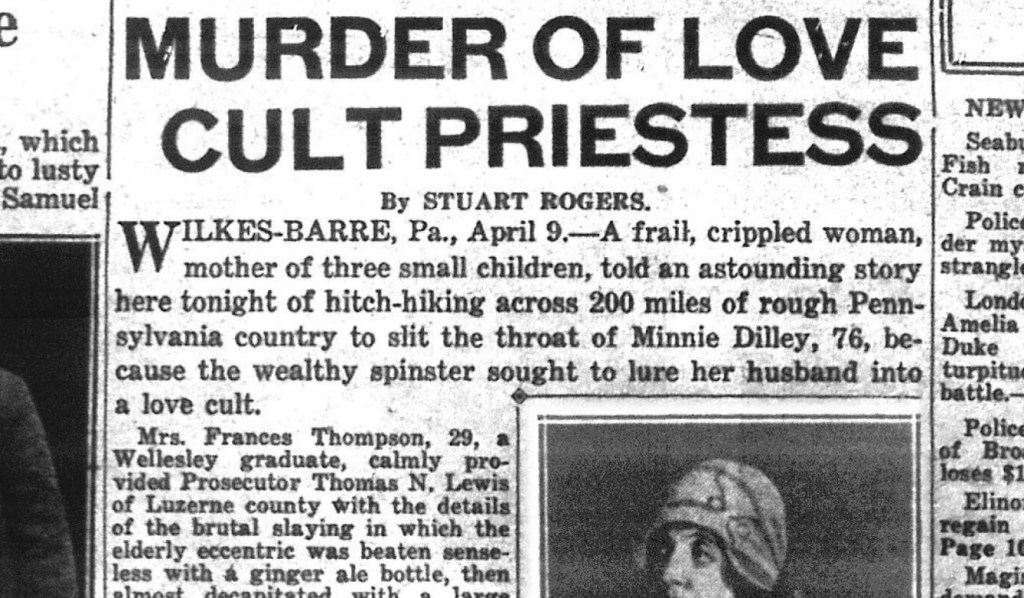
Minnie Dilley was a member of a long-established family in Pennsylvania’s Wyoming Valley. She lived alone and was known locally for her reclusive lifestyle. Her home contained a number of unusual architectural modifications, including steel-reinforced doors and windows bolted from the inside. On April 4, 1931, when she was 76, her body was discovered by her nephew inside that house. She had sustained severe blunt-force injuries and a deep laceration to her throat. Investigators recovered a blood-covered ginger ale bottle at the scene, which they identified as the primary blunt-force weapon.
Early police theories focused on robbery, as Dilley was rumored to possess substantial wealth. However, no valuables were reported missing. Investigators soon uncovered about 100 letters sent to Dilley over a three-year period by Frances Thomsen, a 29-year-old Wellesley College graduate and daughter of a Baptist minister. She and her husband Carl had lived across the street from Dilley in the mid-1920s before relocating first to Long Island and later to Pittsburgh. Although the two women had initially been friendly, the relationship reportedly deteriorated after Dilley criticized Frances’s domestic abilities.
On April 8, 1931, Frances Thomsen was taken into custody in Pittsburgh. She subsequently confessed to the killing. According to her statement, she hitchhiked from Pittsburgh to Forty Fort, Pennsylvania, carrying a bread knife concealed in an umbrella and a bottle of ginger ale. She stated that she acted to protect her husband from what she described as Dilley’s “unholy witch powers.”
In her confession, Thomsen described what she called the “Luzerne County Love Cult.” She alleged that Dilley was a “priestess” who intended to use psychic influence and promises of wealth to lure Carl Thomsen to the Pocono Mountains. According to Frances, Dilley planned to establish a “sex colony” or “love cult” for unmarried teachers and businesswomen, with Carl serving as its leader. Thomsen stated that she heard voices warning her of this plan and that, during their final encounter, she believed Dilley was attempting to hypnotize her.
The case received national media attention, in part due to Thomsen’s educational background and the nature of the allegations. Carl Thomsen denied any knowledge of a cult and testified that his wife’s claims were the result of mental illness. He stated that she believed she received messages through the air in a manner he compared to a “radio machine.”
Legal proceedings centered on Thomsen’s mental condition. The Commonwealth of Pennsylvaina initially pursued a first-degree murder charge. Her defense was supported by the Wellesley College Alumni Association, which retained attorneys on her behalf. Witnesses, including her father and former classmates, testified regarding her history of hallucinations and mental instability. During her arraignment, observers reported that she appeared calm and at times smiled at those present, while also attempting to comfort her husband.
In late April 1931, a sanity commission composed of two physicians and an attorney evaluated Thomsen. On May 1, Judge William S. McLean accepted the commission’s conclusion that she was legally insane and ordered her commitment to the Retreat State Hospital. As a result, she was deemed unfit to stand trial, and the criminal prosecution did not proceed.
Following her commitment, probate proceedings addressed Minnie Dilley’s estate. The widely rumored fortune proved to be substantially smaller than expected, with the estate valued at approximately $22,000. Frances Thomsen remained institutionalized at Retreat State Hospital for the remainder of her life. Her mental and physical health reportedly declined during her confinement. She died there in March 1940 at the age of 41.
Key Sources:
Bovsun, M. (2018, December 13). Pennsylvania murderess thought spinster victim controlled husband’s mind in 1931. The New York Daily News.
Bressi, M. (2017, November 23). The Luzerne County Love Cult Murder of 1931. Pennsylvania Oddities.
The New York Times. (1931, April 11). MURDER CONFESSED BY COLLEGE WOMAN: Mrs. Thomsen, Wellesley ’20, Admits Killing Wealthy Spinster Near Wilkes-Barre.
 Encyclopedia of Cults, Sects, and New Religious Movements