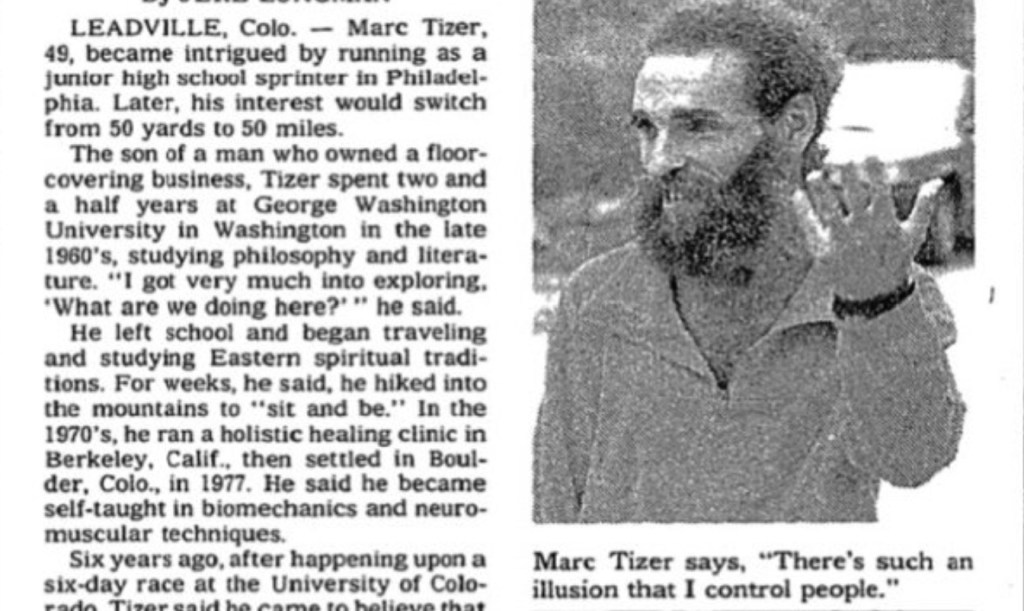
The Divine Madness Running Club, also known as “The Community,” is a spiritual organization that places ultramarathon running at the center of its approach to personal development. The club was founded by Marc Tizer in Boulder, Colorado, during the late 1970s and evolved into the Divine Madness Running Club by the early 1990s.
Before founding the group, Tizer had been involved in political activism in Chicago. He also studied several spiritual and philosophical traditions, including Sufism and the teachings of G. I. Gurdjieff. These influences shaped the group’s early emphasis on a practice referred to as “harmonizing,” which focused on balancing physical, emotional, and spiritual energies.
In 1991, Tizer attended an ultramarathon race. After this experience, he began to emphasize extreme distance running as a way to access what he described as spiritual energy and personal transformation. This shift gradually moved the organization toward a more intense athletic focus. Tizer adopted the name “Yousamien,” often shortened to “Yo.” Within the group he acts as both the primary coach and the central spiritual authority.
Members of the group generally range in age from their mid-20s to late 50s. Many live together in communal housing in Boulder or at a 160-acre gated ranch in New Mexico. Participants typically hold modest jobs and contribute their income to shared living expenses and to the support of Tizer and the organization.
By the early 1990s, several members of Divine Madness had begun achieving strong results in ultramarathon competitions. One example was Steve Peterson, who won the Leadville Trail 100 race four consecutive times. Despite these athletic achievements, the internal practices of the organization became the subject of legal and public scrutiny. In 1996, three former members — Georgiana Scott, John Hunt, and Melissa Huntress — filed a civil lawsuit against Tizer.
The plaintiffs alleged that Tizer exercised extensive influence over members through methods that included sleep deprivation, fasting, and isolation from family and friends. They also claimed that members were encouraged to abandon conventional social relationships. The lawsuit further alleged that Tizer discouraged monogamous relationships. According to the plaintiffs, female members were sometimes required to have sexual contact with Tizer or with other individuals designated by him before pursuing relationships with partners of their own choosing.
Additional accounts from former members described a structure in which certain female followers formed an inner group referred to as the “Yo Ladies.” These women reportedly carried out tasks for Tizer and maintained close personal contact with him. Former members also stated that in 1989 Tizer introduced a system called “envelope marriages.” Under this arrangement, male and female names were placed into a container and randomly paired, with the resulting couples expected to remain together for a week as a way to reduce emotional attachment.
Other allegations involved reproductive decisions within the group. Some former members stated that women were pressured to undergo abortions to avoid forming attachments to motherhood. At the same time, Tizer reportedly claimed that he could regulate his own fertility through unusual abilities.
The group’s emphasis on accepting discomfort and maintaining strict obedience to leadership later became connected to a fatal incident involving a member. In January 2003, Mark Heinemann, a 46-year-old ultrarunner associated with the group, died in Phoenix, Arizona.
Heinemann had just completed a 48-hour endurance race in which he ran more than 200 miles and finished in third place. After the race he returned to a hotel room with other members of the group. Approximately 25 hours later he was found dead. An autopsy determined that Heinemann died from bacterial double pneumonia. Medical examiners reported that his lungs contained large amounts of blood, pus, and vomit.
Physicians reviewing the case stated that the illness would likely have produced noticeable symptoms such as coughing and difficulty breathing. They indicated that medical treatment might have improved his chances of survival. Heinemann’s parents publicly attributed responsibility for his death to the group’s culture of enduring pain and its limited engagement with medical care. A spokesperson for the organization stated that his exhaustion had initially appeared to be a typical consequence of completing a long endurance race.
The financial structure of Divine Madness also became a subject of dispute. Tizer described the group as a nonprofit school dedicated to personal development. Former members, however, reported that participants were encouraged to provide substantial financial contributions. One individual reportedly gave the organization a $100,000 inheritance, while another provided $140,000 after being told the donation was important for her personal transformation.
Ex-members also described Tizer’s lifestyle as involving regular service from followers and frequent alcohol consumption. According to these accounts, he stated that drinking alcohol helped cool what he described as an overheated mind.
Public attention to the group increased as the term “cult” began appearing in media coverage, including reports in The New York Times. In response, Tizer rejected that description and stated that the group was simply a community of individuals attempting to lead balanced lives under the guidance of a teacher. He denied accusations of mind control. In interviews, he argued that cults were typically characterized by members shaving their heads and surrendering all their money, conditions he said did not apply to his followers.
Following the legal disputes of the 1990s and the death of Mark Heinemann in 2003, the organization gradually changed the way it presented itself publicly. The group that had once been known primarily as a running club began to emphasize a network of intentional communities and retreats rather than a formal athletic organization.
Leadership remained centered on Marc Tizer, while activities increasingly took place at a property known as “The Retreat.” This 160-acre site is located in the Gila National Forest in New Mexico. Daily life within the group combines structured discipline with communal living. Members share responsibilities, train together, and follow guidelines set by Tizer.
The training program developed by Tizer is known for its high mileage and demanding schedule. Runners often complete between 120 and 130 miles each week. This training frequently includes 30-mile runs on Wednesdays and trail runs of up to 50 miles on Sundays. During these sessions, Tizer sometimes adds additional distance when runners are already fatigued. He describes this practice as a way of testing a runner’s adaptability and resilience.
Training is also combined with a specific diet. The program emphasizes organic foods and follows a nutritional structure composed of approximately 40 percent fat, 20 percent protein, and 40 percent carbohydrates. Tizer also promotes distinctive running techniques. One method involves a noticeable swinging motion of the hips, which he says increases range of motion in the joints.
The organization also operates Inner Journeys Wilderness Camps, which offer summer wilderness programs for girls at the New Mexico ranch. These programs are presented as outdoor educational experiences connected to the community’s broader activities.
Key Sources:
Evans, C. (1997, October 5). Community or Cult? Spiritual Leader Draws Criticism. The Boulder Daily Camera.
Evans, C. (2004, March 7). Run Ragged: Family questions Divine Madness running group’s role in loved one’s death. The Boulder Daily Camera.
Longman, J. (1997, July 28). A Running Club is 100 Miles Outside of the Mainstream. The New York Times.
Longman, J. (2004, March 7). Death of Runner Places His Sport Under Scrutiny. The New York Times.
Murr, A. (1997, August 17). A Divine Madness? Newsweek.
Schoenfeld, B. (2004, August 4), The Long, Strange Trip of a Running Guru. Sports Illustrated.
 Encyclopedia of Cults, Sects, and New Religious Movements