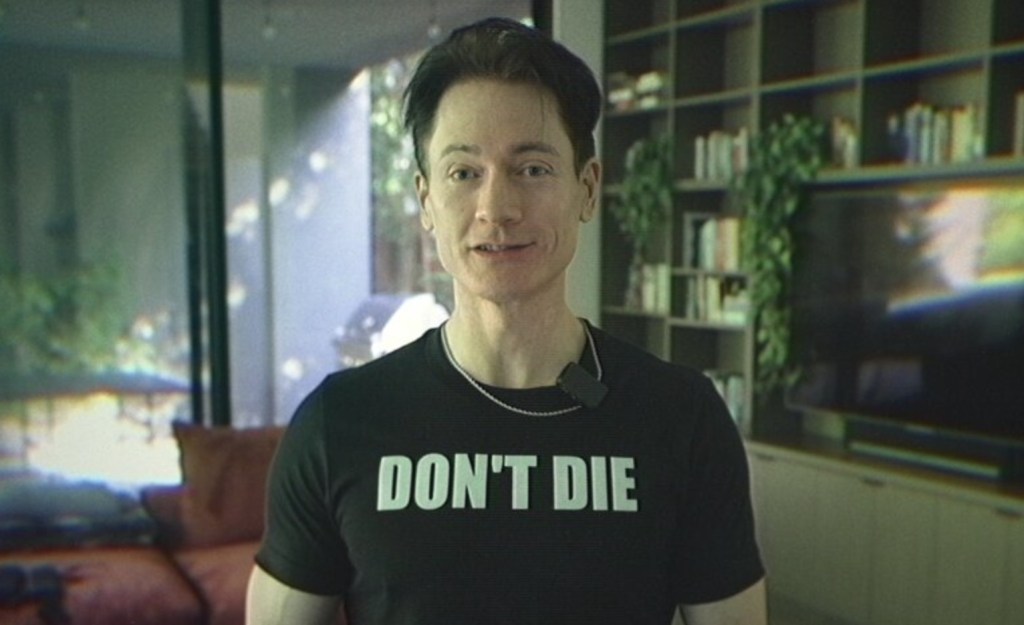
Bryan Johnson was born in 1977, in Provo, Utah, and was raised in a Mormon household. He served a two-year mission in Ecuador before beginning a career in entrepreneurship. In 2007, he founded Braintree, a payment processing company that expanded rapidly under his leadership. In 2012, Braintree acquired Venmo, and in 2013, the combined company was sold to PayPal for $800 million. Johnson earned more than $300 million from the transaction, which he later used to fund ventures including OS Fund and the neurotechnology company Kernel.
By 2021, Johnson shifted his focus from business to personal health and longevity. He launched “Project Blueprint,” a program designed to monitor and optimize various biological functions. The regimen includes a vegan diet of approximately 1,977 calories per day, more than 50 daily supplements, structured exercise, and medical interventions such as gene therapy and plasma transfusions. One widely publicized example involved a “blood exchange” between Johnson, his son, and his father.
As Project Blueprint developed, Johnson expanded its scope into a broader framework called the “Don’t Die” movement. He describes this initiative as a response to the potential emergence of artificial superintelligence and has outlined it as a guiding system for human decision-making. Johnson has also referred to the effort as the creation of a “religion,” presenting it as an evolution of existing social and economic structures.
To support participation, the “Don’t Die” app tracks user behavior and assigns a “Don’t Die Score” based on metrics such as sleep, physical activity, and caloric intake. Users are encouraged to improve their scores by adhering to defined targets. The movement also includes in-person events known as “Don’t Die Summits,” held in cities including Los Angeles, Singapore, and New York. These gatherings typically combine social activities with discussions on health and technology. Admission prices range from $249 to $1,499.
Participants in the movement come from a range of professional backgrounds, including technology and healthcare. Some supporters describe Johnson’s approach as an effort to highlight perceived limitations in current health and food systems. At the same time, observers have noted the presence of a social hierarchy based on adherence to the program, where individuals who closely follow the regimen are viewed as more aligned with its goals.
Johnson has stated his intention to extend his lifespan significantly, including a goal of living until at least 2140, which coincides with the final Bitcoin halving. He has encouraged others to adopt similar practices, presenting the approach as a long-term commitment.
In 2025, Johnson’s profile expanded further with the release of the Netflix documentary “Don’t Die: The Man Who Wants to Live Forever.”
Key Sources:
Long, B. (2025, December 10). The folly of Bryan Johnson’s “Don’t Die.” Theology and Life.
Rogers, J. (2025, February 5). Grim reapers, super veggies, and stem cell IVs: inside Bryan Johnson’s ‘Don’t Die’ summit. Men’s Health.
Waite, T. (2025, April 2). I joined Bryan Johnson’s ‘Don’t Die’ cult for a week. Dazed.
 Encyclopedia of Cults, Sects, and New Religious Movements