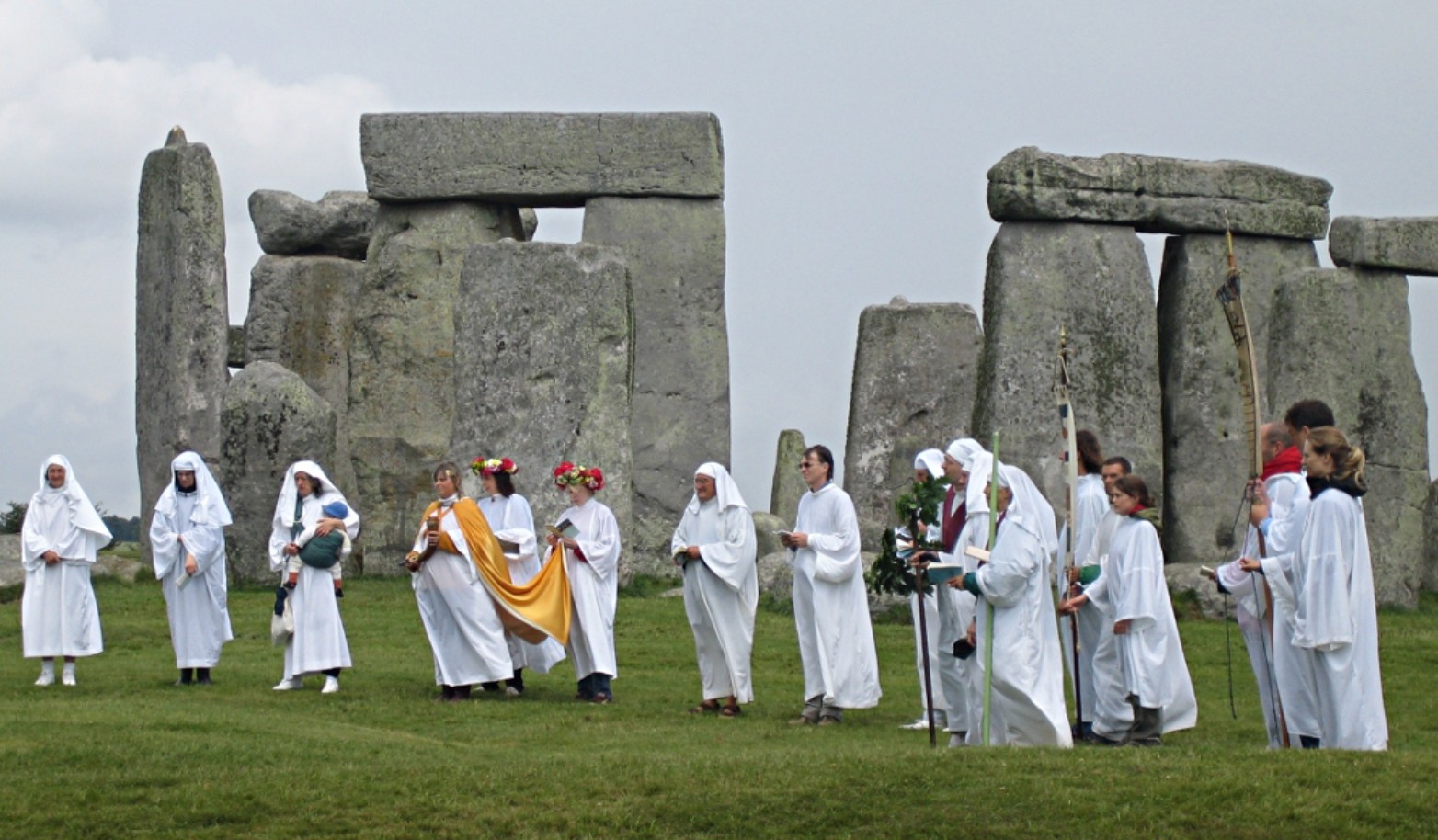
Modern Druidry, also known as Druidism, is a contemporary spiritual and religious movement centered on relationships with the natural world. Its practitioners hold a range of theological views but share a general focus on the perceived sacredness of nature. The movement emphasizes environmental stewardship, meditation, and nature-based rituals. Although it draws inspiration from the Iron Age Druids of Western Europe, modern Druidry developed through later reinterpretations rather than direct historical continuity.
The origins of the modern movement can be traced to 18th-century Britain during the Romantic period, when interest grew in the cultures of ancient Celtic societies. Antiquarians and writers began to reinterpret Druids as representatives of an early form of indigenous spirituality. One influential figure was William Stukeley, an Anglican vicar who identified sites such as Stonehenge as Druidic temples. He described the Druids as “proto-Christians” with beliefs similar to monotheism. These interpretations were developed before archaeology became a formal scientific discipline.
In the late 18th century, Druidry took on a more organized structure. In 1781, Henry Hurle established the Ancient Order of Druids in London. Modeled in part on fraternal societies such as Freemasonry, it functioned as a social and mutual aid organization, offering financial and charitable support to members. Around the same time, Edward Williams, known as Iolo Morganwg, claimed to have discovered manuscripts demonstrating a continuous Druidic tradition in Wales. These documents were later found to be fabricated, but his rituals and the “Gorsedd” traditions became integrated into the National Eisteddfod of Wales.
During the 19th and early 20th centuries, Druidic organizations became established as cultural and fraternal groups. The image of the Druid as a robed elder figure became widely recognized during this period. In the early 1900s, Druid groups began holding ceremonies at Stonehenge, a practice that continues despite evidence that the site predates the historical Druids by several millennia. While many groups remained social or cultural in nature, a shift toward explicitly religious interpretations developed over time.
A transition toward modern religious Druidry took place in the mid-20th century. In 1964, Ross Nichols founded the Order of Bards Ovates and Druids (OBOD) after separating from a larger fraternal body. Nichols incorporated elements of Celtic mythology and “Earth mysteries” into a structured spiritual system, contributing to Druidry’s development within Neopaganism.
In the United States, a separate development occurred in 1963 at Carleton College in Minnesota. Students formed the Reformed Druids of North America (RDNA) as a response to a mandatory religious attendance policy. After the requirement was removed, the group continued to meet and gradually developed into a spiritual movement centered on reverence for “Mother Earth.”
Further developments took place in the 1980s as groups sought different approaches to practice and historical interpretation. In 1983, Isaac Bonewits founded Ár nDraíocht Féin (ADF), which adopted a broader Indo-European framework rather than focusing solely on Celtic traditions. In 1986, the Henge of Keltria formed as a separate group emphasizing Celtic reconstructionism and the use of historical and literary sources.
Theology in modern Druidry is non-dogmatic and varies among practitioners. Some identify as polytheists who honor Celtic deities, while others describe themselves as pantheists, animists, or participants in blended traditions such as “Christodruid” practice. Additional variations include “Zen Druids” and “Hasidic Druids.” Despite these differences, many share an emphasis on the vitality of the natural environment. Data from the World Druidry Survey conducted between 2018 and 2020 indicates that a majority of practitioners engage in activities such as environmental restoration, habitat creation, and related forms of stewardship.
Ritual practice is often organized around the “Wheel of the Year,” a cycle of eight seasonal observances that includes solstices, equinoxes, and four cross-quarter festivals: Imbolc, Beltane, Lughnasadh, and Samhain. While some practitioners observe all eight, others adapt their rituals to local environmental conditions. Ceremonies are commonly held outdoors and may include directional invocations, storytelling, music, libations, and shared food within a defined ritual space.
Many Druid organizations use a three-tier structure consisting of Bards, Ovates, and Druids. Bards focus on artistic expression and storytelling, Ovates on healing and nature-based knowledge, and Druids on teaching and leading rituals. Local groups are often called “groves,” reflecting an association with trees and forest settings, while larger organizations may be led by individuals titled “Arch Druids” or “Chosen Chiefs.”
Education plays a central role in the movement. Organizations such as OBOD offer structured courses, and practitioners often study mythology, folklore, and botany. With no central authority, practices are informed by a range of sources, including classical writers like Caesar and Strabo, medieval Irish and Welsh texts, and personal interpretation or meditation. Some groups emphasize academic reconstruction, while others incorporate elements of earlier revival traditions.
In the late 20th and early 21st centuries, Druidry gained wider public recognition. In the late 1990s, English Heritage permitted Druid groups to access Stonehenge for summer solstice observances following a period of negotiation. In 2010, the Charity Commission for England and Wales granted charitable status to the Druid Network, recognizing it as a religious organization. By 2020, the movement had spread to multiple countries across six continents. The expansion of digital communication has also influenced the movement. Many practitioners now participate in online groups, educational programs, and digital archives.
Key Sources:
Adler, M. (2006). Drawing down the moon: Witches, Druids, Goddess-Worshippers, and Other Pagans in America. Penguin Books.
Billington, P. (2011). The path of Druidry: Walking the Ancient Green Way. Llewellyn Worldwide.
Cooper, M. T. (2009). Pathways to Druidry: A Case Study of Ár nDraíocht Féin. Nova Religio: The Journal of Alternative and Emergent Religions.