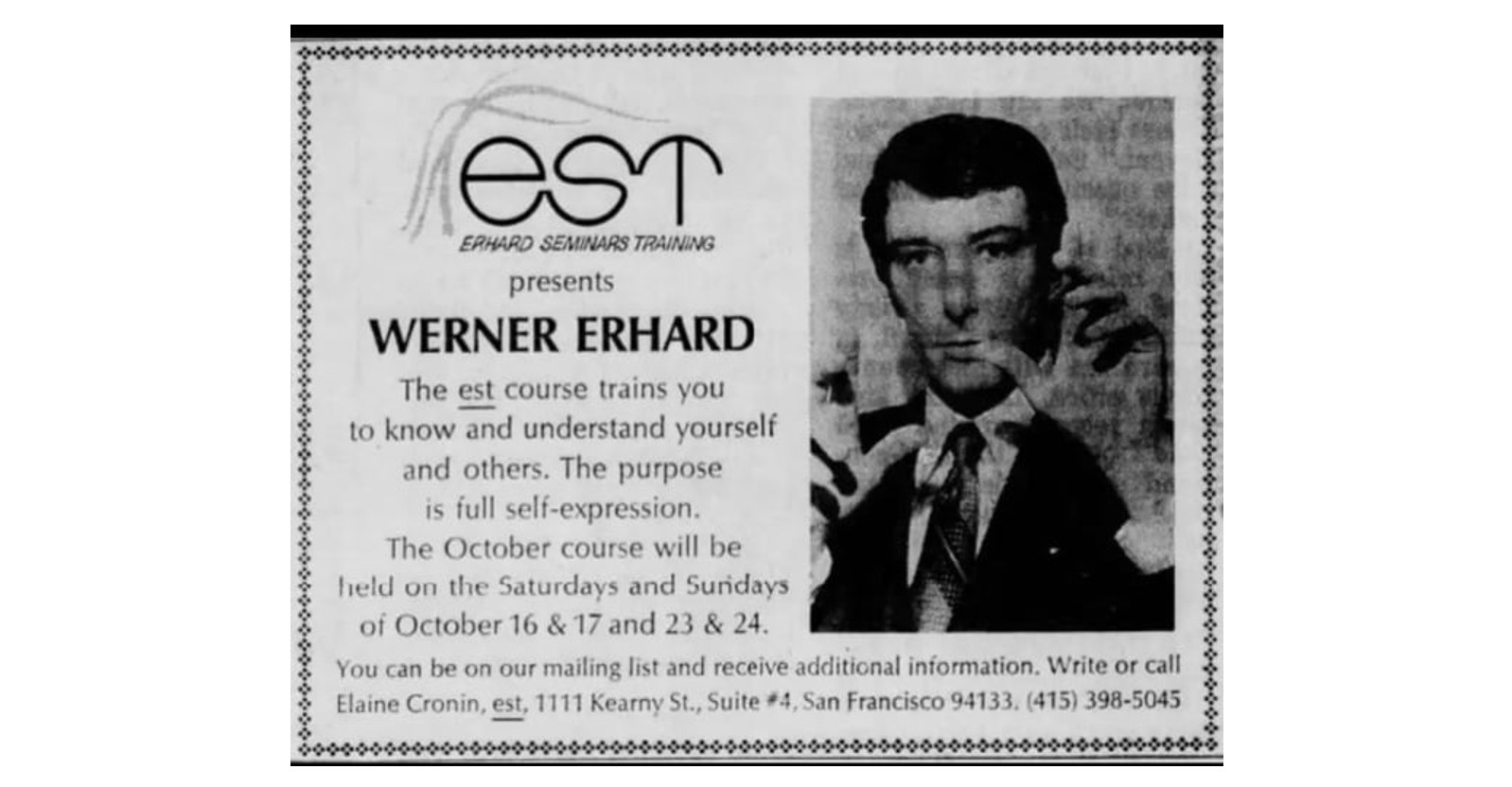
Erhard Seminars Training (est) was founded in 1971 by Werner Erhard and became a prominent organization within the Human Potential Movement of the 1970s. The program offered a structured course called “The est Standard Training,” typically delivered over two consecutive weekends and totaling about 60 hours. It aimed to produce a cognitive shift described as “getting it,” which focused on personal responsibility and changes in how individuals approached their lives and problems.
Werner Erhard was born John Paul Rosenberg in Pennsylvania in 1935. In 1960, he left his first wife and four children and moved west, later changing his name to Werner Hans Erhard. Before founding est, he worked in door-to-door sales, including managing encyclopedia sales for Parents Cultural Institute and Grolier Society. During this period, he studied a range of psychological and spiritual systems, including hypnosis, Dale Carnegie’s public speaking courses, Scientology, and Mind Dynamics. In 1971, he described experiencing a personal realization while driving across the Golden Gate Bridge, which he cited as the basis for creating est. Critics later noted similarities between est and earlier systems such as Mind Dynamics and Scientology.
The first est training took place in October 1971 at the Jack Tar Hotel in San Francisco. The organization expanded rapidly, training more than 62,000 people within its first year. By the mid-1970s, seminars were held in twelve major cities and extended into institutional settings, including federal penitentiaries such as the facility at Lompoc, California.
The training environment followed a structured and restrictive format. Groups of around 250 participants attended sessions governed by strict rules, including limits on talking, smoking, and unscheduled breaks. The instructional approach included directed meditation and forms of verbal confrontation. Trainers often used direct language and structured exercises intended to challenge participants’ assumptions and behavioral patterns.
One exercise, known as the “Danger Process,” involved participants standing on stage while being questioned by others in the group. This process sometimes resulted in visible emotional reactions, including crying or physical discomfort. Despite the intensity of the format, a 1976 study reported that about 80% of participants stated they felt improved outcomes in areas such as relationships and self-perception after completing the training.
As est grew, it also attracted criticism. Some observers argued that the seminars used methods associated with indoctrination or mental conditioning. The organization relied heavily on unpaid volunteers, and the strong identification of graduates with the program led some sociologists to classify it as a new religious movement. Critics also pointed to the limited disclosure of training content, as participants were often discouraged from describing their experiences in detail to others.
Legal and financial issues also emerged over time. In 1986, the U.S. Tax Court upheld a claim by the Internal Revenue Service that est owed more than $3.3 million in back taxes related to transactions involving intellectual property. The organization also faced lawsuits alleging negligence. In one case following a participant’s death after involvement in the “Danger Process” in 1983, a court determined that the training was not the direct cause of death, although a jury found Erhard and the organization negligent in their broader conduct. During this period, the Church of Scientology reportedly conducted actions against Erhard, viewing est as a competing system.
By the early 1980s, public perception of est began to change. In response, the organization adjusted its approach to make the program less confrontational. The final est Standard Training was held in San Francisco in December 1984. In January 1985, Erhard introduced “The Forum,” a revised program offered through Werner Erhard and Associates. This version emphasized discussion and conceptual exploration rather than the stricter conditions of earlier trainings.
In 1991, amid legal pressures and personal controversies, Erhard sold the company’s assets to a group of employees and withdrew from public life, later leaving the United States. The new employee-owned organization became Landmark Education, later known as Landmark Worldwide. It continued to offer programs based on modified versions of est’s concepts.
Although est trainings are no longer conducted, concepts associated with the program continue to appear in corporate training and self-help materials.
Key Sources:
Bartley, W. W. (1978). Werner Erhard: The Transformation of a Man, the Founding of est. Clarkson Potter Publishers.
Brewer, M. (1975, August 1). “We’re Gonna Tear You Down and Put You Back Together.” Psychology Today.
Bry, A. (1976). EST (Erhard Seminars Training): 60 Hours that Transform Your Life. HarperCollins Publishers.
Kornbluth, J. (1976, March 19). Werner Erhard of est: How the king of the brain-snatchers created his private empire. New Times.
Rodgers, A. (1983, July 16). Life Training or Brainwashing? EST: The Story Behind Erhard Seminar Training. The Concord Monitor.