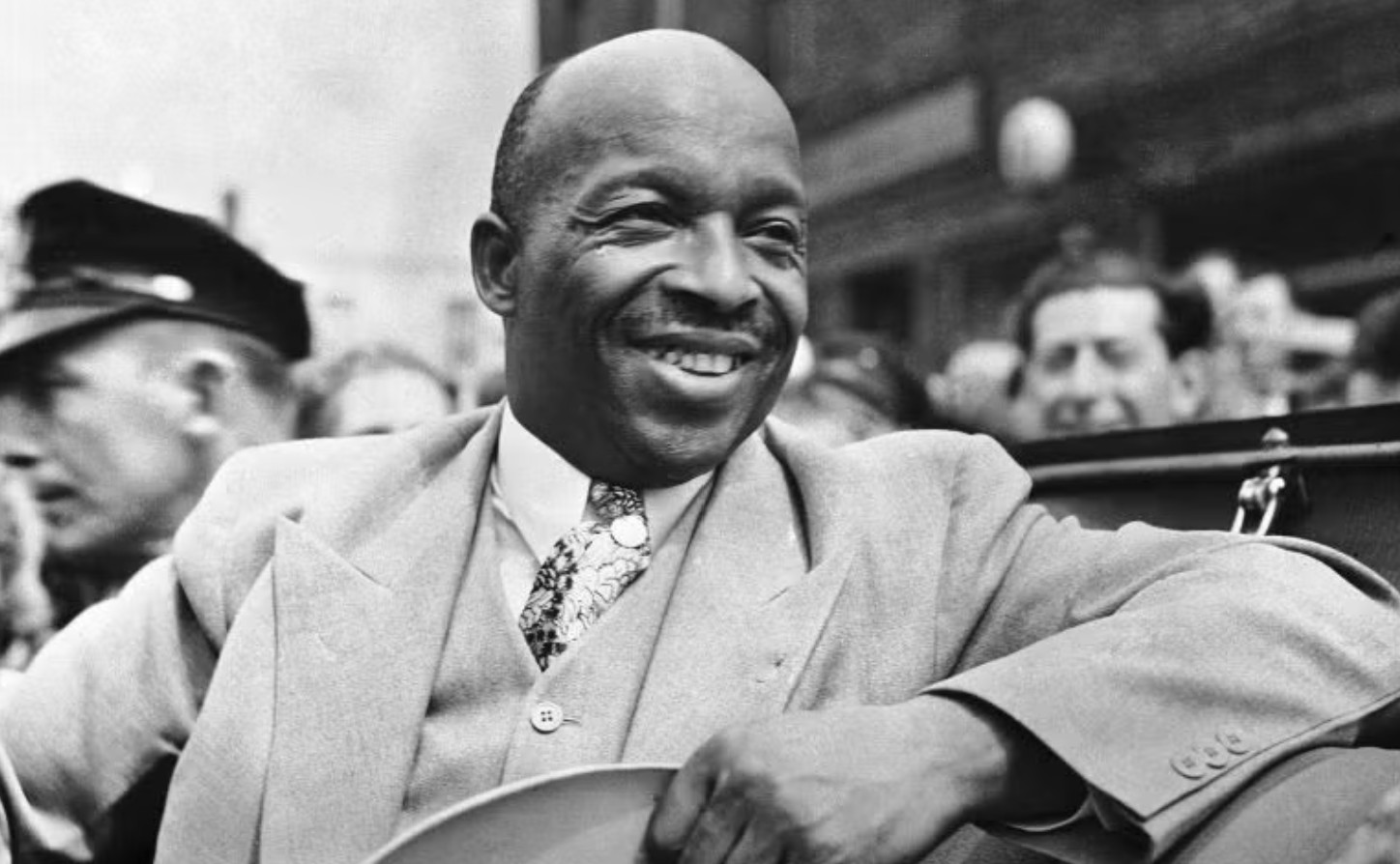
Father Divine’s origins remain uncertain. He was born around 1876, though the exact date and place are disputed, as he would intentionally obscure details about his early life. He declined offers to document his biography, stating that the history of God would not be useful in human terms. A woman named Eliza Mayfield claimed to be his mother and said his birth name was Frederick Edwards from North Carolina, while FBI records listed him as George Baker. Later research suggests he may have been born in Rockville, Maryland, to a former slave.
Around the start of the 20th century, he was working as a gardener in Baltimore and attending a Baptist church where he sometimes preached. In 1906, he traveled to California and encountered the New Thought movement, which emphasized the role of positive thinking in overcoming hardship. This idea became central to his later teachings.
In 1907, he met Samuel Morris, a traveling preacher who claimed to be God. After Morris was expelled from a Baltimore congregation, the man who would become Father Divine became his follower, adopting the name “The Messenger” while Morris took the name Father Jehovia and a third man, John Hickerson, called himself Reverend Bishop Saint John the Vine. The group preached together until 1912, when disagreements over divine authority led to its breakup. At that point, Father Divine declared himself God and began preaching independently.
He traveled to Georgia, where he attracted attention and conflict. In 1913, he was sentenced to 60 days on a chain gang. After his release, he gathered followers in Valdosta, many of them Black women, and promoted celibacy and the rejection of gender distinctions. On February 6, 1914, he was arrested on charges of lunacy. The case drew attention, but a court later found him mentally sound.
Later in 1914, he moved to Brooklyn, New York, with a small group of followers and established a commune. He prohibited sex, alcohol, tobacco, and gambling. During this period, he adopted the name Reverend Major Jealous Divine. He also married a follower named Peninniah, known as Mother Divine. Both maintained that the marriage was not physically consummated.
In 1919, the group relocated to Sayville, New York, becoming the first Black homeowners in the area. They established a commune that drew attention from local residents. Father Divine held free weekly banquets and assisted followers in finding employment. The movement began attracting white members, which was unusual for the time.
Tensions with the local community escalated. On November 15, 1931, police arrested 78 people at the commune for disturbing the peace. During the trial in May 1932, Father Divine was sentenced to one year in prison and fined $500. Shortly after the sentencing, the presiding judge died of a heart attack. Father Divine commented briefly on the event, which some followers interpreted as significant. He was released on appeal in June 1932.
Following his release, he moved to Harlem, where his movement expanded rapidly between 1932 and 1942. The organization, known as the International Peace Mission, acquired hotels, restaurants, and shops that provided low-cost services and employment during the Great Depression. The group became a major property holder in Harlem.
By 1934, the movement had spread across the United States, with additional activity abroad. Reports at the time often overstated membership, though estimates suggest tens of thousands of adherents. That same year, Father Divine formed a temporary alliance with the Communist Party of America due to shared positions on civil rights, despite his own support for capitalism. After the Harlem Riot of 1935, the movement increased its political activity, holding a convention in 1939 that opposed segregation while criticizing aspects of New Deal programs.
Legal challenges followed. In 1937, a former follower sued to recover money entrusted to the movement. The court ruled in her favor. Additional claims from other individuals supported the judgment. In July 1942, Father Divine moved the organization’s headquarters to Philadelphia. During this period, the movement declined in size. Peninniah died around 1943, though the event was not publicly emphasized.
On April 29, 1946, Father Divine married Edna Rose Ritchings, a 21-year-old white Canadian follower known as Sweet Angel who became the new Mother Divine. The marriage drew attention due to the age difference, its interracial nature, and its apparent contradiction of the movement’s teachings on celibacy. The organization addressed the situation by presenting the marriage in symbolic terms, celebrating the anniversary and maintaining that it remained consistent with its doctrine.
In 1953, a follower donated the Woodmont estate in Gladwyne, Pennsylvania, which became his primary residence. As he aged, Father Divine continued to speak on social issues, including support for reparations for descendants of enslaved people. He avoided direct involvement in the broader civil rights movement and rejected racial classifications. He died on September 10, 1965, at Woodmont. His followers did not publicly frame the event as a conventional death and continued to maintain his residence as a place of significance.
Following Father Divine’s death, the second Mother Divine took over as the head of the movement, rejecting claims made in 1972 by Jim Jones of the Peoples Temple that he was the reincarnation of Father Divine. She led the movement until her death in 2017.
Key Sources:
Burnham, K. E. (1979). God comes to America: Father Divine and the Peace Mission Movement. Lambeth Press.
Dixon, V. (2018, October 29). The radical restaurants of Father Divine, founder of Peace Mission. Eater.com.
Harris, S., & Crittenden, H. (2011). Father Divine: Holy Husband. Literary Licensing, LLC.
Watts, J. (1992). God, Harlem U.S.A.: The Father Divine Story.
Weisbrot, R. (1983). Father Divine and the Struggle for Racial Equality. University of Illinois Press.
Whelan, A. (2017, March 7). Mother Divine, leader of the International Peace Mission, dies at 92. The Philadelphia Inquirer.