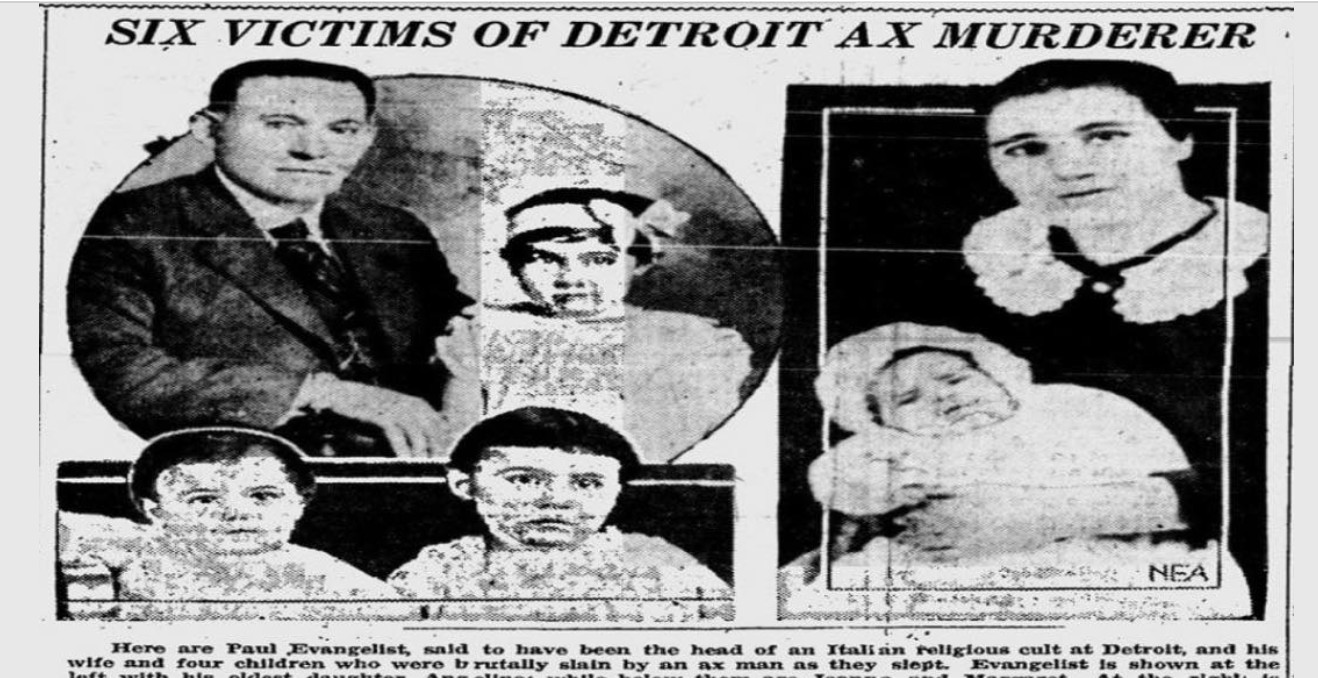
Benjamino Evangelista was born in Naples in 1885 and immigrated to Philadelphia in 1904 with his brother Antonio. Their relationship deteriorated two years later after Benjamino, who Americanized his name to “Benny,” began claiming to receive divine visions tied to occult beliefs. Antonio, who was a practicing Catholic, rejected these claims and sent Benny to York, Pennsylvania, to work on a railroad crew. While there, Benny Evangelista met another immigrant, Aurelius Angelino, who shared his interest in mysticism and spiritual practices.
In 1919, Angelino suffered what was described as a mental breakdown and killed his twin sons with an ax. Following the crime, Evangelista distanced himself from the situation and moved to Detroit. There, he established himself as a carpenter and real estate landlord. He married a woman named Santina, and the couple had four children. Although he achieved financial stability, Evangelista continued pursuing his spiritual interests with increasing intensity.
Over time, Evangelista began presenting himself publicly as a “Divine Prophet” and spiritual healer. He moved his family into a house at the corner of Saint Aubin Street and Mack Avenue and transformed the basement into a ritual space. The room contained altars, knives, animal remains, and papier-mâché models representing celestial bodies. Evangelista referred to the display as the “Great Celestial Planet Exhibition” and charged visitors five cents to tour it.
In addition to the exhibitions, Evangelista sold herbs, spiritual remedies, and curses for fees that reportedly reached ten dollars, a substantial amount at the time. He also self-published a book titled The Oldest History of the World Discovered by Occult Science in Detroit, Michigan, which he claimed had been dictated to him by God during trance states. Evangelista developed a following among members of Detroit’s Italian immigrant community, though some neighbors and former clients viewed him as fraudulent or unstable.
On July 3, 1929, Vincent Elias arrived at the Evangelista home for a planned real estate transaction. After entering the house, Elias discovered multiple bodies. In the basement, Benny Evangelista was found seated at a desk with his hands folded in what appeared to be a prayer position. His head had been severed and placed on the floor near his feet. Three framed photographs of a deceased Evangelista child surrounded the head.
The killings extended throughout the rest of the house. Santina Evangelista was discovered in bed, nearly decapitated and partially dismembered. Beside her was the couple’s 18-month-old son, whose skull had been crushed. In another room, the three older children were also found dead in their beds. Investigators reported no signs of forced entry, robbery, or struggle, leaving the motive unclear.
The investigation encountered problems from the outset. Detectives failed to properly secure the crime scene, allowing reporters and members of the public to enter the house and potentially contaminate evidence. Police also struggled to gather information from Detroit’s Italian immigrant community, where distrust of authorities and fear connected to Evangelista’s occult reputation may have discouraged cooperation. The only physical evidence recovered was a single bloody fingerprint found on a doorknob.
Investigators focused on three primary theories. The first involved the “Black Hand,” an extortion network historically active within Italian immigrant communities. Police discovered a six-month-old letter in the house warning Evangelista, “This is your last chance.” However, authorities noted that by 1929 the Black Hand had largely faded, replaced by more organized Mafia groups, and the ritualistic elements of the crime did not align with typical organized crime killings.
A second theory focused on Umberto Tecchio, a client who had visited Evangelista on the evening of July 2 to make a final payment on a property. Police recovered an ax and a large knife from Tecchio’s boarding house and noted that he had previously killed his brother-in-law in an unrelated incident. Despite the suspicions, investigators were unable to connect him directly to the Evangelista home on the night of the murders. Tecchio was released and later died in 1934.
The third and most enduring theory involved Aurelius Angelino. In 1923, six years before the Detroit killings, Angelino escaped from the Fairview State Hospital for the Criminally Insane in Pennsylvania and was never found. Investigators noted similarities between the Evangelista murders and Angelino’s 1919 ax killings of his own children. Records from the earlier case reportedly also showed that Evangelista’s fingerprints had been found at the scene, suggesting a long and complicated connection between the two men.
Despite years of investigation, no suspect was ever charged. The only surviving creature recovered from the home was the family dog, which had escaped and was found a year later. The Saint Aubin house was eventually demolished, and the property remained vacant for decades.
Key Sources:
Dillon, L. (2022, September 19). The Detroit Occult Murders: What happened to Benny Evangelista? Historic Mysteries.
The Detroit Free Press. (2023, April 23). Free Press Flashback: Ax murders of a Detroit cult figure, family remain unsolved mystery.
Willard, J. (2021). The murder of a preacher: The True Story of Benny Evangelista. Trellis Publishing.