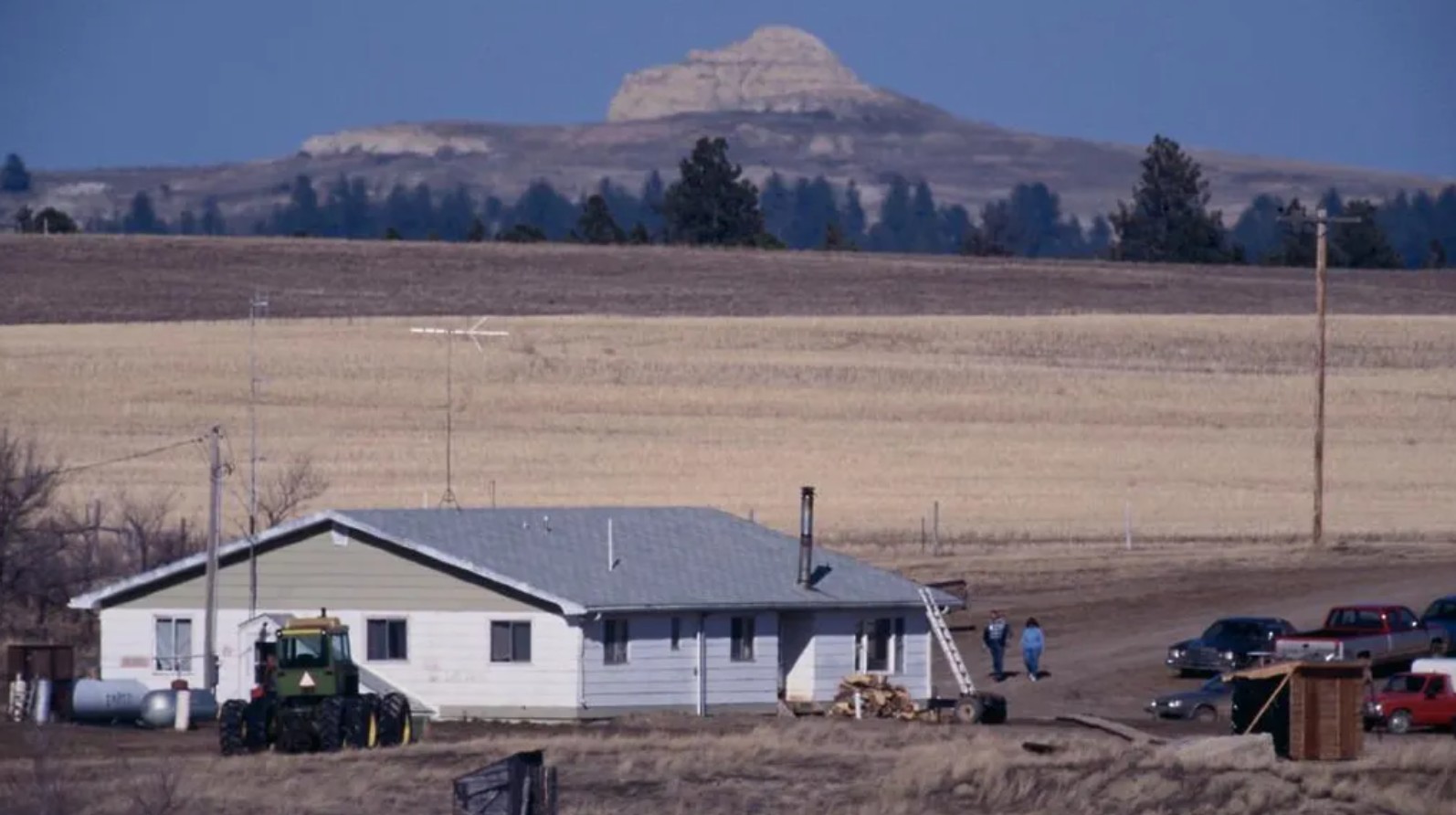
The Freemen, also known as the Montana Freemen, were an anti-government Christian Patriot militia that emerged in 1993, operating from a foreclosed 960-acre farm outside the town of Jordan, Montana. The group declared the property to be “Justus Township” and proclaimed themselves “sovereign citizens” who were exempt from outside laws, taxes, and government authority. Drawing their ideology from the radical right and the 1980s Posse Comitatus movement, they sought to establish a white Christian republic governed by what they called common law.
The Freemen’s beliefs were rooted in Christian Identity, a religious movement that teaches that white people are the true biblical Israelites and that nonwhites and Jews descend from Cain. From this perspective, the federal government was viewed as an illegitimate, Satanic institution, while taxes, driver’s licenses, building permits, and other civic obligations were rejected as tools of a corrupt “New World Order.” Researchers who studied extremist movements have argued that this apocalyptic worldview appealed to some economically distressed individuals by framing personal financial difficulties as the result of a broader government conspiracy.
Former members, local residents, and county officials often described the group’s insular culture as cultlike. Relatives and community members said followers appeared completely committed to the group’s beliefs, while members divided families by treating anyone who rejected their ideology as an enemy. Some members also directed threats of violence toward relatives who opposed them. Scholars noted that the movement’s religious convictions made negotiation especially difficult, as many followers believed they were participating in a final struggle between good and evil and were prepared to die rather than compromise.
Under the leadership of LeRoy M. Schweitzer, the Freemen transformed their sovereign citizen ideology into a large-scale financial fraud operation. Members used commercial legal manuals to file fraudulent multimillion-dollar liens against public officials they considered adversaries. They then used computers and laser printers to produce counterfeit checks and money orders backed by those false liens.
Authorities estimated that the group circulated approximately $20 million in fraudulent financial instruments nationwide, often overpaying for goods and requesting cash refunds. The scheme targeted banks, merchants, and government agencies. In 1995, members unsuccessfully attempted to purchase large quantities of firearms, ammunition, and bulletproof vests from a Montana gun dealer using a fraudulent $1.4 million check.
The Freemen also established their own parallel system of government, holding mock trials in occupied courtrooms where they issued arrest warrants and even a writ of execution against a federal judge. Tensions with local authorities escalated in early 1995 after Garfield County rancher William Stanton became the first Montana resident convicted of terrorism for using violence to achieve political ends. The following day, four armed Freemen were arrested outside a local courthouse while protesting an Internal Revenue Service property seizure.
The federal response reached its climax in the spring of 1996. After foreclosing on the Justus Township property, the Federal Bureau of Investigation launched a sting operation targeting the group’s financial schemes. On March 25, 1996, agents arrested Schweitzer and another leader, Daniel Petersen Jr. When authorities attempted to serve warrants on eight additional members at the ranch, an armed standoff developed.
Mindful of the deadly confrontations at Ruby Ridge in 1992 and Waco in 1993, the FBI adopted a cautious approach intended to avoid reinforcing the group’s apocalyptic expectations. In late April 1996, the bureau allowed political activist Bo Gritz to enter the compound as a mediator. Accompanied to the perimeter by Randy Weaver of the Ruby Ridge incident, Gritz spent four days attempting to negotiate before leaving unsuccessfully. He later described the Freemen’s arguments as a mixture of legal and religious “mumbo-jumbo.” After an 81-day standoff, the remaining Freemen surrendered peacefully on June 14, 1996.
The subsequent trials resulted in lengthy federal prison sentences for many of the group’s leaders. Schweitzer was convicted on 25 counts, including conspiracy, bank fraud, armed robbery, and firearms violations, and received a 22-year prison sentence. He died in 2011 at the federal Administrative Maximum facility in Florence, Colorado. Other leading members received prison terms ranging from one to 15 years. Even while incarcerated, several continued filing fraudulent property liens against judges and attempting to extort prison officials, resulting in additional criminal convictions and sentence extensions into the 2000s.
Key Sources:
The Associated Press. (2003, March 25). Two charged with trying to free Montana Freemen leader.
Goodstein. L. (1996, April 9). “Freemen’s” theological agenda. The Washington Post.
Kenworthy, T. (1996, April 1). Strange saga of “freemen.” The Washington Post.
Reuters. (1998, July 3). Montana jury convicts Freemen leaders.
Snow, R. L. (2002). Terrorists among us: The Militia Threat. Da Capo Press.
Worthington, R. (1996, April 15). Freemen leader a man with a mission. The Chicago Tribune.