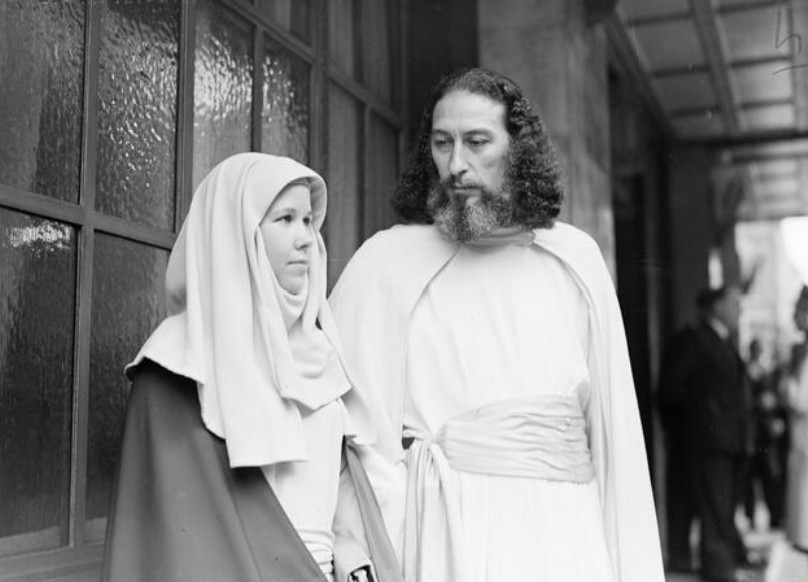
The WKFL (Wisdom, Knowledge, Faith, and Love) Fountain of the World, often referred to simply as “Fountain of the World,” was founded in California around 1948 by Francis Herman Pencovic, who later legally changed his name to Krishna Venta. Born in San Francisco on March 29, 1911, to a Romanian Jewish immigrant father and a Utah-born mother, Pencovic led a varied early life. He attended high school in Nevada, married twice, served in the United States Army during World War II, and accumulated a minor criminal record across several states. Following the war, he turned toward religious leadership and, in April 1948, publicly declared himself to be the physical reincarnation of Jesus Christ.
After assuming the identity of Krishna Venta, he developed a religious system that combined elements of Christianity, Eastern mysticism, Theosophy, and early UFO beliefs. Venta taught that he was a 244,000-year-old cosmic being from a lost planet called Neophrates, which he described as humanity’s original home before it became uninhabitable. According to his teachings, he had guided a fleet of spacecraft to Earth and had appeared repeatedly throughout history to provide spiritual guidance to figures including Moses, the Buddha, Mohammed, and Joseph Smith. Seeking to assemble a prophesied group of 144,000 “elect” who would survive an approaching apocalypse, Venta established the Fountain of the World’s headquarters on communal land in Box Canyon near Chatsworth and Simi Valley, California.
Life at the Box Canyon compound was organized around strict communal principles. New members were expected to surrender personal assets to the organization, and residents worked within a shared economic system to maintain the property. Followers adopted a distinctive appearance that included robes, barefoot living, and long hair and beards for men. Venta also introduced a set of “Twelve Commandments” that incorporated his teachings concerning cosmic forces and spiritual obedience into a framework based on traditional Judeo-Christian laws.
The community’s unusual lifestyle attracted public attention and prompted early allegations that Venta exercised extensive control over followers’ finances and personal lives. At the same time, the Fountain of the World developed a favorable public reputation through its involvement in charitable and emergency relief efforts. In 1949, members gained national attention when they participated in rescue and recovery operations following the crash of Standard Air Lines Flight 897R in the Simi Hills. During the following decade, the group regularly assisted with disaster relief efforts, fed homeless individuals, provided shelter to travelers, and volunteered to combat seasonal wildfires throughout Southern California. These activities earned recognition from local officials and generated goodwill within surrounding communities.
As the movement expanded, tensions developed within the organization. Critics and former members raised concerns about financial management, failed apocalyptic predictions, and allegations of sexual misconduct involving Venta. His teachings increasingly emphasized a Cold War-era doomsday scenario in which a racially motivated civil war would erupt in the United States. Venta predicted that African Americans would defeat white Americans before a Soviet invasion overwhelmed the victors. He taught that his followers would remain protected in a hidden valley during the conflict and would later emerge to defeat the Russians and establish his rule as a global spiritual leader. Over time, some members became skeptical of these predictions and of rumors that community resources were being used to support Venta’s personal habits.
Internal disputes reached a climax on December 10, 1958. Two former followers, Peter Duma Kamenoff and Ralph Muller, arrived at the Box Canyon headquarters carrying 20 cartridges of dynamite and detonators. The men had previously recorded statements expressing their intention to hold Venta accountable for what they viewed as fraudulent conduct and for allegations that he had engaged in sexual relationships with their wives. During a confrontation inside the compound’s main stone-and-timber monastery building, an explosion occurred that killed Venta, the two former members, and seven additional residents. Among the dead were a senior administrator known as Cardinal Gene, his wife, and their eleven-month-old son. The blast destroyed the headquarters, injured several children in a nearby dormitory, and sparked a brush fire that burned approximately 150 acres.
The death of Krishna Venta marked the beginning of the movement’s decline, although the organization continued in several locations. Venta’s widow, Mother Ruth Pencovic, assumed leadership and remained at the California property while attempting to consolidate followers around a secondary settlement in Homer, Alaska, which had been established in 1956. Other disciples, including members known as Sister Thedra and Sister Wali, relocated to Mount Shasta, California, where they claimed to receive ongoing spiritual guidance from Venta after his death. Without its founder, however, the movement experienced a substantial decline in membership throughout the 1960s.
The Box Canyon property continued to attract attention from alternative religious and countercultural groups after Venta’s death. In 1968, Charles Manson and several early members of his commune lived at the Fountain of the World property for a period of months. Manson reportedly studied Venta’s teachings, particularly those concerning an approaching racial conflict, and unsuccessfully attempted to position himself as the group’s new messianic leader before being expelled. During the same year, Sun Myung Moon and his followers also temporarily occupied the site.
By the mid-1970s, most of the remaining Fountain of the World facilities had disappeared, and the organization was formally dissolved in the early 1980s. Although remembered for its distinctive religious teachings and communal lifestyle, the movement’s history remains closely associated with both its extensive public service activities and the violent events that led to its decline.
Key Sources:
Barrera, S. (2024, June 19). 16.5-acre cult settlement in West Hills’ rugged Box Canyon lists for $4.8M. The Los Angeles Daily News.
Hill, G. (1958, December 11) 9 Killed in Blast at Cult’s Center. The New York Times.
Hunu, J. (2012). Legends of Mount Shasta. Smashwords.
Jenkins, P. (2000). Mystics and Messiahs: Cults and New Religions in American History. Oxford University Press.
Renshaw, E. (2020, January 10). Looking back: Krishna Venta aimed to inspire local religious leaders in Sioux Falls. Instead, he was met by police. The Sioux Falls Argus Leader.