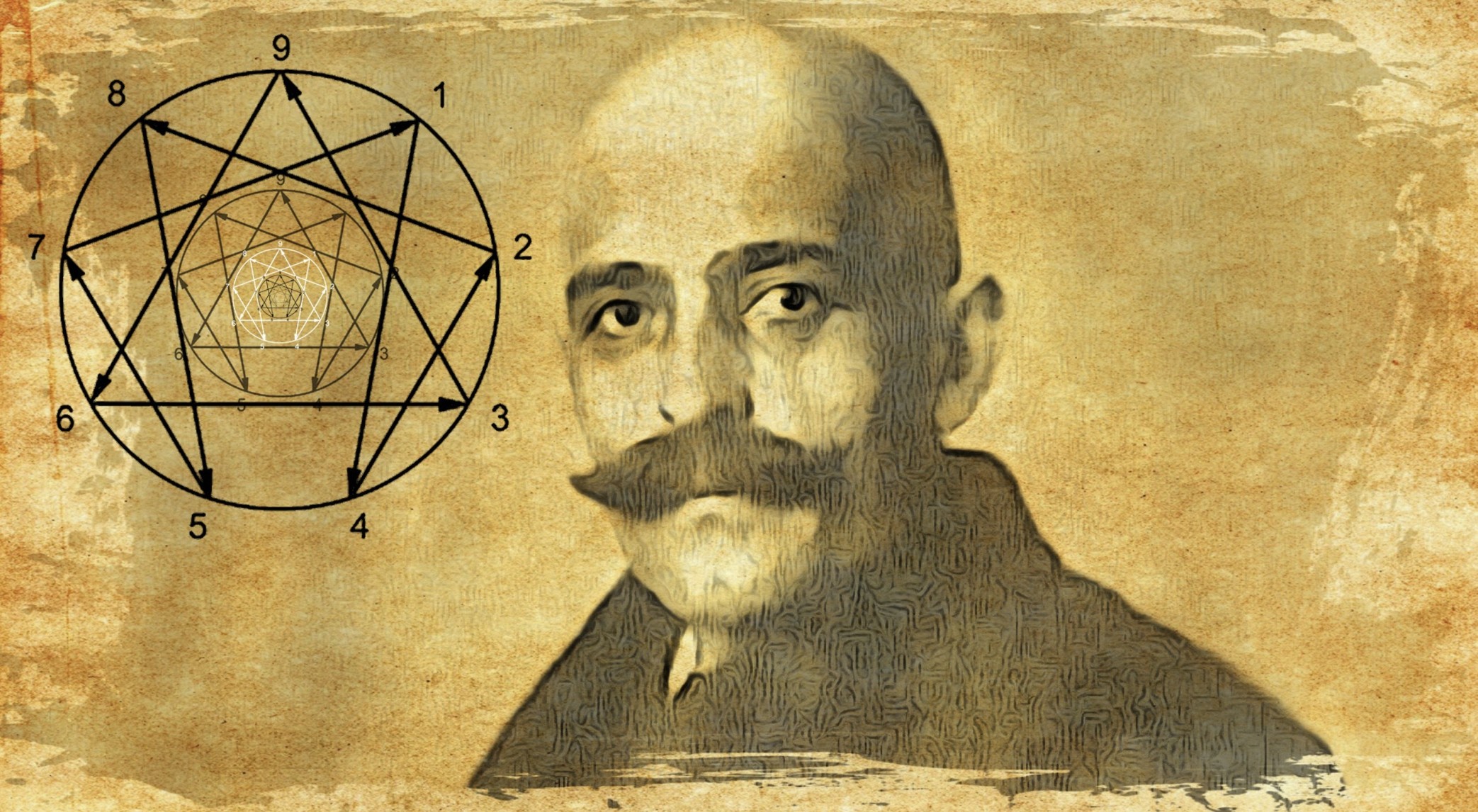
George Ivanovich Gurdjieff was a philosopher, mystic, spiritual teacher, composer, and choreographer whose teachings gave rise to one of the 20th century’s influential esoteric movements. At the center of his system was the claim that ordinary human beings do not possess consciousness in a meaningful sense but instead exist in a state of “waking sleep” — a mechanical condition governed by automatic reactions rather than sustained awareness.
Gurdjieff taught that people could awaken from this condition through deliberate and sustained effort, a process he and his students called “the Work” or “self-remembering.” His approach was later termed the “Fourth Way” by his most prominent pupil, P. D. Ouspensky. It combined elements associated with the fakir, the monk and the yogi into a discipline intended to develop the body, emotions and intellect simultaneously without requiring practitioners to withdraw from ordinary life.
Considerable uncertainty surrounds Gurdjieff’s exact birth date, with estimates ranging from 1866 to 1877, although most surviving official records point to 1877. He was born in Alexandropol, in the Yerevan Governorate of the Russian Empire, present-day Gyumri, Armenia. His surname was an anglicized Russian rendering of the Greek surname Georgiádes.
His father Ivan Ivanovich Gurdjieff was an ethnic Greek and a respected bardic poet who managed substantial herds of livestock. Family accounts traced their ancestry to Greeks who emigrated from Byzantium after the fall of Constantinople in 1453, initially settling in Anatolia before moving to Georgia. Gurdjieff’s mother was long considered Armenian, although some more recent scholarship has suggested that she may also have been of Greek descent.
Gurdjieff spent his childhood in Kars, the administrative capital of the annexed Transcaucasus region. The area had a diverse population that included Armenians, Greeks, Georgians, Russians, Kurds, Turks and Yazidis. He became fluent in several languages, including Armenian, Pontic Greek, Russian and Turkish.
His early influences included his father and Dean Borsh, the priest of the town’s cathedral. As he read widely and encountered phenomena he believed could not be explained through conventional science, Gurdjieff developed the conviction that humanity had once possessed a body of hidden knowledge that had since been lost.
He came to believe that this knowledge could not be recovered through mainstream science or conventional religion. According to Gurdjieff’s own autobiographical account, described primarily in Meetings with Remarkable Men, he spent roughly the years from 1884 to 1912 traveling through Central Asia, Egypt, Iran, India, Tibet, and other regions in search of esoteric knowledge.
Gurdjieff remained deliberately vague about the ultimate source of his teachings, at times describing them as a form of “esoteric Christianity.” His account included encounters with dervishes, fakirs and purported descendants of the Essenes whose teachings, he claimed, had been preserved at a monastery called Sarmoung.
Later researchers proposed that the various “remarkable men” in his writings could also be interpreted symbolically as personality types centered on the physical body, emotions or mind. Gurdjieff claimed that he supported himself through activities including operating a mobile repair shop, manufacturing paper flowers and dyeing sparrows yellow so they could be sold as canaries. Some commentators have also speculated that he may have been involved in political intelligence activity connected to the “Great Game.”
Gurdjieff’s documented career began around 1913. He had arrived in Moscow on New Year’s Day 1912 and began attracting his first students, among them his cousin, the sculptor Sergey Merkurov. That same year, he married Julia Ostrowska, a Polish woman, in Saint Petersburg.
In 1914, he advertised a planned ballet titled “The Struggle of the Magicians.” A major development came in 1915, when Gurdjieff accepted the writer and mathematician P. D. Ouspensky as a student in Moscow. The following year, composer Thomas de Hartmann and his wife, Olga, became pupils. During this early Russian period, Gurdjieff’s system was complex and metaphysical and frequently employed scientific-sounding terminology.
The Russian Revolution soon disrupted his activities. In 1917, Gurdjieff left Petrograd and returned to his family home in Alexandropol. During the October Revolution, he established a temporary study community in Essentuki in the Caucasus. While he was there, news arrived that his father had been killed by Turkish forces in Alexandropol. As conditions deteriorated during the Russian Civil War, Gurdjieff fabricated a newspaper account about an impending scientific expedition and used it to leave Essentuki with 14 companions.
In March 1918, Ouspensky formally broke away from Gurdjieff and eventually settled in England, where he taught independently. Their relationship remained ambivalent for decades.
In the spring of 1919, Gurdjieff met the artist Alexandre de Salzmann and his wife, Jeanne, who became his students. Jeanne de Salzmann later became one of his most important followers and assisted Gurdjieff with his first public demonstration of the Sacred Dances at the Tbilisi Opera House in June 1919.
In 1919, Gurdjieff relocated to Tbilisi, Georgia, where he opened his first formal Institute for the Harmonious Development of Man. Political conditions in Georgia worsened in May 1920, prompting Gurdjieff and his group to travel to the Black Sea coast and then by ship to Constantinople. There, he rented apartments near a Sufi lodge, and he and his students witnessed the whirling ceremony of the Mevlevi dervishes. It was also in Constantinople that Gurdjieff first met John G. Bennett, then a British military intelligence officer. Bennett later noted Gurdjieff’s shaven head, large black mustache and commanding demeanor.
Between 1921 and 1922, Gurdjieff traveled through Western Europe, giving lectures and demonstrations in cities including Berlin and London. During this period, several prominent students originally associated with Ouspensky came into Gurdjieff’s orbit, most notably editor A. R. Orage.
After an unsuccessful attempt to obtain British citizenship, Gurdjieff established his Institute for the Harmonious Development of Man at the Prieuré des Basses Loges in Avon, near Fontainebleau south of Paris, in October 1922. The estate housed several dozen residents, including members of Gurdjieff’s family and White Russian émigrés.
At the Prieuré, Gurdjieff put his teaching into practice through lectures, music, dance and substantial manual labor intended to develop students physically, emotionally and intellectually at the same time. Many educated, middle-class newcomers found the institute’s spartan conditions and emphasis on strenuous physical labor difficult.
Critics and observers also raised allegations about authoritarian and cultlike dynamics. Gurdjieff exercised extensive authority over followers’ daily lives, including their diets, schedules and interpersonal relationships. Observers described his behavior toward students as volatile and unpredictable, including episodes in which he appeared to erupt in anger before quickly returning to a calm manner.
The atmosphere at the Prieuré attracted further public attention after the death of writer Katherine Mansfield from tuberculosis at the institute in January 1923. Critics subsequently called Gurdjieff “the man who killed Katherine Mansfield,” alleging that his rigorous regimen and lack of conventional medical oversight contributed directly to her death.
Supporters maintained that Mansfield was already terminally ill and considered her final days at the institute meaningful. Detractors also cited what they described as Gurdjieff’s psychological control over followers, isolation of students from their families, opaque financial demands and manipulation of group dynamics as evidence of a destructive cult atmosphere.
Beginning in 1924, Gurdjieff made repeated visits to North America, working with pupils originally recruited by A. R. Orage. That year, he suffered a near-fatal automobile accident while driving alone from Paris to Fontainebleau.
His wife and mother nursed him back to health despite the medical expectations surrounding his injuries. While recovering, Gurdjieff formally disbanded the Prieuré institute in August 1924, dispersing what he described as his “less dedicated” pupils while retaining his core followers.
Unable to write by hand because of his condition, he began dictating Beelzebub’s Tales to His Grandson. He composed it in a mixture of Armenian and Russian and used a deliberately convoluted style intended to require active interpretation from readers.
Gurdjieff’s mother died in 1925, followed by his wife, Julia, who died of cancer in June 1926. From late 1925 through spring 1926, Gurdjieff was in New York raising funds. His direct and demanding approach to money alienated some supporters during his subsequent American visits. A Chicago-based group was founded in 1927 by writer Jean Toomer.
Despite these activities, the Prieuré remained in debt and closed permanently in 1932. Gurdjieff subsequently formed a new, all-female teaching group in Paris known as “The Rope,” whose members included writers Kathryn Hulme, Jane Heap and Margaret Anderson, as well as Dorothy Caruso. In 1936, he settled into a small apartment at 6 Rue des Colonels-Renard in Paris, where he remained for the rest of his life.
During World War II, Gurdjieff continued teaching from the apartment, hosting elaborate dinners featuring toasts to “idiots,” accompanied by vodka, cognac and Eastern delicacies. His teaching during this period relied primarily on direct personal interaction rather than formal group instruction.
His involvement in the oriental rug trade allowed him to provide charitable relief to wartime neighbors, although the activity resulted in at least one night in police custody. Following the war, Gurdjieff reconnected with former students.
After Ouspensky died in October 1947, Ouspensky’s widow encouraged his remaining students to visit Gurdjieff in Paris. Many had believed Gurdjieff was dead because Ouspensky had deliberately withheld information that he was still alive.
Gurdjieff survived a second serious automobile accident in 1948. After recovering, he finalized arrangements for the publication of Beelzebub’s Tales, made two further trips to New York and visited the prehistoric cave paintings at Lascaux. He died of cancer at the American Hospital in Neuilly-sur-Seine on October 29, 1949. His funeral was held at the St. Alexandre Nevsky Russian Orthodox Cathedral in Paris, and he was buried in the cemetery at Avon.
The foundation of Gurdjieff’s teaching was the idea that ordinary human beings cannot perceive reality accurately because they exist in a continuous, hypnotic state of “waking sleep.” He argued that established religious traditions had lost contact with their original vitality.
In his framework, the traditional paths of the Fakir, Monk and Yogi each developed a different aspect of a person: physical asceticism, emotional devotion and intellectual study. Gurdjieff regarded these approaches as limited because each concentrated on one dimension of the human being and traditionally required withdrawal from ordinary life.
His Fourth Way sought to develop the physical, emotional and intellectual dimensions simultaneously while allowing practitioners to remain engaged in everyday existence. Gurdjieff himself placed relatively little emphasis on the specific term “Fourth Way”; Ouspensky made it central to his presentation of the teaching between 1924 and 1947.
According to Gurdjieff’s framework, human beings function through three primary centers: intellectual, emotional and physical or moving. He also described two higher centers that remain inactive in most people. He distinguished between “Essence,” the innate and natural part present from birth, and “Personality,” which develops through social conditioning. His concept of the “many I’s” described ordinary psychology as fragmented into numerous disconnected impulses rather than governed by a single, stable sense of self.
Practices intended to address this condition included self-observation, “conscious labour,” meaning action undertaken with full presence, and “intentional suffering,” which involved struggling against automatic habits.
Gurdjieff’s cosmology centered on two universal laws. The Law of Seven described natural and human processes as proceeding through periodic cycles of rise and decline, while the Law of Three held that every phenomenon arises through active, passive and reconciling forces.
Their interaction was represented in the Enneagram, a nine-pointed geometric figure that Gurdjieff presented as a universal symbol capable of encoding knowledge. The Enneagram later became associated with personality typology through figures including Oscar Ichazo and Claudio Naranjo, although that modern use is largely separate from Gurdjieff’s original cosmic formulation.
Gurdjieff used practical methods intended to foster self-awareness, including group meetings, music, lectures, sacred dances and physical exercises. In the “Stop” exercise, students were required to freeze instantly on command to interrupt automatic behavior.
His musical output totaled roughly 200 collaborative compositions, created primarily with Thomas de Hartmann during the 1920s, and drew on Caucasian, Central Asian and Russian Orthodox influences. The “Movements,” or sacred dances, were an integral part of his teaching and were intended to disrupt habitual physical postures and create new opportunities for self-observation.
After Gurdjieff’s death, his ideas were preserved and transmitted through a network of key pupils. Ouspensky helped spread his ideas through In Search of the Miraculous. Thomas de Hartmann co-founded the Gurdjieff Foundation in New York with his wife, Olga, who had served as Gurdjieff’s secretary. A. R. Orage served as the movement’s representative in the United States and translated several of Gurdjieff’s works.
Modern study groups continue to operate in various parts of the world, maintaining practices associated with Gurdjieff’s teaching, including self-observation, group work and the Movements.
Key Sources:
Churton, T. (2017). Deconstructing Gurdjieff: Biography of a Spiritual Magician. Simon and Schuster.
Gurdjieff, G. I. (2021). Beelzebub’s tales to his grandson. Rare Treasure Editions.
Gurdjieff, G. I. (2021). Meetings with Remarkable Men. Rare Treasure Editions.
Lipsey, R. (2019). Gurdjieff reconsidered: The Life, the Teachings, the Legacy. Shambhala Publications.
Ouspensky, P. D. (2001). In search of the miraculous: Fragments of an Unknown Teaching. Houghton Mifflin Harcourt.
Taylor, P. B. (2020). G.I. Gurdjieff: A Life.