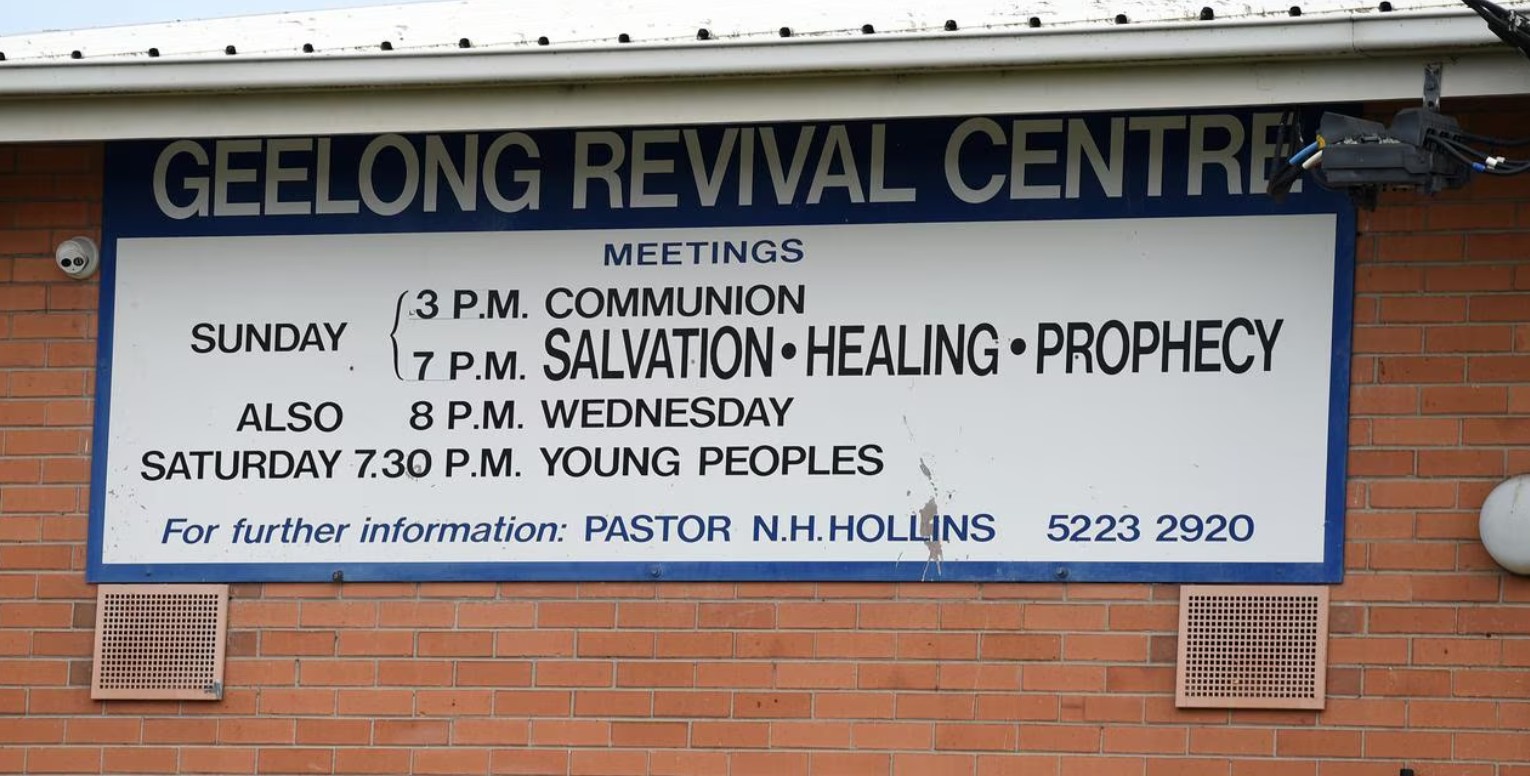
The Geelong Revival Centre (GRC) is a Pentecostal church headquartered in Norlane, a suburb of Geelong, Victoria, Australia. Founded around 1960, the GRC expanded under pastor Noel Hollins into a network of more than 20 affiliated assemblies across Australia and internationally. Hollins led the church for about 65 years until his death in April 2024 at age 93. During his tenure, the GRC became the subject of investigative journalism and accounts from former members who characterized it as a high-control, apocalyptic sect.
Allegations concerning the church have included extensive control over members’ personal lives, mandatory shunning of former followers, discouragement of medical treatment, physical punishment of children, invasive sexual questioning, and the internal handling of allegations of child sexual abuse.
Under Hollins, the church developed a centralized spiritual and administrative hierarchy. Followers referred to him as “the apostle” and regarded him as God’s representative on Earth. Baptized members were designated as “saints” and practiced glossolalia, or speaking in tongues, which Hollins taught was a form of direct communication with God.
The GRC’s theology focused on an anticipated nuclear apocalypse and the Battle of Armageddon. Hollins taught that the world was engaged in spiritual warfare and that GRC members alone would survive the coming destruction. Other religious denominations, non-members, and the wider society were described as destined for damnation.
Daily and weekly life at the GRC required significant commitments of time and behavior. Members, including children, attended multi-hour weekly services at the Norlane headquarters, as well as periodic 11-hour prayer and sermon sessions conducted without food. The church also held annual camps lasting several weeks. Traditional holidays, including Christmas, were prohibited, while birthday celebrations were significantly restricted.
The GRC maintained a hierarchy with Hollins at the top, followed by male members, who were given authority over women. Women, in turn, were assigned responsibility for disciplining children. Gender roles were strictly defined. Women were expected to submit to their husbands, were prohibited from initiating courtships, and were encouraged to forgo higher education and professional careers in favor of domestic responsibilities.
Courtships and marriages were also subject to church oversight. Proposed relationships required pastoral approval, and Hollins personally approved, rejected, or arranged marriages. He also regulated when married couples could have children. Chaperones were required during courtships, while physical affection was restricted. Members who engaged in premarital sex could be expelled from fellowship for two years. Women who violated the church’s purity rules were permanently prohibited from wearing white at their weddings.
Sermon recordings from the 2010s showed pastors publicly criticizing working mothers who relied on childcare. The sermons also described professional women’s clothing as a “mark of the world” and criticized husbands who assisted with household chores on the grounds that they were failing to maintain authority within the home.
Former female members reported that Hollins exercised control over personal matters, including the sexual histories of teenage girls and young women. They described one-on-one interrogations in which they were asked to provide explicit details about their sexual experiences.
According to former members, women were pressured to disclose these details under threat of expulsion, including in cases where the sexual encounters had been non-consensual. In one reported case, a young woman was interrogated and then suspended from the fellowship for a year after experiencing a non-consensual sexual assault. Church leadership reportedly expected her to marry the perpetrator.
The GRC’s approach to medical treatment also emphasized faith healing over conventional healthcare. Church literature and pastoral guidance reportedly presented visits to physicians and the use of prescription medications, particularly for mental health conditions such as anxiety and depression, as indications of weak faith or spiritual failure.
Former members said they were told that relying on medical treatment was equivalent to surrendering to the devil. They reported that this contributed to some individuals with serious physical or psychiatric conditions avoiding conventional treatment.
In one case in the early 2000s, a pastor read an 18-year-old former member’s suicide note aloud to the congregation. The pastor reportedly presented her death as a warning against leaving the church.
The physical discipline of children was also explicitly encouraged within the community based on biblical interpretations. Former members described instances of corporal punishment, including cases in which adolescents were beaten with bamboo implements that they had selected themselves. In another reported case, a church member physically disciplined an autistic child for behaviors associated with his condition. The child’s mother was reportedly told that more physical punishment was necessary to correct the behavior.
The GRC also maintained separation from wider society through ideological instruction and behavioral restrictions. Members were instructed to avoid mainstream media, popular music, the internet, and secular entertainment, which church leaders characterized as corrupting influences. Social contact with non-members, referred to as “karmis,” was discouraged. Children attending public schools reported being separated from peers outside the church.
Mandatory shunning served as a primary means of internal discipline. Individuals who left or were formally expelled were subjected to social separation. Remaining family members, including spouses, parents, and children, were forbidden from contacting, visiting, or providing comfort to them.
Former members have described psychological difficulties after leaving the church, including long-term post-traumatic stress symptoms, anxiety, and instances of suicide among former followers.
Financially, Hollins managed church funds centrally and directed substantial tithes and donations into organizational accounts, while maintaining what was described as a modest personal lifestyle. Questions were also raised about the church’s handling of criminal allegations. Reports of misconduct, including child sexual abuse, were allegedly required to be brought directly to Hollins for internal resolution rather than reported to civil authorities.
In 2024, prominent GRC member Todd Hubers van Assenraad was sentenced to 22 years in prison by Victoria’s County Court for sexually abusing nine young boys. Court proceedings revealed that when one victim’s father initially reported the abuse to Hollins, the pastor did not contact police. Instead, he arranged a private meeting with the alleged offender. Law enforcement became involved only after a mother independently reported the abuse.
When media organizations approached Hollins about allegations concerning the GRC, he repeatedly declined to address specific claims and accused former members of fabricating allegations because of personal grievances. Hollins died in April 2024, after which leadership of the church passed to pastor Brian Griggs. Griggs likewise declined to comment publicly on the church’s practices.
Key Sources:
Baker, A. (2024, December 6). Church leader demands details of young female members’ sex lives. News.com.au.
Baker, R. (2024, December 5). Call to outlaw ‘coercive’ cults, stop financial secrecy for extreme churches. The Age.
Molloy, S. (2025, February 22). I thought I lived a normal life —at 40, I realized I was in a notorious cult-like church and ran away. The New York Post.
Tippett, H. (2022, September 7). Ex-members allege mental abuse at the hands of Geelong ‘cult.’ The Geelong Advertiser.