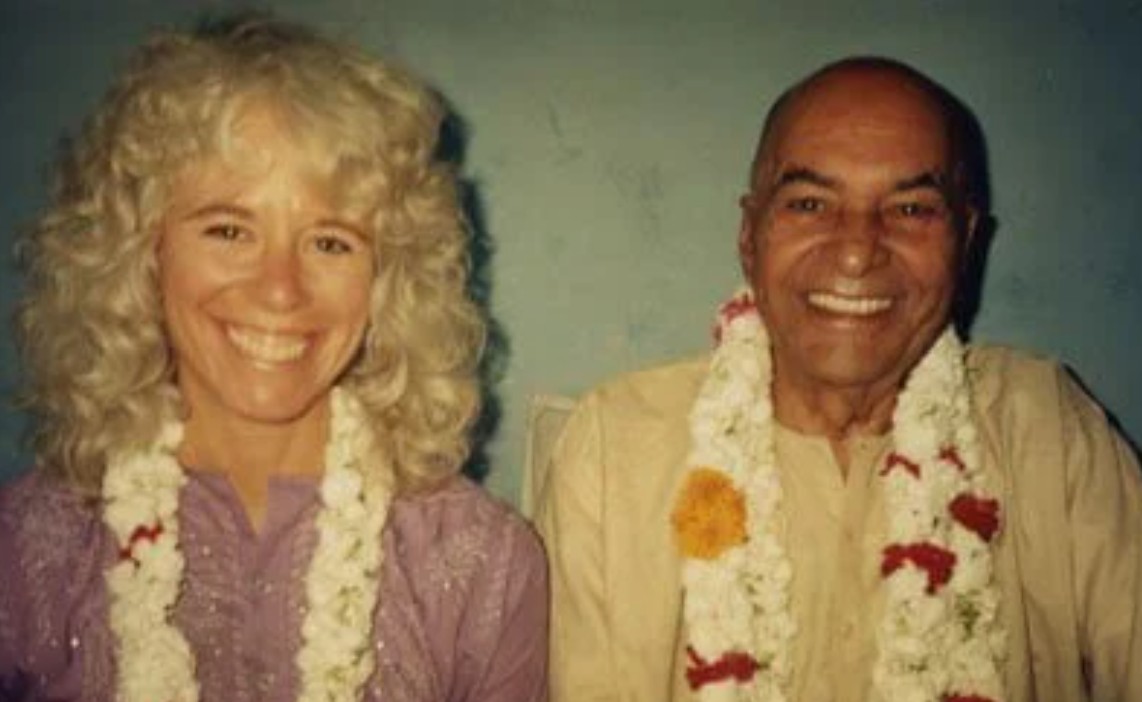
Gangaji is an American spiritual teacher and author associated with the Neo-Advaita non-dual movement. She was born Merle Antoinette Roberson in Texas in 1942 and raised in Mississippi. Some sources render her name as Antoinette Varner or refer to her informally as Toni. After graduating from the University of Mississippi, Roberson married her first husband, had a child, and worked as an elementary school teacher in Memphis, Tennessee. In 1972, she moved to California, where her first marriage ended in divorce.
During her years in California, Roberson became increasingly involved in spiritual exploration. She eventually married her second husband, Eli Jaxon-Bear. Together, they managed a Tibetan Buddhist dharma center under the guidance of Kalu Rinpoche, giving Roberson an early background in formal meditation practice.
Roberson’s spiritual search continued across political activism, subcultural movements, and various spiritual traditions. In 1990, she and Jaxon-Bear traveled to India seeking what they described as direct spiritual awakening. Jaxon-Bear first met Sri H.W.L. Poonja, an Indian teacher commonly known as Papaji, who taught a form of self-inquiry associated with the tradition of Ramana Maharshi. Papaji was based near the Ganges River in Lucknow.
After Jaxon-Bear reported experiencing spiritual realization, Roberson joined him in meeting Papaji. She later described the encounter as a turning point that resolved her longstanding spiritual search and changed her understanding of individual personal identity. Papaji recognized what he regarded as Roberson’s self-realization and gave her the name Gangaji, which refers to the sacred Ganges. He also instructed her to bring his teachings to Western audiences.
After returning to the United States, Gangaji established the Gangaji Foundation to support her teaching work. The organization sponsored open teaching gatherings known as satsang, published books, and distributed audio and video recordings.
Gangaji’s central message reflects the principles of Neo-Advaita philosophy. She teaches that human beings are fundamentally pure consciousness and are already inherently free. In this view, spiritual realization does not require an extended process of self-improvement or an effort to escape ordinary life, but recognition of what she describes as present truth.
Gangaji subsequently authored several books that developed these ideas. Her books and teaching talks use an intimate and accessible style and emphasize equality between teacher and student. Rather than presenting herself as an authority removed from her students, Gangaji encourages seekers to direct their inquiry inward.
Her teachings also caution against using spiritual practice as a form of “spiritual bypassing,” a term used to describe attempts to avoid addressing personal pain, relationship conflicts, or broader forms of suffering through spiritual beliefs or practices.
At the same time, the movement surrounding Gangaji, like other contemporary Neo-Advaita communities, has faced scrutiny and allegations of cultlike practices from critics, cult researchers, and former followers. Much of the criticism concerns institutional power dynamics associated with modern guru-led communities. Critics and researchers have argued that devotion to a teacher regarded as enlightened can create conditions for unquestioning compliance, psychological dependency, or financial exploitation.
Some critics have also argued that the non-dual concept of ultimate freedom can be used to dismiss criticism, minimize ethical concerns, or discourage followers from addressing psychological harm that occurs within a spiritual community.
These questions about leadership and institutional dynamics received greater public attention in October 2005, when Gangaji and Jaxon-Bear temporarily separated after Jaxon-Bear acknowledged having a secret three-year sexual relationship with an adult student who was also a teacher within his organization, the Leela Foundation. The executive director of both foundations publicly described the relationship as a breach of trust and an abuse of power within the teacher-student relationship.
Gangaji and Jaxon-Bear reconciled three months later and subsequently consolidated their operations by merging their respective organizations. The combined foundation operates from Ashland, Oregon, where it continues to host events, publish media, and maintain its network of followers.
Key Sources:
Gangaji. (2005). The Diamond in Your Pocket: Discovering Your True Radiance.
Gangaji, & Moore, R. (2003). Just Like You. Do Publishing Company.
Plain, R. (2006, October 14). Spiritual leaders’ split leads to consolidation of groups. The Ashland Daily Tidings.
Robinson, R. M. (2007). Ordinary women extraordinary wisdom: The Feminine Face of Awakening. Mantra Books.