The “Franklin Conspiracy” refers to a series of allegations that emerged in Omaha, Nebraska, during the mid-to-late 1980s. The claims alleged that a child sex-trafficking network connected to prominent local and national figures had operated for years under the cover of a community credit union. What began as an investigation into financial fraud expanded into one of the most controversial episodes of the “satanic panic” era, generating allegations of ritual abuse, blackmail involving political figures, and a series of unexplained deaths among people connected to the case.
Two separate grand juries ultimately concluded that the abuse allegations were unsubstantiated and described them as fabricated, although some investigators, journalists, and former members of the legislative committee later argued that the inquiries had been compromised.
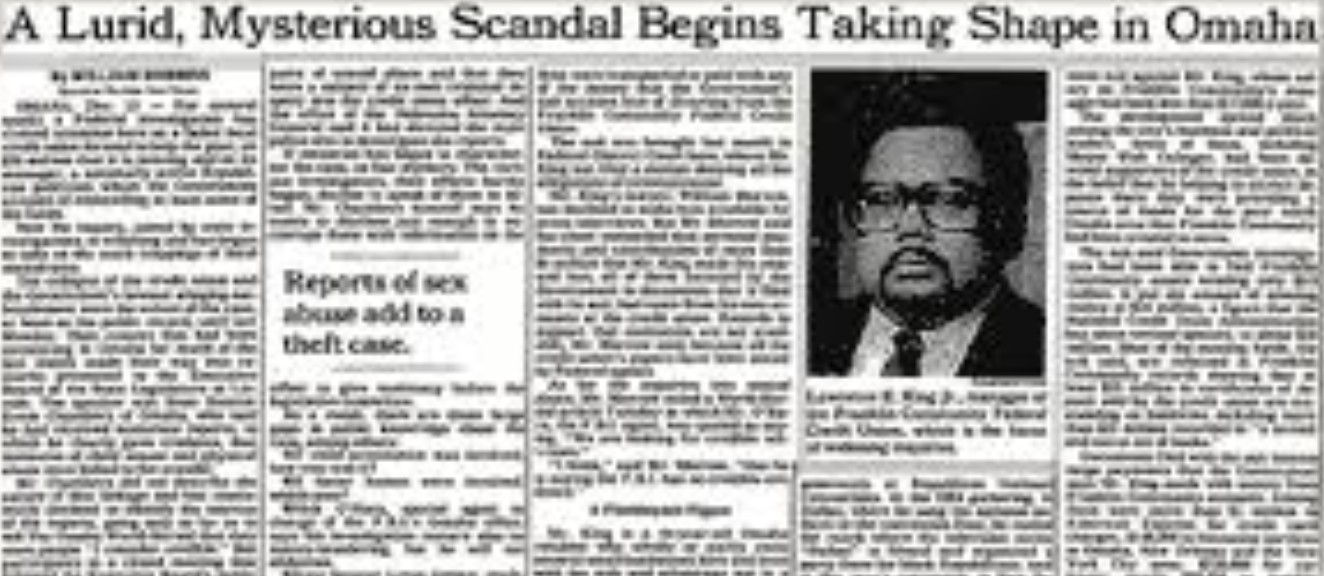
At the center of the controversy was Lawrence E. King Jr., manager of the Franklin Community Federal Credit Union, a small Omaha institution founded in 1968 to provide financial services to the city’s African American community. King assumed management in 1970 and significantly expanded the credit union over the following decade, including through a program that administered welfare and disability payments for members. He also offered certificates of deposit with above-market interest rates, a practice that later came to be characterized as a Ponzi-like arrangement requiring a constant influx of new deposits to meet existing obligations.
As King’s influence grew, so did his public profile. Although his reported salary from the credit union was approximately $16,000 annually, he maintained an affluent lifestyle that included a Mercedes, chartered aircraft, and residences in both Omaha and Washington, D.C.
King became active in Republican politics, eventually serving as chairman of the National Black Republican Council and performing the national anthem at Republican National Conventions during the 1980s. He also sat on the boards of local charitable organizations, including Boys Town and the Omaha Girls Club. Those affiliations later figured prominently in allegations that he had used his charitable connections to identify vulnerable children.
Questions about the credit union’s finances had surfaced years before the scandal became public. An anonymous complaint to the National Credit Union Administration in 1981 prompted an inquiry that found several hundred thousand dollars unaccounted for.
In 1984, a former employee sent a letter alleging embezzlement and was subsequently dismissed. Federal audits were delayed through much of the decade. When regulators closed the institution in November 1988, examiners initially found tens of millions of dollars missing, with the total losses eventually estimated at approximately $39 million.
At the same time, though largely outside public attention, allegations of physical and sexual abuse involving foster children connected to individuals within the credit union’s circle had been reaching Nebraska social workers and law enforcement since at least 1985.
One Washington County investigation involving foster children living with a credit union board member, who was also King’s cousin, produced allegations of severe physical abuse. One child later told investigators she had been sexually abused for years. A social worker who compiled an extensive report based on interviews concluded that the children’s accounts were credible because of the consistency of their statements, but the report received little apparent response from the agencies to which it was submitted.
Additional reports followed over the next several years. A police interview involving a teenage girl who had participated in a modeling session arranged by an Omaha photographer led investigators to an apartment leased by King. Building employees also described rumors that King associated with young boys.
In 1988, investigators separately interviewed two teenage girls whose accounts closely matched one another. Both described parties where children were allegedly drugged and sexually abused by adult men, including individuals they identified as prominent in business, politics, and law enforcement.
They also described occult imagery and rituals, including robed participants and ceremonies referred to as “power meetings.” One witness alleged that an infant had been killed during a ritual. Investigators who received the initial statement did not pursue that allegation further, and the officer involved was later reassigned, a move that state senator Loran Schmit later suggested was intended to halt the investigation.
In November 1988, the Nebraska Legislature established the Franklin Committee to investigate both the collapse of the credit union and the abuse allegations. The committee was chaired by state senator Loran Schmit, with Ernie Chambers serving as vice chairman.
Its second investigator, former state trooper Gary Caradori, adopted a more expansive investigative approach by seeking out alleged victims directly. He collected videotaped testimony from several young men and women who said they had been recruited as children, transported to other cities by airplane, and sexually abused by networks of adult men connected to King and other prominent individuals.
The witnesses’ accounts contained similar descriptions of apartments, aircraft flights, and alleged participants. At the same time, several witnesses had personal histories that later became central to disputes over their credibility, including psychiatric hospitalization, prior criminal charges, or diagnoses of dissociative disorders.
One witness, who had received a diagnosis involving dissociative identity disorder, testified that she had been recruited into an interstate trafficking network, subjected to ritual abuse, and involved in the unsolved 1982 disappearance of an Iowa paperboy. Those allegations remain unresolved and have never been independently verified.
The investigation attracted national attention after an attorney working with the committee publicly released a memorandum identifying several individuals named in the videotaped testimony. National and regional media covered the allegations while local efforts sought to challenge the witnesses’ credibility.
In early 1990, following FBI interviews, two of the four videotaped witnesses recanted significant portions of their testimony. Supporters of the committee argued the recantations resulted from pressure by federal investigators, while critics viewed them as evidence that the original accounts had been fabricated or influenced.
The investigation took another turn in July 1990 when Caradori and his young son died after the small airplane he was piloting broke apart in flight over Illinois. Before the trip, Caradori had reportedly told colleagues that he expected to obtain physical evidence, including photographic negatives.
Investigators found no definitive cause for the crash, and no evidence of sabotage was established. Nevertheless, members of Caradori’s family and several committee supporters believed foul play was involved.
Former CIA Director William Colby, later retained by the committee, found no evidence of mechanical tampering but reportedly told committee members privately that he suspected the crash had not been accidental. Colby himself died several years later in a canoeing accident near his Maryland home, a death that has likewise generated speculation despite the absence of evidence supporting foul play.
Later that month, a Douglas County grand jury concluded that the abuse allegations were fabricated and suggested they may have originated with a disgruntled former Boys Town employee. The grand jury indicted two accusers on perjury charges.
A federal grand jury reached a similar conclusion in September 1990 and indicted one of the principal witnesses, Alisha Owen, on eight counts of perjury. She ultimately served more than four years in prison.
The federal proceedings also resulted in charges against King. In 1991, he pleaded guilty to conspiring to embezzle the approximately $39 million missing from the credit union and received a fifteen-year prison sentence. Despite the grand jury findings and perjury prosecutions, one witness, Paul Bonacci, later obtained a civil default judgment against King after King failed to appear in court to contest the lawsuit.
Public interest in the case continued after the criminal proceedings concluded. In 1992, former state senator John DeCamp, who had assisted the Franklin Committee, published a book arguing that the abuse allegations were substantially true and that official investigations had been obstructed to protect influential individuals.
Around the same period, Yorkshire Television produced a documentary examining the allegations, but it was withdrawn shortly before its scheduled broadcast for reasons that were never publicly explained. The cancellation became part of continuing claims that the case had been covered up.
The years following the grand jury investigations were marked by several deaths involving individuals connected directly or indirectly to the case, including relatives of witnesses, associates of King, and at least one police officer who had conducted an independent inquiry. Authorities attributed the deaths to causes including accidents and suicide. Those who questioned the official findings have cited the deaths as evidence of a broader effort to silence witnesses, although no investigation has established a connection between them.
Those who dispute the official findings emphasize the consistency of independently collected witness testimony, delays and irregularities in the early investigations, and the unresolved circumstances surrounding Caradori’s death. No subsequent investigation has conclusively resolved the competing interpretations, and the case continues to be cited in discussions of both institutional failures and the dynamics of moral panic.
Key Sources:
The Chicago Tribune. (1990, August 27). Sex Scandal Rumors Won’t Die In Omaha.
Lake, T. (2023, December 15). An Iowa paperboy disappeared 41 years ago. His mother is still on the case. CNN.
Robbins, W. (1988, December 25). Nebraska Inquiry Is Given File on Sex Abuse of Foster Children. The New York Times.
Robbins, W. (1990, July 29). Omaha Grand Jury Sees Hoax in Lurid Tales. The New York Times.