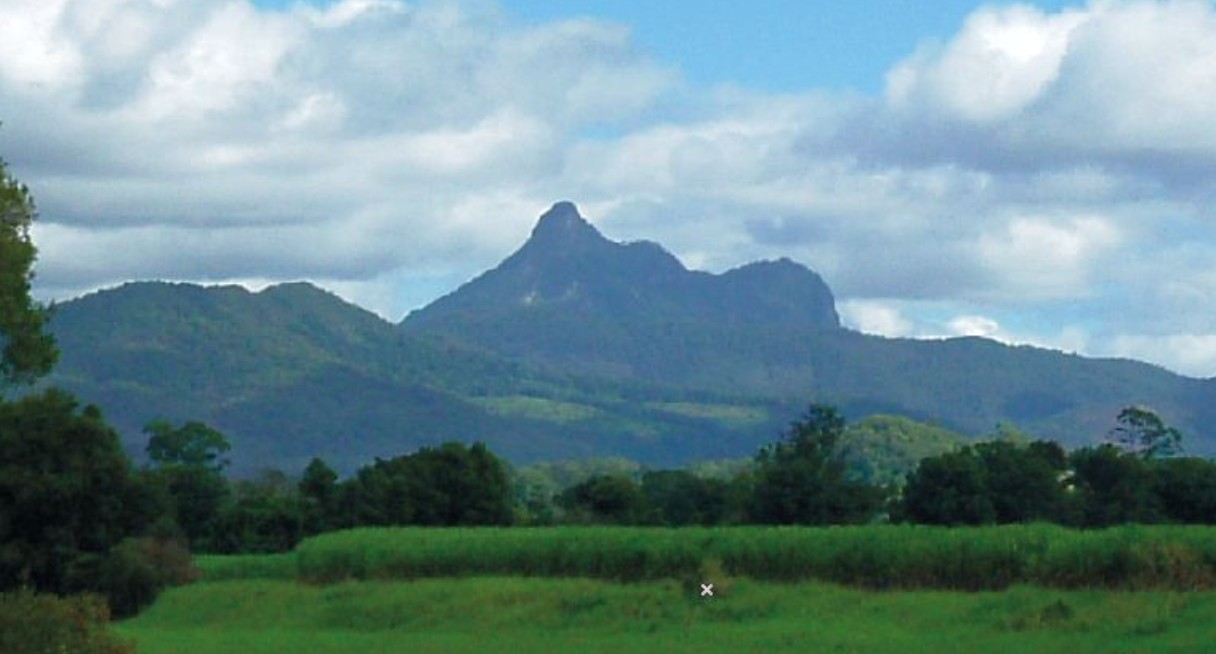
The Garden Ashram was a Hare Krishna-affiliated intentional community near Mullumbimby in the Northern Rivers region of New South Wales, Australia, situated on the Tweed River near Wollumbin (Mount Warning), a mountain significant to the Indigenous Bundjalung people. The region’s volcanic soil and heavy rainfall had long attracted people drawn to alternative lifestyles and Eastern spirituality.
Rather than belonging to the mainstream International Society for Krishna Consciousness (ISKCON), the ashram followed a breakaway lineage founded by Srila Narayana Maharaja, a former Indian police officer who joined a religious mission in 1947 and built his own network of temples after ISKCON founder A.C. Bhaktivedanta Swami Prabhupada died in 1977. Two of Narayana Maharaja’s Australian centers were established near Mullumbimby, one becoming known locally as the Garden Ashram, on an isolated property bordering a national park.
The property lacked a vehicular bridge; people crossed the river on foot via a log footbridge, drove through shallow water, or used boats during floods. Residents once built a barge from 44-gallon drums to ferry Narayana Maharaja across floodwaters. Despite having only one legally recognized two-bedroom house with electricity, phone service, and toilets, the ashram housed 15-20 residents living in tents, caravans, shipping containers, and hand-built huts.
Adult members typically arrived with prior involvement in alternative spirituality, often introduced through social networks in Mullumbimby. Communal life centered on shared meals, festivals, devotional singing, and a rigorous daily routine starting around 4 a.m. with ritual bathing, tilak markings, pre-dawn worship (mangala arti), and continuous chanting of the Hare Krishna mantra. Days included temple labor, property upkeep, and distributing or selling religious literature, with evening bhajans, scripture study, and chanting often continuing past midnight.
Residents included people drawn to conspiracy theories about fluoride and chemtrails, university dropouts, and international backpackers doing WWOOFing farm work. Former members described internal tensions involving multi-level marketing schemes, rivalries, and suspicion of informants from rival Hare Krishna factions, alongside the shared religious life.
Theologically, the group practiced a branch of Gaudiya Vaishnavism holding Krishna as the supreme deity, with human life meant to culminate in return to a spiritual realm. Members believed in karma-driven reincarnation shaped by one’s mental state at death, reinforcing an emphasis on constant religious remembrance. Other spiritual traditions, including rival Hare Krishna lineages, were considered invalid.
Finances were described as opaque; few adults held conventional jobs, many relied on welfare, and former members alleged fraudulent disability claims. Children’s small allowances were sometimes sent directly to Narayana Maharaja during his trips to India, and families financed international travel to India despite limited income, partly through street sales of religious texts.
Narayana Maharaja remained the central authority, reachable mainly through Australian visits or gatherings in Lucknow, India. Items associated with him (foot dust, food remnants, bath water) were treated as sacred relics. A formal hierarchy placed renunciate monks (sannyasis) highest, followed by married men, unmarried men, women, and children. Women were required to address men as “Prabhu” (master) and follow strict modesty rules, and menstruating women were segregated from rituals over contamination beliefs. The group encouraged arranged marriages, young motherhood, and older men marrying much younger foreign brides.
Children received fear-based religious education featuring graphic depictions of hell and punishments by Yamadutas, servants of the god of death. Scientific facts were replaced with theological claims, such as the sun being closer to Earth than the moon and earthquakes being caused by elephants. Children’s exposure to mainstream media and secular education was heavily restricted; they were taught physical discomfort could offset karmic debt and were steered away from Western medicine toward Ayurveda or faith healing. Practices included eating food previously offered to the deity even after it fell on the floor, and using untreated water from the Ganges and Yamuna.
Former members and cult researchers have characterized the Garden Ashram as cultic, citing the guru’s authority, rigid hierarchy, isolation from outsiders (“karmis”), and control over diet, relationships, and child-rearing. Domestic discipline was treated as private, and dissent could lead to ostracism or expulsion, often costing former members their entire social support network. Many have since reported lasting psychological effects, including trauma symptoms and difficulty readjusting to mainstream life.