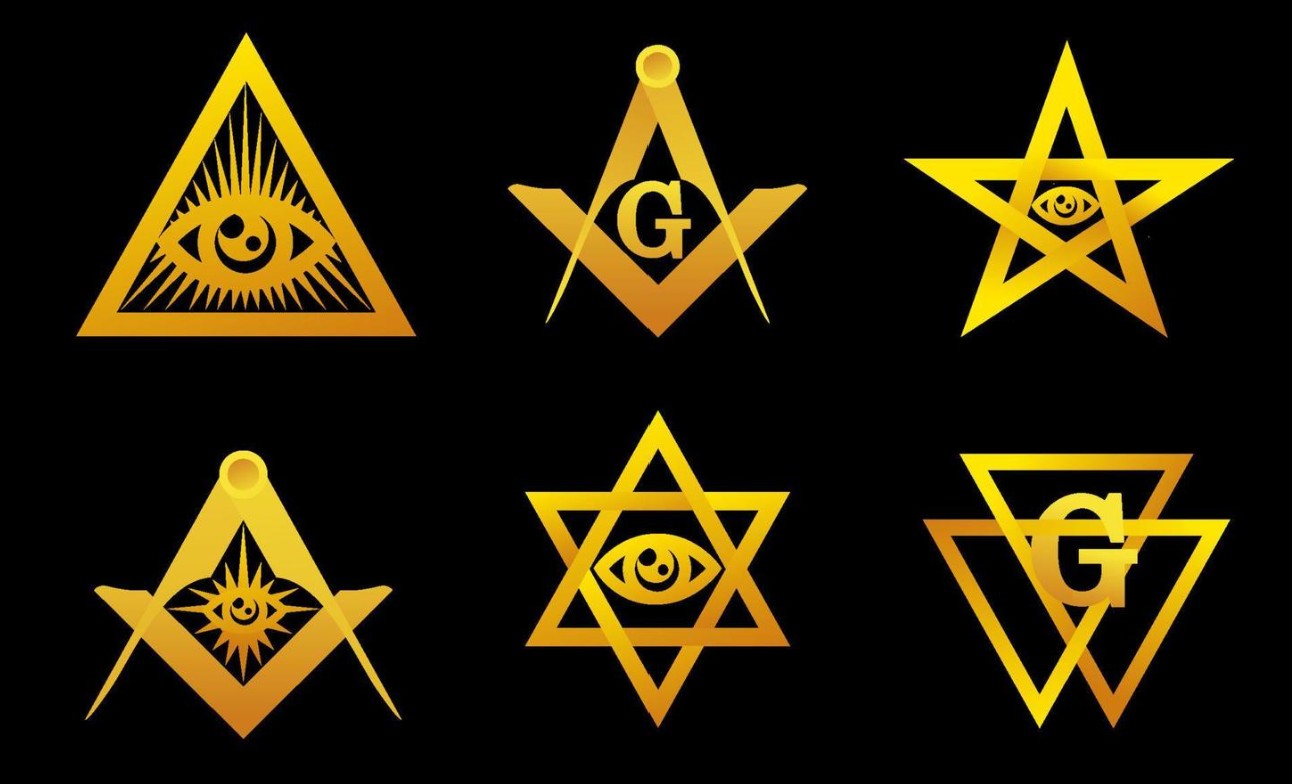
Freemasonry is the world’s oldest and largest fraternal organization. According to Masonic legend, its roots trace to the biblical construction of King Solomon’s Temple, a project described as requiring stonemasons to organize into groups with specialized responsibilities. No concrete historical evidence supports Masonic activity in ancient times.
Historically, Freemasonry traces its origins to the medieval guilds of stonemasons. During the Middle Ages, stonemasons and architects formed a class of workers able to travel between countries. This mobility was a freedom not extended to serfs, who faced strict travel restrictions. The term “free” is thought to derive from this mobility.
These craftsmen built many of Europe’s cathedrals and other significant structures. In this era, working stonemasons guarded practical trade secrets, though these do not appear to correspond to the secrets associated with modern Freemasonry. Until the 16th century, Masons remained craftsmen learning a practical trade within guilds and unions.
Firm written evidence of Masonic organizations dates to the 14th century, making it the oldest surviving secular fraternal organization in the world. Historians trace the movement’s roots to a body of documents known as the Old Charges, spanning from the Regius Poem of around 1425 through the early 18th century. These documents connect the craft to a mythologized history, describe the responsibilities of different grades, and outline how oaths of fidelity were administered. Ceremonial regalia first appears in the historical record during the 15th century.
The minute records of the Lodge of Edinburgh (Mary’s Chapel) No. 1 in Scotland document an unbroken line from an operative lodge dating to 1598 to a modern speculative lodge. It is widely considered the oldest Masonic lodge in the world. At the start of the 17th century, union membership began to decline. Members of broader society were increasingly permitted to join as patrons, and eventually as full “accepted” masons. This is the origin of the phrase “Free and Accepted Masons.”
By the close of the 17th century, accepted or non-practicing masons outnumbered working stonemasons within these unions. Discussion shifted from the practical trade toward moral philosophy. The groups absorbed a mystical dimension from esoteric traditions, laying the groundwork for the speculative system that characterizes the fraternity today.
On June 24, 1717, the first Grand Lodge, originally the Grand Lodge of London and Westminster and later renamed the Grand Lodge of England, was established when four existing London lodges came together for a joint dinner. Over the following decade, most existing lodges in England joined this new body, which promoted the growth of the fraternity. The Grand Lodge of Ireland and the Grand Lodge of Scotland were established separately, in 1725 and 1736 respectively. Neither body immediately brought all existing lodges in their countries under one authority.
The Grand Lodge of England appointed a Provincial Grand Master for North America in 1731, based in Pennsylvania, which eventually led to the Grand Lodge of Pennsylvania. In 1739, Erasmus James Philipps, who became a Freemason while serving on a boundary commission in New England, became provincial Grand Master for Nova Scotia, founding the first Masonic lodge in Canada at Annapolis Royal.
Between 1730 and 1750, the original Grand Lodge adopted changes that some lodges refused to accept. This led a rival body to form in 1751 calling itself the Antient Grand Lodge of England, signaling that it preserved older traditions the original body had abandoned. The self-styled Antients coined the term “modern” to describe the original body, terminology historians still use.
Additional colonial lodges received authorization from the Antient Grand Lodge of England as well as from the Grand Lodges of Scotland and Ireland. The latter was represented among traveling military lodges attached to the British Army. Many lodges came into existence without a formal warrant, seeking official authorization only once their survival seemed assured.
During the 18th-century Age of Enlightenment, Freemasons formed an international network that met according to ritualistic programs, and the fraternity played a role in spreading Enlightenment ideals across Britain, France, and beyond. British Freemasonry offered members a systematic creed with its own myths, values, and rituals, fostering codes of conduct including notions of liberty and equality inherited from earlier guild traditions. Freemasonry was prominent in France, where by 1789 there were between 50,000 and 100,000 French Masons, making it a frequently joined Enlightenment-era association.
Masonic lodges established a form of constitutional self-government within the lodge itself, complete with constitutions, laws, elections, and representatives, a model some historians view as having influenced the wider world. This was the case on the European continent, where the appearance of the first lodges in the 1730s was often perceived as politically threatening by state authorities.
Individual lodges operated separately from one another, however, and Masons did not act as a unified political bloc. American historians note that Benjamin Franklin and George Washington were Masons, though the significance of Freemasonry to the American Revolution remains debated. Some historical analysis has also questioned Masonic claims of equality within lodges, noting that membership tended to attract men from similar social backgrounds.
Following the American Revolution, independent Grand Lodges developed separately within each state. There was brief consideration of establishing an overarching Grand Lodge of the United States, with George Washington proposed as its first Grand Master, but state Grand Lodges were unwilling to cede authority to such a body. On April 30, 1789, Washington took his first presidential oath of office using a Bible belonging to St. John’s Lodge No. 1 of New York, administered by Robert Livingston, who served as both Chancellor of New York and first Grand Master of that state’s Grand Lodge.
Specific affiliated groups were founded in this era, some designed for family members of Masons. The Order of the Eastern Star, founded in 1850, admits Master Masons and their close female relatives, with each chapter led by a Worthy Matron and incorporating both the Old and New Testaments into its five degrees. The Shrine, founded in 1872, emphasizes fellowship alongside a moral and philanthropic focus. DeMolay was later established as a youth organization for young men between thirteen and twenty-one, sponsored by Masonic lodges and teaching virtues including fidelity, courtesy, and patriotism.
During the 20th century, Freemasonry continued to serve as a social and political force in Europe, but faced suppression under Fascist and Communist regimes. Throughout its history, the fraternity has drawn criticism and opposition on religious, moral, and political grounds. The Catholic Church, a number of Protestant denominations, and certain Islamic countries or entities have opposed or banned membership in Masonic organizations. Some of this opposition is rooted in antisemitism or broader conspiracy theories, and in various historical periods Freemasons have faced persecution under authoritarian regimes.
In the early 21st century, estimates of total worldwide Masonic membership range from roughly two million to more than six million. The United Grand Lodge of England has a combined membership of around 175,000, the largest single jurisdiction, followed by the 51 U.S. Grand Lodges (one per state plus the District of Columbia) with a combined membership of roughly 875,000. The Grand Lodge of Ireland reports approximately 19,000 members, and the Grand Orient de France, the largest jurisdiction within Continental Freemasonry, claims over 50,000.
Grand Lodges and Grand Orients function as independent, sovereign governing bodies overseeing Masonry within a given country, state, or geographic jurisdiction. Within the American system, each state’s Grand Lodge holds authority over lodges within that state, with no higher authority above it. There is no single worldwide governing body overseeing all of Freemasonry, and connections between jurisdictions depend entirely on voluntary mutual recognition; each may refer to itself as regular while labeling others as irregular.
Because each jurisdiction operates independently, there is diversity across the fraternity worldwide. Grand Lodges exercise limited authority over their constituent lodges, which function, in effect, as private clubs; ritual wording, the number of officers, and the layout of meeting rooms vary by jurisdiction.
Private Lodges are the most autonomous units of the fraternity, holding authority to elect their own candidates, sometimes with jurisdictional rights over prospective members residing nearby. Non-local lodges also exist, organized around shared interests such as hobbies, sports, Masonic research, professional ties, military regiments, or university affiliations.
Lodge officers are typically elected or appointed annually. Every lodge includes a Master, two Wardens, a Treasurer, a Secretary, and a Tyler, an outer guard stationed outside the door during meetings, with additional offices varying by jurisdiction. The head of an individual lodge is titled the Worshipful Master.
Modern Freemasonry is generally divided into three broad traditions. Anglo-American Freemasonry requires that a volume of sacred law, such as the Bible or Quran, be open during lodge meetings, requires members to profess belief in a supreme being, restricts membership to men, and forbids discussion of religion or politics within the lodge.
Continental or Liberal Freemasonry has moved away from these restrictions, particularly regarding religious belief and political discussion. Women’s Freemasonry, or Co-Freemasonry, includes women-only organizations, such as the Order of Women Freemasons in the United Kingdom, and mixed-gender organizations, such as Le Droit Humain; these groups vary between conservative and liberal models depending on their governing body.
The foundational structure of Freemasonry consists of three degrees inherited from medieval craft guilds: Entered Apprentice, Fellow of the Craft, and Master Mason. Candidates are progressively taught the meanings of Masonic symbols and entrusted with grips, signs, and words that identify their level of initiation. Reaching the rank of Master Mason typically takes a few months in the United States, compared with a mandatory three-year process in England.
Together, the three degrees make up Craft Freemasonry, and anyone holding any of them is considered a Freemason or Mason. Blue Lodges, called Craft Lodges in the United Kingdom, offer these three degrees and, in most jurisdictions, also confer the rank of Past or Installed Master. After completing the Craft degrees, a Mason becomes eligible to pursue additional degrees through concordant bodies administered separately from the Grand Lodges, which vary by jurisdiction and may or may not be formally approved by a Mason’s home Grand Lodge.
The Ancient and Accepted Scottish Rite offers a system of 33 degrees, including the three Blue Lodge degrees, administered through a national or local Supreme Council and utilized across North America, South America, and Continental Europe; the thirty-third degree is reserved as an honor for designated Masons.
In America, a comparable system called the York Rite administers three orders — the Royal Arch, Cryptic Masonry, and Knights Templar — with its highest degrees requiring members to swear a Christian oath, though in some lodges this does not require the member to actually be Christian, only willing to take the oath.
All Masonic meetings include ritual and educational components, such as performing ceremonies, conferring degrees, delivering lectures on Masonic history, reading papers on various topics, conducting research, and demonstrating proficiency to earn a new degree, sometimes called a “wage increase.” Meetings often conclude with a formal dinner, sometimes called an Agape or festive board, usually held in dedicated Masonic temples.
Beyond ritual and business, lodges commonly host social functions bringing together members, their partners, and non-Masonic guests, often combined with charitable fundraising. Charity is described as a central purpose, alongside moral improvement and personal development among members. Contributing to charity is considered an obligation of both individual Masons and lodges collectively, supporting causes such as education, healthcare, and support for the elderly.
The bulk of formal Masonic ritual centers on the ceremonies associated with each degree. A candidate progresses through initiation as an Entered Apprentice, is passed to the rank of Fellow Craft, and is raised to the rank of Master Mason, with each stage entrusting the candidate with additional knowledge, such as passwords, signs, and grips specific to that rank. Although nominally secret, this symbolism is available in published sources, including material issued by Masonic organizations themselves.
The ceremonies are built around the allegorical legend of the construction of the Temple of Solomon and the death of its chief architect, Hiram Abiff. In some jurisdictions, painted images called tracing boards illustrate the themes of each degree. In the ceremony that raises a candidate to Master Mason, the blindfolded candidate acts out the role of Hiram Abiff, refusing to reveal Masonic secrets and being symbolically struck down and wrapped in a shroud, before the ceremony concludes with an explanation of the five points of fellowship.
Another annual ceremony is the installation of a lodge’s Master and officers. In some jurisdictions, the position of Installed Master is treated as a distinct rank carrying its own secrets and privileges; after a year presiding, the Master installs a successor and becomes a Past Master, retaining certain privileges. In other jurisdictions, this is not a separate grade.
The Bible serves as the Volume of Sacred Law for most Western lodges and is one of three objects that together form the Three Great Lights, required to be on display whenever a lodge is in session; the other two are the compass and the square. The sacred volume need not be the Bible specifically, but may instead be whatever scripture is revered by the lodge’s membership.
Masons swear at each degree to protect fellow members, typically upon the Bible within the Anglo-American tradition, while Progressive Continental Freemasonry permits swearing on books other than scripture, a divergence that has historically caused rifts between Grand Lodges.
Freemasonry is frequently labeled a secret society, a characterization that has generated controversy among its critics. Masons generally reject the label, noting that membership itself is not concealed and that the organization’s constitution, rules, aims, and principles are publicly available.
Key Sources:
Hall, M. P. (2010). The secret teachings of all ages: An Encyclopedic Outline of Masonic, Hermetic, Qabbalistic and Rosicrucian Symbolical Philosophy. Courier Corporation.
Handbook of Freemasonry. (2014). Brill.
Jacob, M. C. (2007). The origins of Freemasonry: Facts and Fictions. University of Pennsylvania Press.
Önnerfors, A. (2017). Freemasonry: A Very Short Introduction. Oxford University Press.
Stevenson, D. (1990). The origins of Freemasonry:Cambridge University Press.