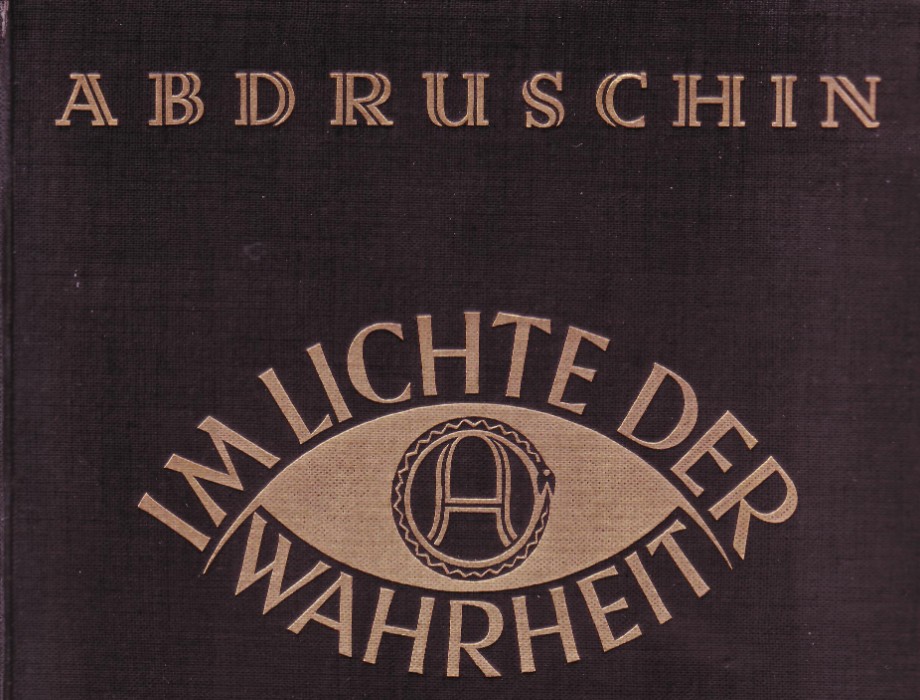
The Grail Movement is a millenarian new religious movement that emerged in central Europe during the early 1920s under the leadership of Oskar Ernst Bernhardt, a German businessman who wrote under the pen name “Abd-ru-shin.” Before the First World War, Bernhardt worked in London. From 1914 to 1919, he was interned as a German national. After his release, Bernhardt returned to Germany and began gathering followers. In 1921, he formally organized them as the Order of the Grail.
In 1923, Bernhardt described having a profound religious experience, after which he adopted the name “Abdruschin” and declared himself the “Son of Man.” He claimed a messianic role comparable to that of Jesus. He began publishing his lectures in the “Grail Papers,” which were compiled in 1926 as his foundational scripture, In the Light of Truth: The New Grail Message.
Bernhardt presented his writings not as the basis for a new church, but as a restoration of lost divine truths. He taught that existence was governed by automatic cosmic laws, including the Law of Reciprocal Action and the Law of Gravitation. He also identified himself as the earthly incarnation of Imanuel (Sir Parsifal).
In 1928, Bernhardt established a communal settlement at Vomperberg in the Tyrol region of Austria. Followers moved to the site and constructed residences, workshops, and a 300-seat worship hall. Contemporary newspapers referred to Bernhardt as the “Messiah of the Tyrol.”
In 1929, Bernhardt proclaimed a “Cosmic Turning Point.” He stated that the Day of Judgment was imminent and that he would lead 144,000 human spirits in a cosmic victory over Lucifer. The predicted events did not occur in the early 1930s, and support for Bernhardt declined among some followers.
Following Germany’s annexation of Austria in 1938, the Nazi regime seized the Vomperberg settlement and placed Bernhardt under surveillance, effectively ending the movement’s institutional presence there. Bernhardt was subsequently relocated to Saxony, where he died in 1941. He attributed the failure of the predicted apocalypse to humanity’s failure to respond to his call.
After the Second World War, Bernhardt’s widow, Maria, reestablished the movement and the Vomperberg settlement. Between 1949 and 1950, she published a revised edition of The Grail Message. Leadership subsequently passed to Maria’s son, Alexander Freyer, who led the movement until 1968, and then to Irmgard Bernhardt, who remained in leadership until 1990.
During the postwar period, the movement expanded internationally, including into North America and, by the 1980s, Africa. The movement also experienced a series of internal divisions. In 1956, disagreements over the authenticity of the revised Grail Message led the Brazilian branch to separate and establish the Order of the Grail on Earth.
A later succession dispute in 1999 produced a further division. One faction aligned with Siegfried Bernhardt, who retained control of the physical Vomperberg settlement. A larger numerical faction formed around Herbert Vollmann and later Jürgen Sprick. The movement has also faced legal scrutiny and allegations of cultlike behavior, particularly in France. It was included in a 1995 report by the French Parliamentary Commission on Cults.
By 2021, the Grail Movement comprised an estimated 40,000 fully initiated members worldwide. Although its historic center remains in Europe, its membership has shifted geographically. The movement now has more adherents in Africa, particularly Nigeria, than in Europe.
Key Sources:
Abd-Ru-Shin. (1998). In the Light of Truth: The Grail Message. Grail Foundation Press.
Bautz, F. W. (2003). Biographisch-bibliographisches Kirchenlexikon.
Vollmann, H. (1975). Knowledge for the world of tomorrow.