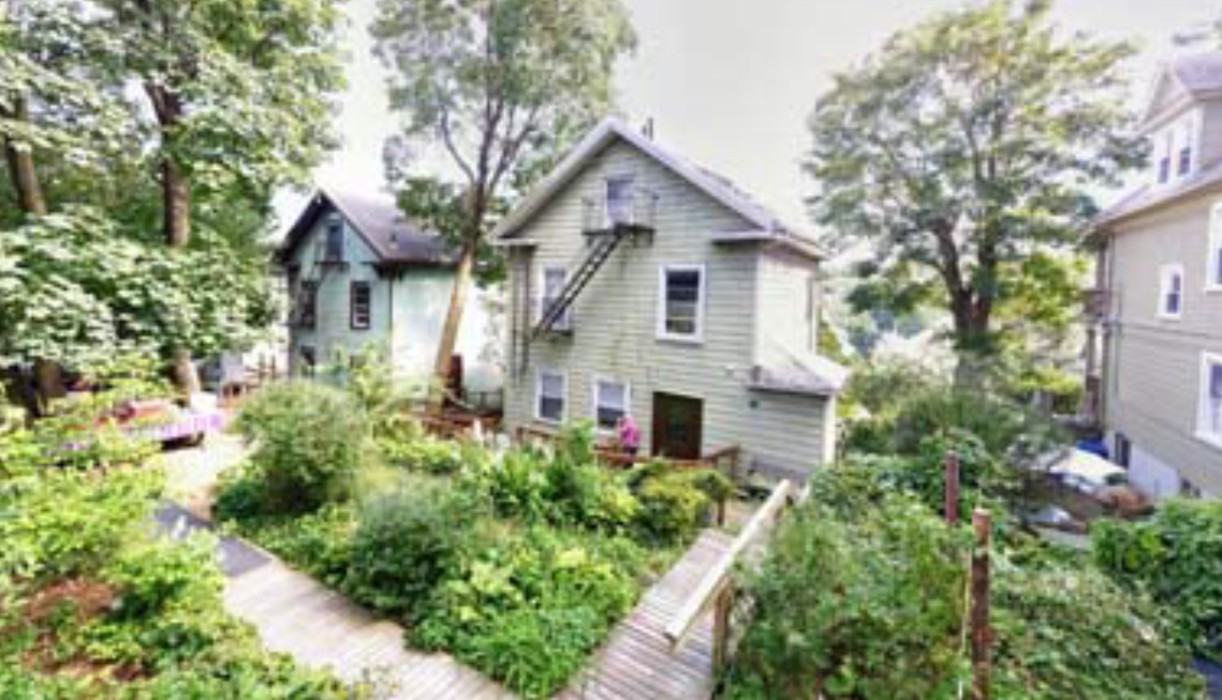
Ganas is an intentional community located in Tompkinsville, on the North Shore of Staten Island, New York. Established in 1979, the group has been described over the course of its history as an urban kibbutz, an experiment in cooperative living, and a commune. It has also faced persistent allegations from critics and former members that it operated as a cult.
The community is situated on a hill in a working-class neighborhood and consists of a cluster of clapboard houses connected by shared yards and paths. The properties overlook the harbor toward Manhattan and Brooklyn. At its peak, Ganas housed between 65 and 100 residents across eight to 10 adjoining properties.
The key figure in the formation of Ganas was Mildred Gordon. Before establishing the Staten Island community, Gordon operated GROW, an unaccredited school in New York City that trained group therapists. In the early 1970s, GROW came under investigation by city and state authorities for issuing fraudulent credentials from unaccredited institutions.
Following the closure of GROW, Gordon relocated to San Francisco, where she studied biofeedback and developed a philosophy she called “Feedback Learning.” In California, she assembled a core group of followers that included Jeff Gross, Bruno Krauchthaler, Susan Grossman, and a retired money manager known as George.
In 1974, Gordon and her associates incorporated in California as a tax-exempt nonprofit called the Foundation for Feedback Learning (FFL). After spending a brief period on New York’s Lower East Side, the group settled in 1979 at 139 Corson Avenue in Tompkinsville, Staten Island. The property became the community’s primary residence.
The organization adopted the name “Ganas” in the early 1990s. The Spanish word roughly translates to the motivation or desire to act. The group continued its legal existence under FFL and later entities.
Ganas developed a governance system divided into two groups. The “Core Group” consisted of long-term members who pooled their income, shared personal property, and jointly handled administrative decisions. A broader population consisted of loosely affiliated residents who rented rooms, paid for board, and participated in communal meals without joining the financial pooling arrangement.
The group’s foundational rules prohibited violence, illegal activity, unearned residence, and unstructured complaining. Members were required to raise grievances during formal early-morning group sessions known as “Planning.”
Feedback Learning became the central practice of Ganas. The system was a form of intensive group therapy intended to break down individual defenses. During daily morning meetings at 139 Corson Avenue, members discussed personal histories, interpersonal conflicts, and daily grievances.
The group would then subject the individual to direct criticism intended to identify behavioral patterns and assumptions about identity. Participants referred to this process as “killing their buddhas.” Birthday observances for younger members were sometimes turned into multi-hour feedback sessions that cataloged personal shortcomings. These sessions were recorded on videotape for internal archives.
Critics and journalistic accounts later focused on the controlling aspects of Feedback Learning. Archival recordings showed Gordon telling a participant that her goal was to reprogram his thinking to match her own. Former members described the environment as psychologically coercive and alleged that Gordon exercised extensive influence over personal, financial, and romantic decisions.
The community also developed an unconventional approach to relationships and family planning. Ganas promoted sexual openness and non-monogamy, encouraging members to share partners and regard multi-partner relationships as a standard arrangement. Several former members, however, reported that Gordon directly managed these relationships. They alleged that she paired individuals, discouraged relationships she opposed, and pressured members into unwanted sexual encounters.
For several decades, childbearing was actively discouraged. Gordon presented the community itself as a substitute for having children. Most long-term members remained childless, although a small number of children lived within the community during its later years.
Ganas also adopted non-traditional approaches to marriage. In 1982, founding members Jeff Gross and Susan Grossman married with Gordon’s encouragement. Gross’s father subsequently helped finance an additional property on Corson Avenue for the group.
In 1995, the community staged a “four-way” wedding ceremony involving Gross, Grossman, and two other members, who exchanged formal vows. Around 2001, Gordon, then in her eighties, married Dave Greenson, a man approximately 40 years younger than her. Gordon and Greenson moved to an apartment in Brighton Beach, Brooklyn, that was purchased by the Core Group. Gordon continued visiting Staten Island several times a week to direct Feedback Learning sessions.
Financially, Ganas operated through a combination of nonprofit activities, for-profit businesses, and real estate holdings. Regular residents paid monthly room and board of about $700, while Core Group members turned over outside earnings or worked in community-owned enterprises. The group operated several secondhand retail businesses under the “Every Thing Goes” brand. These included a furniture store, a clothing shop, and a bookstore-café.
For many years, Ganas reported its finances through FFL’s nonprofit tax filings under the categories of “Feedback Learning Skills Development” and “Interpersonal Skills Development.” Between 2001 and 2005, FFL reported average annual revenues of approximately $475,000. In 2006, the Core Group restructured its operations by creating Ganas Community LLC and Ganas Food Company LLC. The entities were established to manage the community’s commercial ventures separately from the nonprofit organization.
Over the decades, Ganas accumulated a real estate portfolio estimated at $10 million. The group acquired properties without mortgages in Staten Island, Brooklyn, upstate New York, Virginia, California, and Spain.
Despite public descriptions of Ganas as an open, non-hierarchical community without formal dogma, the group continued to face allegations that it operated as a cult. Detractors accused its leadership of using brainwashing techniques, arranging marriages of convenience to assist non-citizens with immigration status, and restricting individual autonomy.
Tensions between Ganas and its critics eventually contributed to a violent incident involving co-founder Jeff Gross and former resident Rebekah “Becky” Johnson. Johnson joined Ganas in 1986 and lived there intermittently until she was evicted for non-payment of rent in the late 1990s.
After leaving the community, Johnson filed a civil lawsuit alleging assault and coercive manipulation within Ganas. She later dropped the lawsuit. Johnson subsequently began a public campaign against Gross, accusing him of predatory behavior and immigration fraud through the distribution of flyers and graffiti. Johnson was arrested on stalking charges in December 2004.
In May 2006, Gross was shot multiple times outside his home on the Ganas property in Tompkinsville. He survived the attack and identified Johnson as the shooter, saying she had ambushed him from nearby bushes.
Law enforcement searched Johnson’s residence and recovered target-practice materials. Johnson was charged with attempted murder and went to trial in 2008. Her defense attorney argued that Gross had falsely accused her in an effort to discredit her allegations concerning Ganas and its cult-like practices. In August 2008, a jury acquitted Johnson of all charges related to the shooting.
The shooting and subsequent trial brought significant national media attention to Ganas. Coverage focused on the community’s history of open relationships, its internal structure, and its relationships with former members.
Following the incident, Gross was expelled from Ganas in October 2007 amid disputes over property security and the internal disclosure of his personal schedule. Gross later filed civil lawsuits against both Johnson and Ganas. He eventually secured an unpaid $1.3 million civil judgment against Johnson while living in an undisclosed location.
In the years after the trial, Ganas continued operating on Staten Island, although its structure changed as its founding members aged. Journalistic accounts from the 2010s described a more subdued daily routine centered on the “Every Thing Goes” retail businesses and communal meals.
Key Sources:
Herbert, D. G. (2022, June 7). The cult leader of Staten Island. Esquire.
Jacobs, A. (2006, June 1). Ganas: Free Love, Hate and an Ambush at a Commune on Staten Island. The New York Times.
McClure, K. (2009, June 9). Joining a cult (well, sort of). Vice.
Newitz, A. (2006, April 13). Big love at Ganas, New York City’s most exclusive commune. New York Magazine.