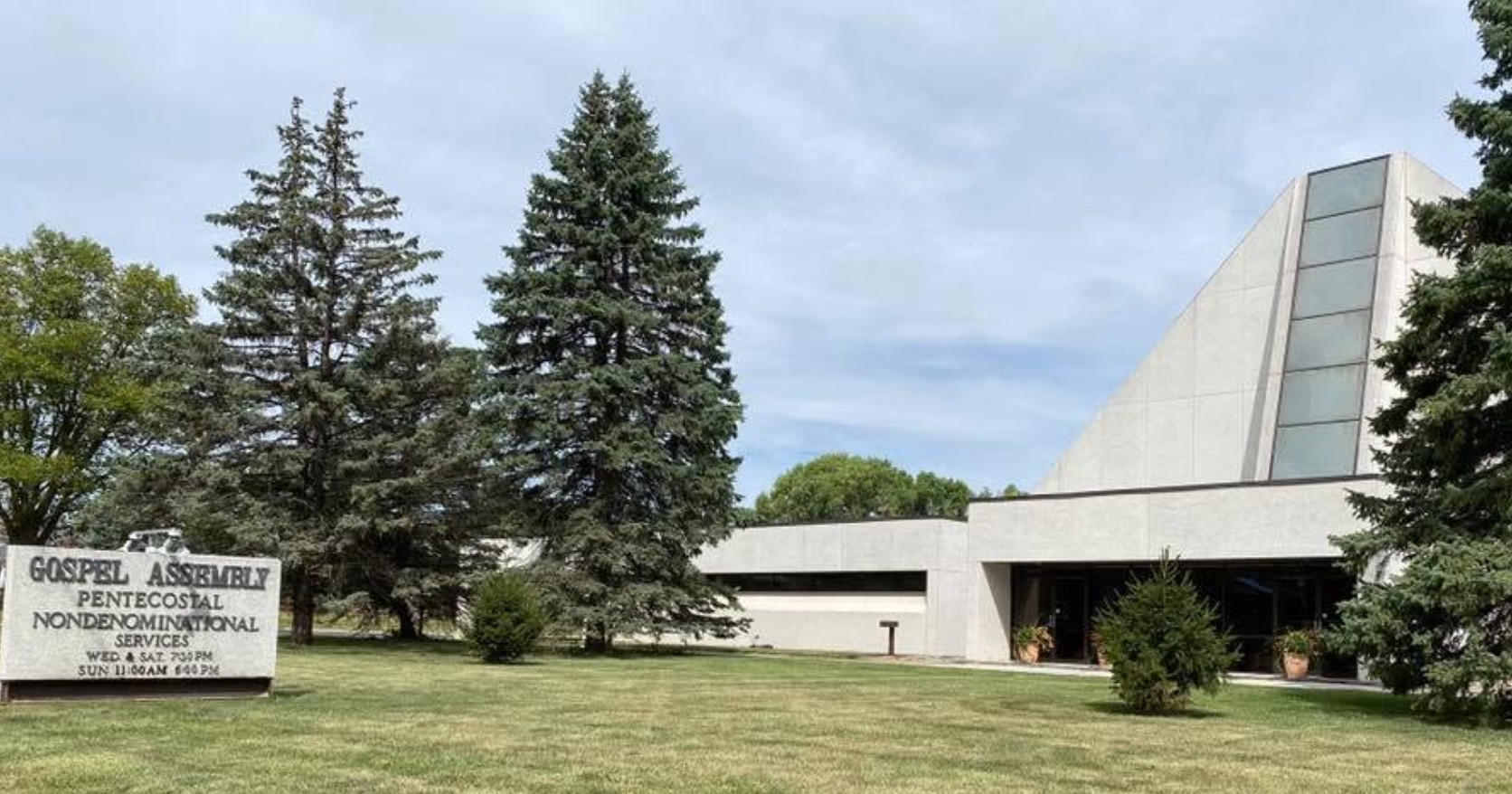
Gospel Assembly Churches is a non-denominational Christian movement founded in 1914 by William Sowders, a former Louisville police officer, during the early years of American Pentecostalism. The movement began in Paducah, Kentucky, before Sowders established a central congregation in Louisville, which he led until his death in 1952.
Before settling on its current name, the group operated under several titles, including “The School of the Prophets,” the Latter Rain Movement, and This Present Day Move of God. Critics have argued Sowders built the group’s core beliefs by blending Pentecostal ideas with elements of Jehovah’s Witness and Seventh-day Adventist theology.
After Sowders died, leadership passed to T.M. Jolly, who ran the movement from St. Louis until 1991, continuing to expand congregations across the country. In 1963, Jolly appointed minister Lloyd Goodwin to lead a Des Moines, Iowa congregation.
Goodwin stayed with the main movement for several years before breaking away in the early 1970s, claiming personal divine revelations and declaring himself “the Apostle” for the modern era. He taught that salvation depended on submitting to his spiritual authority, and his Des Moines branch developed independently from then on.
Goodwin died in 1996, and leadership passed first to his brother Vernon, then to his nephew Glenn, who has maintained his uncle’s authority despite several of Lloyd Goodwin’s end-times prophecies failing to come true.
Theologically, Gospel Assembly Churches treats the Bible as authoritative but issues no formal doctrinal statement, holding instead that the church is in a state of ongoing spiritual development. Members call their fellowship “the Body of Christ” and refer to other denominations as “Babylon.”
The movement also departs from mainstream Christianity by holding an Arian-influenced view of the Godhead, treating the Father and Son as separate, unequal beings. Services follow an open-order format with spontaneous participation and congregational orchestral music, alongside an emphasis on personal holiness, modest dress, and moderate living.
The movement has since expanded to 17 countries, including parts of Western Europe, Southern Africa, Mexico, the Caribbean, and Kenya, with U.S. congregations in 40 states and global membership estimated at 150,000 to 200,000.
Major sites include a historic Shepherdsville, Kentucky campground established in 1935 for ministerial “threshing floor” gatherings, and a 3,000-seat Louisville convention center. The Des Moines branch, meanwhile, remains independent and publishes its own quarterly newsletter.
Alongside its growth, the movement has drawn sustained criticism. Though it presents itself as a Christian fellowship, some critics allege certain congregations function as a sociological cult.
Former members describe “heavy shepherding” — significant control over personal life, career, finances, and marriage — along with social isolation, pressure to conform, and public humiliation from the pulpit. Some reported a persistent fear that leaving would bring spiritual damnation, and some congregations allegedly withheld marriage certificates from newlyweds to maintain leverage.
Financial practices have drawn similar scrutiny. Former members describe pressure to tithe heavily and fund construction projects, sometimes selling homes or taking out long-term loans to comply.
Critics also point to an internal teaching called “righteous deception,” said to permit lying to protect the institution, along with allegations that officials bribed government representatives in some developing countries.
The movement’s history includes serious legal controversies. T.M. Jolly was removed from leadership in 1991 after admitting to sexual misconduct and was later convicted of child sexual abuse.
The Des Moines branch has faced its own historical abuse allegations, though many could not be prosecuted due to expired statutes of limitations. Federal authorities also found that monetary gifts to Lloyd Goodwin had been improperly hidden from tax regulators, and a former senior elder admitted to editing sermon tapes and misleading tax investigators under legal direction to conceal internal misconduct.
Current leadership, including Glenn Goodwin, rejects the “cult” label, maintaining the movement follows biblical principles without elevating human leaders to messianic status. Leaders describe many abuse allegations as legacy issues unrelated to current practices and say the church does not condone abuse or illegal conduct.
Longtime members and defenders emphasize the community and spiritual conviction they find in the fellowship, arguing that former members’ accounts reflect individual grievances rather than the organization’s present reality.
Today, Gospel Assembly Churches remains a decentralized fellowship spanning the U.S. and several other countries. Its history is shaped by Sowders’ founding, Jolly’s leadership, Goodwin’s independent Des Moines offshoot, and ongoing disputes over theology, authority, and treatment of members.
Key Sources:
Lhotka, W. C. (1992, September 26). Church backs ex-minister facing charges. The St. Louis Post-Dispatch.
Lhotka, W. C. (1993, August 11). Probation for abuser stirs anger: Minister molested girls who sought counseling. The St. Louis Post-Dispatch.
Schmitt, T. (2001, February 28). Heaven or hell? Cityview Des Moines.
Simbro, W. (1993, July 30). Church fights against labels: ‘This church is not a cult,’ pastor says. The Des Moines Register.