The International Church of the Foursquare Gospel, commonly known as the Foursquare Church, is a global Pentecostal Christian denomination within the evangelical tradition. Founded in January 1923 by Canadian-born evangelist Aimee Semple McPherson, it grew from a single congregation at the Angelus Temple in Los Angeles into an international movement. Its history has been shaped by its distinctive theology, early adoption of mass media, the public life of its founder, and institutional controversies that have periodically prompted accusations of cultlike behavior.
Aimee Elizabeth Kennedy was born in 1890 in Salford, Ontario, and was raised by a mother active in the Salvation Army. As a teenager, she wrote a widely publicized letter to a Canadian newspaper opposing taxpayer-funded instruction in evolutionary theory, foreshadowing her later public criticism of scientific explanations for human origins.
In 1907, she converted to Pentecostalism and married Irish missionary Robert James Semple. The couple joined William Durham’s Full Gospel Assembly in Chicago, where she learned the Pentecostal practice of speaking in tongues. During a missionary trip to China, both contracted malaria and Robert Semple died of dysentery. Aimee Semple returned to the United States with their infant daughter, Roberta, and resumed religious work alongside her mother.
McPherson married accountant Harold Stewart McPherson in 1912, and the couple had a son, Rolf. The marriage became strained after she experienced an illness that she interpreted as a divine call to preach. In 1915, she left her husband to pursue an independent evangelistic ministry, and the couple divorced in 1921.
By the late 1910s, McPherson had established herself as a prominent itinerant revivalist known for energetic preaching and public healing demonstrations. In 1917, she launched her publication “Bridal Call,” which addressed women’s roles in ministry. She was ordained by the Assemblies of God in 1919, and her profile grew following revival meetings in Baltimore that attracted widespread newspaper coverage of reported healings. After a severe bout of influenza in 1918, she became convinced that Los Angeles would serve as the permanent center of her ministry and began raising funds for a large church.
Large-scale healing campaigns became central to both her popularity and the controversies surrounding her ministry. A 1921 revival in Balboa Park in San Diego attracted an estimated 30,000 attendees and required military assistance to control the crowds. That same year, a gathering of Romani Americans in Denver, following reports that a tribal chief had been healed, generated donations that helped finance the construction of the Angelus Temple. Although medical panels and skeptical journalists found no evidence of deliberate fraud, observers continued debating whether the reported healings resulted from suggestion, mass psychology, or genuine religious experience.
The theological foundation of her movement was established in October 1922 during a sermon in Oakland. Drawing on a vision from the Book of Ezekiel, McPherson described the “Foursquare Gospel,” centered on Jesus Christ as Savior, Baptizer with the Holy Spirit, Healer, and Soon and Coming King. Believing the vision required an independent organization, she severed ties with the Assemblies of God.
In January 1923, McPherson dedicated the Angelus Temple in Los Angeles’ Echo Park neighborhood. The 5,300-seat domed building, constructed for approximately $250,000 through donated labor and materials, quickly became one of the country’s earliest megachurches. Within a decade, it claimed 10,000 members and reported tens of millions of visitors. On adjacent land that she personally owned, McPherson established the L.I.F.E. Bible College to train ministers and provide a centralized foundation for the movement’s expansion.
McPherson’s services combined religious instruction with elaborate theatrical presentation. Her “illustrated sermons” incorporated costumes, stage sets, orchestras, and visual effects to communicate theological themes. Although she publicly criticized secular theater and motion pictures as sinful, she became the first female evangelist to systematically adopt Hollywood-style production techniques, and her services surpassed attendance records previously set by revivalists such as Billy Sunday.
As McPherson’s public profile grew, critics increasingly questioned the concentration of authority within the movement. The church’s original episcopal structure granted her veto power over organizational decisions and sole authority to appoint officers and employees. Critics argued that she used followers’ religious devotion to build a personal empire, while supporters viewed her leadership as central to the church’s mission.
McPherson also became a national celebrity. She led weekly parades through downtown Los Angeles alongside civic leaders and film stars, further increasing the church’s visibility. In 1924, she obtained a federal broadcasting license and became only the second woman in the United States to operate a radio station, KFSG, which she used to broadcast sermons and solicit financial support.
Alongside its revival campaigns, the church developed an extensive charitable ministry that served people without distinguishing between those considered “deserving” or “undeserving.” During the Great Depression, the Angelus Temple operated commissaries, soup kitchens, and free medical clinics that are estimated to have assisted approximately 1.5 million people. Relief efforts also responded to disasters, including the 1925 Santa Barbara earthquake and the 1933 Long Beach earthquake.
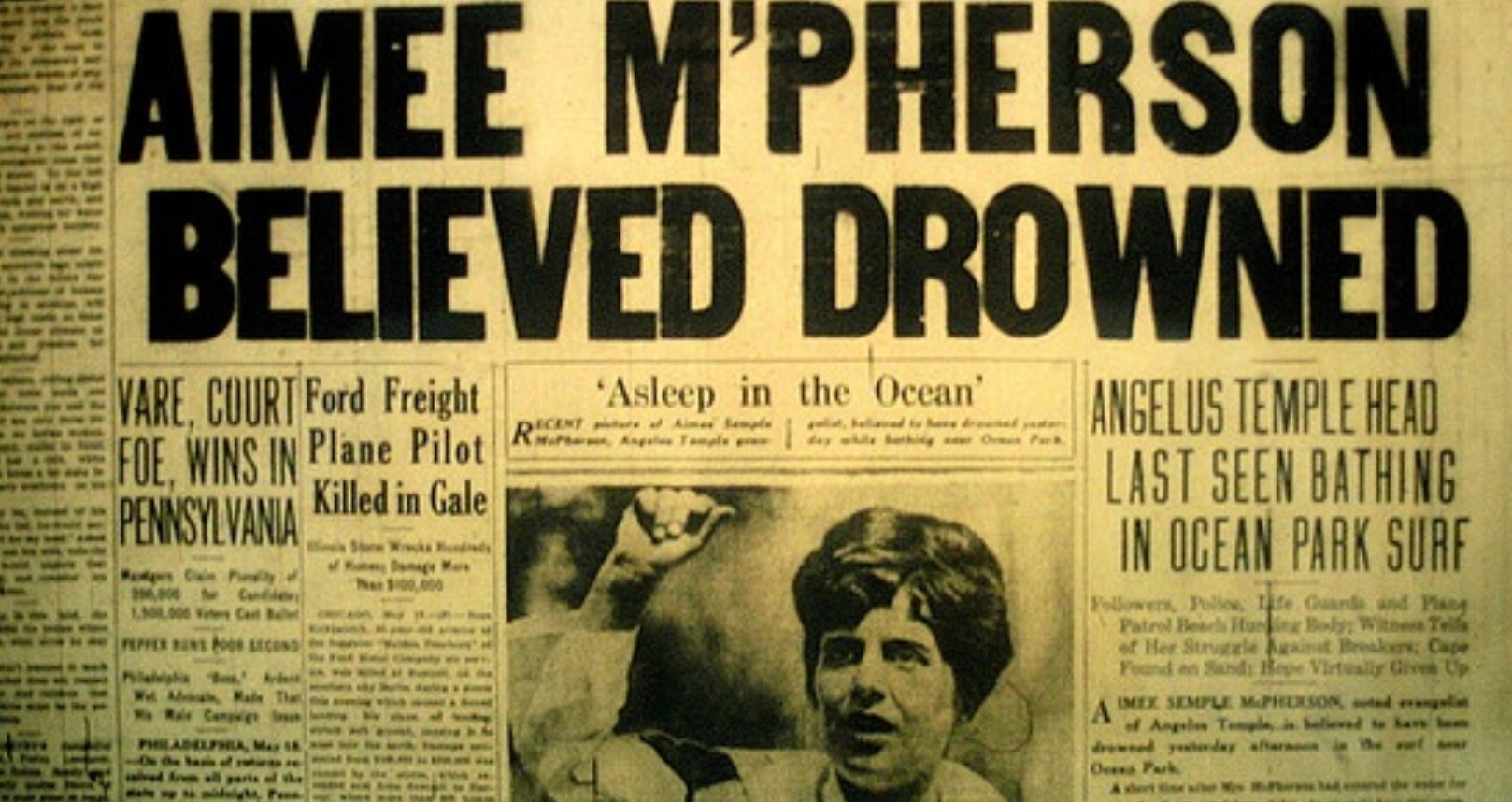
The movement’s trajectory changed dramatically on May 18, 1926, when McPherson disappeared while swimming near Santa Monica. Her disappearance prompted an extensive search and widespread media coverage. Five weeks later, she reappeared in Douglas, Arizona, claiming she had been kidnapped, drugged, and held in a shack in the Mexican desert before escaping on foot. Journalists and prosecutors instead alleged that she had staged the disappearance to pursue an affair with former radio engineer Kenneth Ormiston. A grand jury investigation and conspiracy trial followed, costing Los Angeles newspapers an estimated $500,000.
McPherson faced perjury and obstruction charges carrying potential prison sentences totaling 42 years, but the case collapsed after Ormiston identified another woman as his companion. The charges were dismissed in January 1927 for insufficient evidence, although public speculation continued for the remainder of McPherson’s life.
Internal disputes further affected the church during the late 1920s and early 1930s. McPherson’s mother, Mildred Kennedy, who had managed much of the ministry’s growth, disagreed with her daughter over finances and lifestyle. After an unsuccessful effort to remove McPherson from leadership, Kennedy resigned in 1930, during a period that also coincided with McPherson’s nervous breakdown.
At the same time, unsuccessful investments in real estate, hotels, and cemetery plots left the church with substantial debt. McPherson’s 1932 marriage to actor David Hutton generated additional controversy after he publicly promoted their relationship during a cabaret tour. The marriage ended in divorce in 1934, while lawsuits brought by McPherson’s daughter and a senior assistant contributed to a lasting estrangement from Roberta.
The church’s finances stabilized during the mid-1930s under business manager Giles Knight, who settled lawsuits and eliminated much of its debt. McPherson resumed full-time ministry and embarked on a world tour in 1935, during which she met Mohandas Gandhi and Benito Mussolini. The following year, she publicly renewed ties with classical Pentecostal traditions by inviting prominent Black ministers to preach at the Angelus Temple.
Throughout the late 1930s, the denomination maintained an official pacifist position. After the United States entered the Second World War, however, McPherson abandoned pacifism and characterized the conflict as a struggle against fascism. The Angelus Temple organized air-raid blackout drills and war-bond campaigns, and McPherson received an honorary Army rank while requiring ministerial candidates to support military service.
McPherson died on September 27, 1944, in an Oakland hotel room after overdosing on sleeping pills, including a barbiturate for which she did not have a valid prescription. Although the circumstances prompted speculation about suicide, investigators ruled the death accidental. Her body lay in state at the Angelus Temple for three days, attracting an estimated 45,000 mourners, before she was buried at Forest Lawn Memorial Park in Glendale.
Her son Rolf K. McPherson became president of the denomination and led it for 44 years, guiding the church further into the American evangelical mainstream. Under his leadership, the Foursquare Church joined the National Association of Evangelicals in 1952. In 1948, it also helped establish the Pentecostal Fellowship of North America, which was reorganized in 1994 as the Pentecostal/Charismatic Churches of North America following a merger that included the Church of God in Christ.
The denomination also experienced significant schisms. In 1968, Chuck Smith’s Calvary Chapel congregation separated from the Foursquare Church following governance disputes and established the independent Calvary Chapel movement. In 1983, Arizona pastor Wayman Mitchell left to found the Potter’s House Christian Fellowship.
Later administrations, including those of John R. Holland and Paul C. Risser, oversaw significant financial developments, including the 2003 sale of radio station KFSG-FM for $250 million. Risser’s administration ended in controversy after denominational funds were invested in ventures later determined to be fraudulent Ponzi schemes. The losses totaled an estimated $15 million, leading to Risser’s resignation in March 2004 and a financial recovery effort led by his successor, Jack W. Hayford.
The denomination has continued to face legal and reputational challenges related to allegations of sexual misconduct and administrative concealment. A 2012 lawsuit in Beaverton, Oregon, settled out of court, involved a volunteer who had been permitted to supervise youth activities despite a prior conviction for a sexual offense involving a minor. Additional lawsuits alleging historical abuse were filed in 2007 and 2017. In 2022, a former president of the Foursquare Church in Canada was sued by a former congregant alleging prolonged psychological, spiritual, and sexual exploitation.
Key Sources:
Bahr, R. (1979). Least of all saints: The Story of Aimee Semple McPherson. Englewood Cliffs, N.J. : Prentice-Hall.
Blumhofer, E. W. (1993). Aimee Semple McPherson: Everybody’s Sister. Grand Rapids, Mich. : W.B. Eerdmans Publishing Company.
Sutton, M. A. (2009). Aimee Semple McPherson and the Resurrection of Christian America. Harvard University Press.
Van Cleave, N. M. (2014). The vine and the branches: A History of the International Church of the Foursquare Gospel. Creation House.