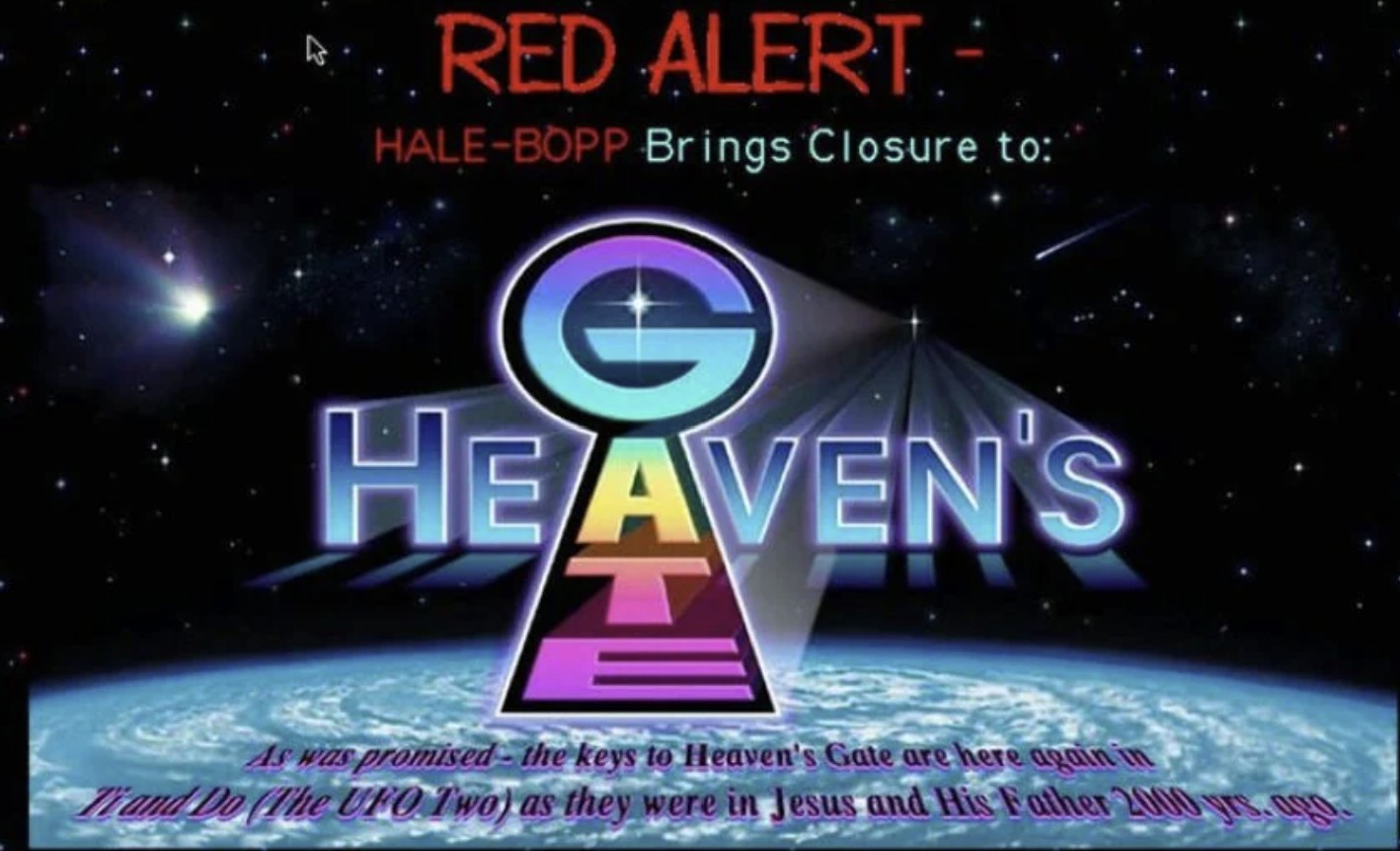
Heaven’s Gate was an American new religious movement that sociologists, historians, and law enforcement have widely categorized as a destructive apocalyptic cult. The movement culminated in the largest mass suicide on United States soil in March 1997. Over more than two decades, 39 adherents lived within a belief system that combined evangelical Christian eschatology, monastic asceticism, New Age philosophy, and science-fiction-influenced ufology.
Founded in the early 1970s by Marshall Herff Applewhite and Bonnie Lu Nettles, the movement operated under various names and organizational structures, eventually developing from an itinerant recruitment effort into a highly disciplined community that sought to leave human biology behind and ascend to a higher cosmic plane.
The origins of Heaven’s Gate were closely connected to the backgrounds of its two founders. Marshall Herff Applewhite was born in 1931 in Texas, the son of a Presbyterian minister. A vocalist and musician, Applewhite pursued an academic career in music and eventually became chairman of the music department at the University of St. Thomas in Houston.
During this period, Applewhite struggled with his sexual identity, a conflict that was complicated by his religious upbringing. After an extramarital affair with a male student, he lost his university position, went through a divorce and experienced periods of depression that resulted in psychiatric hospitalizations.
In March 1972, during this period of personal and existential difficulty, Applewhite met Bonnie Lu Nettles. Born in 1927, Nettles was a registered nurse and mother of four with a longstanding interest in occult practices, astrology and spiritualism. She attended séances, believed she was guided by a 19th-century Franciscan monk named Brother Francis, and claimed to receive telepathic communications from extraterrestrial entities.
The circumstances of their first meeting remain disputed. Applewhite said they met at the hospital where Nettles worked while he was visiting a sick friend, while other accounts suggest that Applewhite was receiving psychiatric treatment there. Regardless of the circumstances, the two quickly formed a close relationship. Applewhite and Nettles established an intense but strictly platonic partnership that provided Applewhite with emotional support and a sense of spiritual purpose. They came to believe that their meeting had been predicted by extraterrestrial intelligence and spent months studying theology together.
Their ideas combined passages from the King James Bible with concepts from Theosophy, popular science fiction and contemporary UFO reports. By the middle of 1972, they had concluded that they were the “Two Witnesses” described in the 11th chapter of the Book of Revelation. They believed they were divine messengers who would deliver an apocalyptic message, be killed by hostile forces, be resurrected and then be transported to heaven aboard a cloud, which they interpreted as a physical alien spacecraft.
The pair adopted several sets of names over the years, including “Bo and Peep” and later “Do and Ti.” In 1973, they began traveling across the United States to spread their teachings. Calling their movement Human Individual Metamorphosis, or HIM, they taught that humans were biological organisms capable of undergoing a literal physical transformation into an immortal extraterrestrial existence. They held public lectures in small towns, college towns and civic centers. Their teachings described Earth as an evolutionary garden created to develop human souls and maintained that the time had come for those souls to be harvested.
The movement’s recruitment efforts produced limited results until September 1975, when a public meeting in Waldport, Oregon, attracted national attention. At the gathering, Applewhite and Nettles persuaded approximately 20 to 30 people to leave their homes, families, jobs and possessions overnight and follow them into the wilderness.
The sudden disappearance of the group members prompted reactions in their communities and extensive media coverage. National broadcasts, including coverage by CBS anchor Walter Cronkite, brought the movement to a wider audience and contributed to early American discussions about cults, coercion and psychological manipulation.
The attention also changed how Applewhite and Nettles approached recruitment. Public visibility exposed the movement to scrutiny from families, law enforcement and the media. In early 1976, after several unsuccessful recruitment meetings and increasing attention, the founders formally closed recruitment.
At its peak, the group had about 100 members. After recruitment ended, Applewhite and Nettles instructed followers to sever remaining ties with their families and previous lives. The members initially lived in small nomadic groups that camped in remote areas across the western United States before eventually reassembling under the founders’ centralized authority in Wyoming and Utah.
During this period, Applewhite and Nettles moved away from their earlier expectation of a public ascension, an event they had called “the Demonstration.” Instead, they developed a more structured monastic lifestyle and expanded their theology.
The movement came to describe the human body as a temporary biological “container” or “vehicle.” To reach “The Evolutionary Level Above Human,” or TELAH, also called the “Next Level,” members were expected to undergo a process of purification intended to eliminate their human identities, emotions, egos and physical desires.
Daily life was organized around uniformity and routine. Members abandoned their birth names and adopted compound names ending in “-ody,” including Lvvody, Jnnody and Rrkody. The names were understood to identify members as spiritual infants under the care of their leaders. Members wore identical, loose-fitting, unisex clothing buttoned to the neck and maintained matching short haircuts. Their daily activities were governed by detailed instructions covering ordinary tasks, including brushing their teeth and shaving.
Sexual activity, romantic relationships and physical intimacy were prohibited. Alcohol, drugs and tobacco were also prohibited. In an effort to eliminate sexual temptation and achieve what the group regarded as complete physical neutrality, Applewhite and at least seven male followers underwent voluntary surgical castrations during the mid-1990s.
The movement’s theology and structure changed significantly in 1985 when Nettles died of liver cancer in Dallas, Texas. Her death created a doctrinal problem because the group had believed that members would physically ascend to the Next Level without undergoing biological death.
Applewhite addressed the issue by teaching that Nettles had not actually died but had abandoned her worn-out physical “vehicle” and returned to a Next Level spacecraft ahead of the other members. The explanation altered the group’s earlier beliefs and made physical death an acceptable, and eventually necessary, method of leaving the human body and transferring consciousness into a perfected Next Level form.
During the late 1980s and early 1990s, the group moved several times and established semi-permanent residences in New Mexico and eventually California. Members also developed computer programming and web-development skills to support themselves without relying on outside donations.
By the mid-1990s, operating under the business name “Higher Source,” members built websites for corporate clients. The group developed a reputation in the early commercial internet era for providing web-design services. Despite this participation in the technology industry, members continued to live within the group’s isolated structure, with Applewhite’s increasingly urgent apocalyptic predictions remaining central to their beliefs.
In late 1995, astronomers discovered Comet Hale-Bopp, which became one of the brightest comets visible in decades. As it approached Earth, rumors circulated in paranormal and UFO communities that an unidentified metallic object, sometimes called the “Companion,” was traveling behind the comet.
Applewhite interpreted the reports as a sign from Nettles. He told members that the object was a Next Level spacecraft sent by Nettles to collect their souls before Earth was “recycled,” which the group understood to mean that the planet would be cleared of human life and prepared for another evolutionary cycle.
In October 1996, Higher Source rented a 9,200-square-foot mansion in Rancho Santa Fe, California, for $7,000 a month in cash. The 39 remaining members began preparing for what they called their final “exit.”
Between March 22 and March 25, 1997, as Comet Hale-Bopp made its closest approach to Earth, the group carried out a three-day, phased mass suicide protocol. Members worked in groups and consumed a lethal mixture of phenobarbital, a powerful barbiturate, combined with applesauce or pudding. They drank vodka with the mixture to accelerate absorption. After becoming unconscious, members placed plastic bags over their heads to ensure death. Members who had not yet taken the mixture attended to those who had. They removed the plastic bags, arranged the bodies on twin beds and covered their upper torsos and heads with square, deep-purple cloths. Those members then took their own lethal doses. Applewhite died during the final wave.
On March 26, 1997, law enforcement officers entered the Rancho Santa Fe mansion after former member Rio DiAngelo alerted authorities. DiAngelo had received a farewell package that included videotaped statements from members explaining their decision to leave.
Officers found 39 bodies arranged throughout the house. The victims ranged in age from 26 to 72 and were wearing identical black shirts, black sweatpants and new black-and-white Nike Decade sneakers. Each member wore a custom embroidered armband reading “Heaven’s Gate Away Team.” Each person also carried a five-dollar bill and three quarters, which the group intended to use for transportation and telephone calls in the Next Level.
At a subsequent news conference, San Diego County Medical Examiner Brian Blackbourne said the scene indicated a planned collective action. He noted that the house was “immaculate,” that the victims had identification and that the differing stages of decomposition were consistent with deaths occurring in separate waves over several days. Investigators initially identified all of the victims as male because of their short haircuts and identical clothing. They later determined that 21 were women and 18 were men.
Jerry Lipscomb of the San Diego Sheriff’s Department said that, before their deaths, each member had reportedly recorded a brief statement. A common theme in the recordings was that “they were going to a better place.”
Investigators found no blood at the scene. The only firearm discovered was a 9mm handgun stored inside a suitcase and unrelated to the deaths. Driver’s license records showed that the members came from several states, including 11 from New Mexico, eight from Texas, four each from California and Colorado, three from Arizona and additional members from Washington, Ohio, Florida and Minnesota.
The discovery generated international media coverage in the days that followed. Some early reports were incomplete or inaccurate, including claims that most of the members were between 18 and 24 years old, that all were male, or that affiliated groups elsewhere were preparing to commit or had already committed similar acts.
On May 6, 1997, former members Wayne Cooke and Chuck Humphrey, who had been known within the group as “Rkkody,” attempted suicide together in a hotel room using methods similar to those used in Rancho Santa Fe. Cooke died, while Humphrey survived after authorities discovered him.
Another former member, James Pirkey Jr., died by suicide from a self-inflicted gunshot wound on May 11, 1997. Humphrey later died by suicide in Arizona in February 1998. His body was found with a five-dollar bill and four quarters and a note that read, “Do not revive.”
Mainstream academic researchers have generally challenged popular explanations based on mysterious forms of “mind control” or the idea that members were so psychologically incapacitated that they could not leave. The personal testimonies and written records left by Heaven’s Gate do not fit all classic descriptions of involuntary compliance.
Instead, available evidence indicates that most members joined willingly and accepted the group’s teachings without external physical coercion. The organized and ritualized nature of the final deaths also differed from cases involving direct physical force or immediate threats, such as the 1978 mass deaths at Jonestown under the direction of Jim Jones.
Heaven’s Gate members appeared to understand themselves as students completing a long educational process and voluntarily moving to a higher level of existence for which they had spent years preparing. Applewhite’s belief that he was likely to die soon from cancer, a diagnosis that his autopsy did not confirm, may also have added urgency to the group’s final decision. He reportedly feared that he might leave before the other members could accompany him.
In the years following the deaths, Heaven’s Gate’s physical and digital remnants developed their own legacy. Two former members, Marc and Sarah King of Phoenix, Arizona, operated the TELAH Foundation and continued maintaining the group’s original website. The site preserved its digital archive and theological materials in the same form in which they existed in March 1997.
The Rancho Santa Fe mansion also remained associated with the event. Local residents arranged for the street to be renamed “Paseo Victoria.” The property was sold through foreclosure in 1999 for $668,000, less than half its assessed value of $1.4 million, to a local developer who demolished the house. Neighbors later purchased the land, built a new residence and changed the street address, removing the physical location associated with the deaths.
Other survivors followed different paths. Rio DiAngelo, who discovered the bodies, later spoke about the continuing effect of his association with Heaven’s Gate. Two decades after the deaths, he said that his connection to the group had made employment difficult because potential employers remained concerned about his past. Another surviving member chose not to participate in the mass suicide because he believed he still had an earthly purpose. He later wrote a book about his experiences.
Key Sources:
Balch, R. (2002). Making Sense of the Heaven’s Gate Suicides. Cambridge University Press.
Bearak, B. (1997, April 28). Eyes on Glory: Pied Pipers of Heaven’s Gate. The New York Times.
Broder, J. (1997, March 31). Marshall Applewhite’s cry for help. Salon.
Feinberg, A. (2014, September 17). The online legacy of a suicide cult and the webmasters who stayed behind. Gizmodo.
Zeller, B. E. (2010). Prophets and Protons: New Religious Movements and Science in Late Twentieth-Century America. New York University Press.
Zeller, B. E. (2014). Heaven’s Gate: America’s UFO Religion. New York University Press.
Zennie, M. (2012, March 26). New Age followers still waiting for aliens to beam them up 15 years after Heaven’s Gate cult suicides left 39 people dead. The Daily Mail.